


Any fan of the Indiana Jones film series knows the “map sequence,” when we see the titular hero jet from country to country, a dotted line across a global map marking the doctor’s progress. He escapes from all kinds of tight spots in all manner of biplanes. There’s a certain freedom to how he travels that a modern explorer can’t quite replicate without private planes and air clearances in the most remote parts of the world.
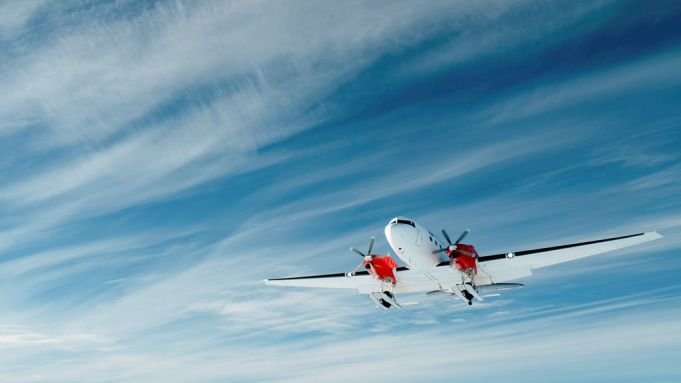
Or can they? The team behind White Desert, the luxury, safari-style camp in East Antarctica’s interior, just introduced its second in a series of Dr. Jones expeditions. An ode to Indy, these self-described “modern odysseys” offer 13 days of hopping across the Americas on a fully refurbished Basler BT-67, a modified 1940s turboprop plane that flies low and can land anywhere. Short, gravelly runways? Ice-covered tundras? Lands like a cat. It can also avoid major airports and take less traditional flight paths. Following a $10 million overhaul, the Dr. Jones aircraft rivals a private plane, with 12 leather seats and in-flight amenities befitting the $49,000 price tag.
Following a $10 million overhaul, the Basler goes from clunky to classy.
White Desert
Access is the greatest luxury on these journeys. The new Colombia–Guatemala itinerary starts in Medellín and goes deep into the Andes: to San Agustín, a UNESCO site considered the Americas’ largest necropolis, with hundreds of megalithic statues, and Caño Cristales, the uniquely occurring “River of Five Colors.” The Basler moves on to the remote Colombian island of Providencia, known for its pristine barrier reef, shark diving, and thriving Afro-Caribbean Creole culture (bonus: no cruise ships). From there, it’s on to the rainforests, ruins, and volcanic terrain of Petén, Pacaya, and Antigua, Guatemala. Along the way, travelers will meet local shamans, experience traditional llanero (cowboy) culture, and be led by a Mayan spiritual guide and archaeologist. Flights never last more than a couple hours and land at the base of the next adventure.
“This is not about ticking destinations off a list. It’s about entering them deeply—and leaving changed by what you were allowed to see and experience,” says Patrick Woodhead, co-founder and CEO of White Desert. Something of a real-life Dr. Jones, Woodhead was educated in the UK, studying ancient history and philosophy, before becoming a full-time expedition guide. He has since added to his CV: polar explorer, pilot, author (of four books), and company boss, though he hasn’t done it alone. Wife and co-founder Robyn Woodhead, also an acclaimed polar explorer (the first South African to reach the North and South Poles), helped establish the tenets of White Desert, particularly its sustainable practices. They achieved carbon neutrality for White Desert air operations as early as 2007, and she sat on the board of IAATO (International Association of Antarctica Tour Operators), the organization dedicated to promoting safe, environmentally responsible tourism in Antarctica.

Staying above the canopy in Colombia.
White Desert
The last 20 years of tours on the White Continent (by way of Cape Town) have been “mesmerically beautiful,” says Patrick, though adding the Dr. Jones trips to their offering has created summer-to-summer business. Antarctica’s season is November through January, and the Dr. Jones Colombia–Guatemala trip runs Aug. 26–Sept. 7, 2027 (additional dates: Sept. 19–Oct. 1).
Meanwhile, the debut Dr. Jones flight will take off Oct. 18–30, 2026: a 12-day Peru–Patagonia journey (from $59,000) down almost the entire western edge of South America. This isn’t a Machu Picchu trip, says Patrick. It’s meant to deliver “once-in-a-lifetime exploration” across some of the most remote, visually striking landscapes on the continent, including the coastal dunes of Paracas, Peru, Chile’s Atacama Desert, and Torres del Paine National Park. Lodging is predictably five-star, including the recently renovated Tierra Atacama and Tierra Patagonia lodges, yet the adventure level remains high. Be it on a trek to the remote, unexplored ruins of Uaxactún or on a microlight flight over wildlife-filled savannahs, Patrick says, “you’re the hero of your own story.”
