


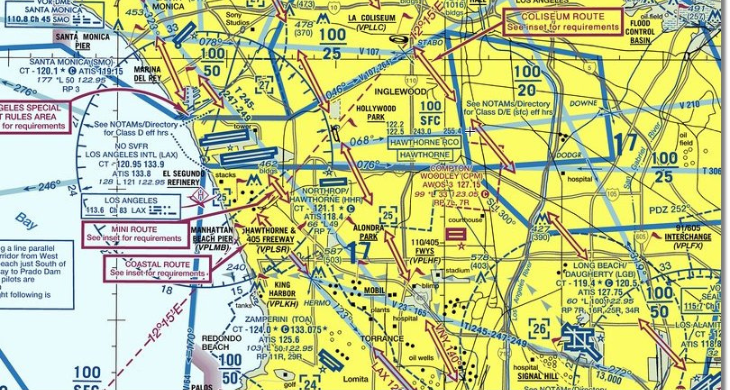
Police operations around LAX were hampered earlier this year as the FAA began implementing restrictions to helicopter traffic around the airport.
The US Federal Aviation Administration (FAA) has published a General Notice (GENNOT) which suspends visual separation between helicopters and aeroplanes in the Class B and C airspace, as well Terminal Radar Service Areas (TRSA) that typically surround busier airports typically those with air transport operations.
The rule change means that air traffic controllers will now ensure separation using radar service. While this is a practice that is common in much of the world, in that case it applies to all VFR traffic transiting the airspace around airports, and not only helicopters. Limiting the change to helicopters and powered lift seems to be an odd choice, given that the impetus for the change comes from the findings of the investigation into the mid air collisions between a US Army UH-60 and CRJ700 near Washington Reagan National Airport (DCA) in January 2025, and tragic though that was, two other large scale fatality collisions between airliners VFR traffic involved light fixed wing aircraft.
The FAA says that the change is based on a “on a year-long review by the FAA’s safety team that used innovative tools to review cross-traffic data and review incident reports.”
“The tragedy over the Potomac one year ago revealed a startling truth: years of warning signs were missed, and the FAA needed dire reform. Since then, we’ve implemented numerous changes to protect the skies over our capital and keep the traveling public safe,” said U.S. Transportation Secretary Sean P. Duffy commenting on the change. “But the job isn’t done. Using innovative data analysis, the safety team at the FAA has identified the need for enhanced protocols at all airports across the National Airspace System”.
“Today, we are proactively mitigating risks before they affect the traveling public,” added FAA Administrator Bryan Bedford. “Following the mid-air collision near Ronald Reagan Washington National Airport (DCA), we looked at similar operations across the national airspace. We identified an overreliance on pilot ‘see and avoid’ operations that contribute to safety events involving helicopters and airplanes.”
In the announcement, the agency said that its data analysis revealed that for high-traffic areas, visual separation was not enough of a safety mitigation tool, citing two near miss events earlier this year near San Antonio International and Hollywood Burbank airports as examples of the type of event the new measure is intended to avoid. Ironically in both cases, ‘see and avoid’ visual separation was applied, and the pilots of the helicopters involved initiated avoiding action to deconflict with the fixed-wing traffic.
The FAA also says in its announcement that helicopter operators should expect approvals for zone transits to be delayed and “may have to adjust their flight routes or be delayed while controllers ensure they maintain safe distance from other aircraft.” It goes on to say that helicopters engaged in Law Enforcement or urgent HEMS missions may be given priority over fixed-wing traffic resulting in interruptions to arrival and departure flows.
This may come as some relief to law enforcement and HEMS operators in the Los Angeles area, which saw areas of the city surrounding LAX become ‘no fly zones’ as the result of a earlier FAA initiative restricting helicopter traffic around the airport with the attendant impact on police and medical operations.
