


The 2026 edition of our AMA: Energy online conference returns on April 30th. Register now!
3D printer manufacturer Farsoon Technologies has expanded its open materials ecosystem to include three industrial polymer powders from EOS’ subsidiary Advanced Laser Materials (ALM).
The ALM partnership adds three powders to the qualified lineup. HT-23 is a PEKK-based blend reinforced with carbon fiber, positioned as a direct replacement for Ultem in high-temperature applications. PA 850 Black is a bio-based polyamide with a melting temperature of approximately 185°C.
Additionally, FR-106 is a flame-retardant material with tensile strength of up to 44 MPa that passes the FAR 25.853 60-second vertical burn test, qualifying it for aerospace and rail interior applications where regulatory compliance governs material selection.
All three run on Farsoon’s 1001P, 601P, 403P, and 252P polymer systems, which span different build volumes and temperature capabilities.
In a separate announcement, the manufacturer unveiled a selective laser sintering (SLS) process for PEBA targeting robotics and footwear production.
Both developments were disclosed ahead of TCT Asia 2026. The ALM partnership extends the range of qualified materials available on Farsoon’s PBF systems, while the PEBA process introduces a two-step production method combining SLS 3D printing with a post-print foaming step.
material. Photo via Farsoon Technologies.
Innovating Flexible Production
Where the ALM partnership adds qualified powders to an existing SLS workflow, the PEBA process introduces an entirely different production method: parts are first 3D printed via SLS, then subjected to a physical foaming step that restructures internal density.
PEBA’s base density sits at approximately 1.0 g/cm³, already around 20% lower than TPU or photopolymer resins. After foaming, that figure drops to between 0.3 and 0.5 g/cm³, with experimental results reaching 0.03 g/cm³.
Those density figures translate to weight reductions of up to 70% relative to conventional TPU parts, alongside energy return rates above 85%. The material also withstands more than 200,000 cycles of 90-degree bending without performance degradation, a threshold relevant to components that flex repeatedly under load.
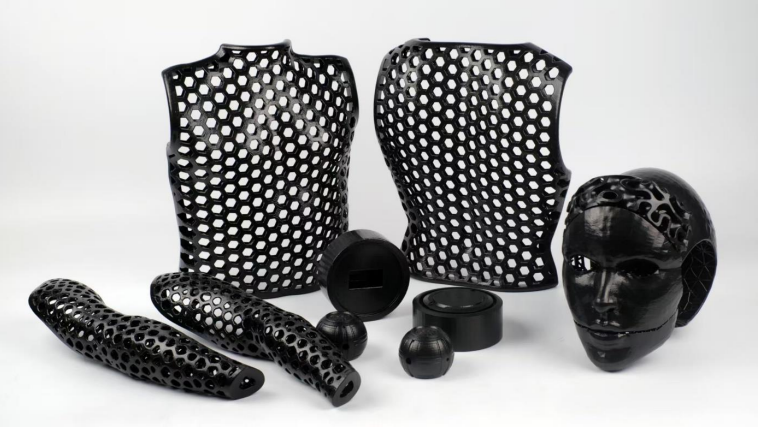
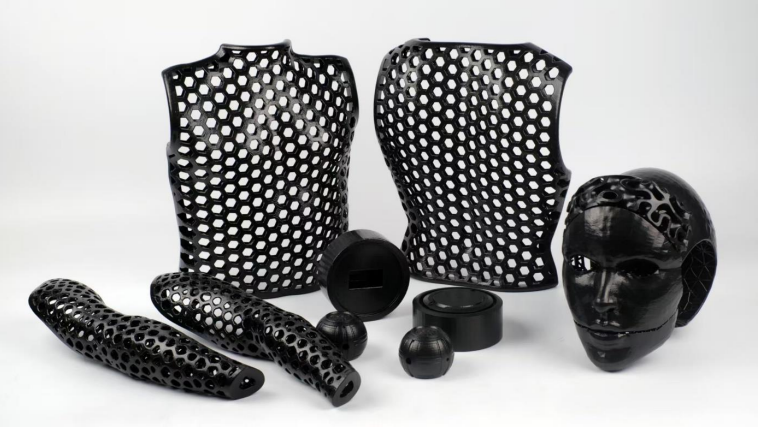
That durability profile makes PEBA useful in two distinct areas. In robotics, the SLS process supports auxetic lattice geometries, structures with a negative Poisson’s ratio that compress inward under load rather than outward, enabling controlled collapse behavior for collision protection systems and gripping actuators.
In footwear, the same foaming capability runs at approximately 12 minutes per pair at foaming ratios up to 1:30, removing the tooling requirements of injection molding and allowing customisation of geometry and surface design within the same production run.
The dominant model in powder bed fusion has historically tied machine buyers to the equipment manufacturer’s own material portfolio, with third-party powders either unsupported or requiring qualification that the manufacturer controls.
Farsoon’s open platform shifts that by exposing processing parameters directly to operators, allowing outside suppliers to bring their own materials to market on Farsoon hardware without the manufacturer acting as gatekeeper. The ALM partnership is a direct product of that architecture. The PEBA process is a different kind of expansion: a new production capability in flexible materials that SLS has historically underserved compared to rigid engineering polymers.
3D Printing Industry is inviting speakers for its 2026 Additive Manufacturing Applications (AMA) series, covering Energy, Healthcare, Automotive and Mobility, Aerospace, Space and Defense, and Software. Each online event focuses on real production deployments, qualification, and supply chain integration. Practitioners interested in contributing can complete the call for speakers form here.
To stay up to date with the latest 3D printing news, don’t forget to subscribe to the 3D Printing Industry newsletter or follow us on LinkedIn.
Explore the full Future of 3D Printing and Executive Survey series from 3D Printing Industry, featuring perspectives from CEOs, engineers, and industry leaders on the industrialization of additive manufacturing, 3D printing industry trends 2026, qualification, supply chains, and additive manufacturing industry analysis.
Featured image shows lattice-structured robotic enclosure. Photo via Farsoon robotic partners.
