


Athens International Airport (AIA) shares how it is transforming the passenger experience through customized ‘voice of the customer’ toolkits that blend cutting-edge AI with human empathy
How are you utilising conversational AI within the terminal? And where did you see opportunities to improve customer service?
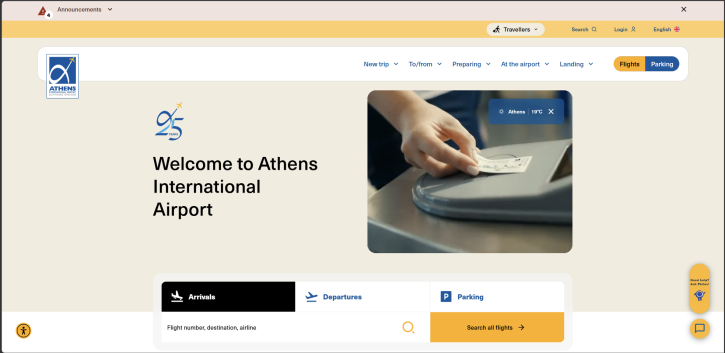
Within the terminal, Athens International Airport uses a virtual travel assistant, Philos – named after the Greek word for friend – to provide passengers with support 24/7 through the web and social media. It helps travellers find information about flights, baggage, parking, shops and other airport services. Philos also connects with the airport’s flight-information system and offers live chat for passengers who need instant assistance from an airport representative. Our priority is to make information easy to access, bringing multiple airport services together through a single conversational interface. The planned evolution towards agentic AI will enable Philos to handle more complex requests, such as combining flight details with shopping options on the way to a gate, or helping passengers complete a parking booking directly within the conversation. The aim is to move beyond answering questions to helping travellers conduct conversations and finding solutions.
Customer experience, however, is shaped long before passengers arrive at the airport and continues well beyond their time in the terminal. Understanding perceptions, expectations, emotions and potential points of friction throughout the entire journey is therefore essential to designing experiences that truly respond to passenger needs. Alongside the airport’s passenger-facing website chatbot, Athens International Airport explored a separate and complementary use of AI through a customer experience research platform designed to help the airport understand passenger journeys more deeply by inviting passengers to document their departure and arrival experiences in their own words through written comments and voice recordings across different touchpoints of the journey. AI supports the interpretation of this rich, unstructured feedback by transforming thousands of passenger narratives into structured insights. Through advanced sentiment analysis, the platform helps identify not only what passengers were saying, but also how they felt at each stage of their journey, highlighting moments of confidence, stress, satisfaction, uncertainty, or delight. By leveraging AI, we were able to analyse and discuss passenger feedback almost as if we were having a direct conversation with passengers themselves, gaining a more human understanding of their experiences, the factors shaping overall impressions, and the areas where improvements could have the greatest impact. This passenger-led approach enabled us to uncover meaningful insights and make more informed decisions focused on enhancing the end-to-end travel experience.
In simple terms, the chatbot helps passengers in ‘real time’, while the AI CX platform helps us listen to passengers at scale, turning their feedback and sentiments into insights that inform decisions and ultimately lead to better customer experiences.
How did you engage with passengers before/during roll-out?
Passenger engagement was approached from two complementary angles. While Philos generates insights from passengers’ day-to-day interactions with the airport chatbot, revealing their information needs and areas of uncertainty, AI CX platform engages passengers more directly by inviting them to document their experiences and emotions throughout the journey. Together, the two initiatives provide complementary perspectives on passenger needs: one through observed behaviour and one through expressed feedback.
Evidence of passenger engagement comes primarily from usage data. In Q1 2026, Philos recorded 16,156 unique users, 19,392 sessions and 31,926 user interactions. Demand was particularly evident during a nationwide airspace disruption on January 4th, 2026, when sessions exceeded 1,800 and the majority of enquiries related to flight information. This highlights the value passengers place on immediate access to reliable information during periods of uncertainty. Analysis of user interactions shows that flight information, airport operations and waiting times are among passengers’ primary areas of interest. It also identified a significant number of unresolved queries, providing valuable insight into where further improvements are needed. These findings have directly informed ongoing development efforts, including enhanced reasoning capabilities and stronger multilingual support.
On the other hand, AI CX platform engages passengers directly during fieldwork. Participants are approached at the airport and invited to access the platform through a QR code, using written comments or voice recordings to document their departure or arrival journey as it unfolded. Rather than following a conventional questionnaire, they were free to describe what stood out, what worked well and what could be improved. This direct engagement showed us that technology alone does not generate participation. Voluntary digital participation cannot be taken for granted, particularly in a time-sensitive airport environment. The technology must fit naturally into the passenger journey, require minimal effort and offer a clearly understood purpose. Flexibility in how and when passengers contribute is equally important, as is active support during recruitment. If the approach is expanded, clearer communication, more active recruitment and an incentive mechanism may help increase participation.
Together, these experiences demonstrated that passengers are receptive to digital assistants and AI-enabled engagement when the tools are intuitive, relevant and easy to use. Their interactions, feedback and participation have played a key role in shaping both platforms, ensuring that development is guided by real passenger needs, expectations and behaviours rather than technology alone.
How are you measuring success and what feedback have you had?
While traditional success metrics focus on measurable KPIs such as usage volumes, engagement rates and interaction levels, the longer-term success of AI solutions lies in their ability to generate insights that support better operational and strategic decisions. Ultimately, the effectiveness of these tools is reflected in the passenger experience itself. By helping identify priorities, understand passenger needs and address pain points more effectively, they contribute to improvements that can subsequently be tracked through established customer experience metrics, including overall satisfaction and perception scores measured through our passenger research programmes.
The current reporting for Philos mainly tracks unique users, total sessions, interactive sessions, interaction volumes and session duration. For Q1 2026, it reports 8,325 interactive sessions, an average of 3.83 user interactions per interactive session, and an average session duration of approximately 2.3 minutes. The ongoing updates align with shortcomings identified in the usage analysis. These include better interpretation of conversational or multi-part questions and more complete handling of requests.
For the AI CX platform, success is viewed beyond traditional performance metrics, focusing on the platform’s ability to generate meaningful customer insights from real-time passenger narratives and uncover journey aspects that may remain hidden in conventional research. A key success factor is passenger participation, as the value of the methodology depends on the richness and authenticity of the feedback collected. We therefore assess the quality of the data, the relevance of the themes identified, and the platform’s ability to analyse qualitative feedback at scale, revealing recurring themes, sentiment patterns and emotional signals. The pilot also informed practical improvements, including simplified participant instructions, enhanced recruitment guidance, extended platform timeout settings, and the addition of structured researcher observations to complement passenger feedback and provide a more holistic view of the journey.
Ultimately , success is defined not only by usage and participation levels, but by how effectively passenger interactions and feedback are translated into meaningful improvements, ensuring that both platforms continue to evolve in response to real customer needs and behaviours.
How did you engage with staff? How does conversational AI benefit them?
A collaborative design approach is considered essential, bringing together employees from different operational areas whose day-to-day experience and business knowledge helped shape solutions that are both relevant and practical. On another note, their involvement is particularly important because the ultimate value of these initiatives is realised through the passenger experience. As the teams responsible for delivering and continuously improving that experience, employees are the first to see the benefits of better insights, more effective decisions and enhanced customer outcomes.
For Philos, dedicated AIA staff from relevant departments contributed different but complementary forms of expertise. Staff with operational knowledge helped shape the substance and accuracy of the responses, while colleagues with direct or digital contact with passengers helped ensure that the tone was friendly, accessible and engaging for users. The intended benefit is to relieve frontline staff of routine enquiries, allowing them to focus on more complex issues that require attention, judgement and human interaction. The intended airport staff benefit is fewer escalations, allowing information desks and live agents to concentrate on genuine exceptions rather than routine enquiries.
For AI CX platform pilot, staff engagement focused on testing, fieldwork design and interpretation of the results. AIA’s project team tested the platform from the passenger perspective, refined the instructions and prompts and adapted the setup to the airport journey. The pilot of AI CX Tool did not create formal new roles, but it demonstrated how AI can make qualitative evidence easier for staff to collect, structure and explore. Looking ahead as a next step, the planned model would extend staff involvement in two complementary ways. Operational departments would use dedicated workspaces to record and monitor findings from routine inspections and observations, while relevant passenger journey insights would be shared with the departments responsible for each area. This would engage teams not only in gathering evidence, but also in interpreting findings and translating them into improvement priorities.
Staff involvement is both a key enabler and a key beneficiary of any initiative, ensuring that airport expertise shaped the solutions while empowering employees to deliver a better passenger experience through more informed decisions, targeted actions and a deeper understanding of customer needs.
Did this require any changes to the way you handle data within the terminal?
The introduction of AI required us to rethink not only how information and feedback are managed, but also how technology interacts with existing airport systems, passenger input and governance processes. As both initiatives evolved, they brought new opportunities to enhance service delivery and customer understanding, while also introducing important considerations around system integration, data management and the responsible use of passenger information.
Philos already draws on integrations with airport systems for flight information. The upcoming agentic architecture will extend that approach by coordinating specialist agents with access to systems and APIs covering flights, baggage, parking and retail.
For AI CX platform, the change began with the way feedback was collected. Rather than responding to predefined questions, passengers documented their experiences independently and in their own words through written comments and voice recordings across multiple journey touchpoints. Researchers introduced passengers to the platform and explained how to use it, while passengers remained in control of what they recorded and when. A key challenge is to analyse, organise and present these results in a clear and meaningful way so that they can gradually be incorporated into the airport’s broader customer experience management approach. It is also important to maintain a clear connection between the findings and the original passenger evidence throughout this process.
Overall, the use of AI introduces broader considerations around data governance and privacy. While the underlying principles of data protection remain unchanged, both operational system integrations and richer forms of passenger feedback require clear responsibilities and appropriate safeguards.
What are the common mistakes airports should look to avoid when deploying conversational AI within the terminal?
One of the most common pitfalls when deploying AI solutions is assuming that all AI technologies offer the same capabilities or can solve every customer experience challenge on their own. Airports should start with a clear understanding of the issue they are trying to address and carefully align the technology, operational processes and human involvement required to achieve the desired outcome. Our experience with both Philos and the AI CX platform highlighted the importance of setting realistic expectations about what AI can do, where human expertise remains essential and how the two can work together most effectively.
For the Philos chatbot, the key lesson is not to assume that a conversational assistant can provide agentic AI capabilities. Conversational assistants based on a predefined knowledge base are designed for information retrieval, while agentic AI combines more advanced reasoning with API orchestration and session memory. These capabilities require different architectures, not simply additional tuning.
At the same time, our experience with the AI CX platform showed that AI should not be treated as a self-sufficient solution. It requires active human oversight to review outputs, identify gaps, validate findings and make informed decisions about how the results should be used. The technology can accelerate analysis and reveal patterns at scale, but responsibility for interpretation and action must remain with humans.
Concluding, it seems that the most common mistake is to view AI as either a replacement for people or a complete solution in itself. The most successful implementations are those that combine technological capabilities with human expertise, ensuring that AI enhances rather than replaces the human contribution to the passenger experience.
What’s next for this technology?
For conversational AI, one of the most promising opportunities is moving from reactive question answering to more proactive and contextual assistance. Rather than waiting for passengers to ask for information, future systems could provide relevant guidance based on the stage of the journey and current operational conditions.
The proposed development opportunities include end-to-end parking, with the ability to check live availability, verify flight details, calculate the required duration and complete a booking within the conversation. Location-aware assistance could allow passengers to scan a QR code at a gate, baggage carousel or security point and receive contextually relevant information. Further opportunities include coordinated passenger guidance, combining flight information with relevant shops and services along the passenger’s route, and multilingual city recommendations through a proposed “This is Athens” integration, combining airport transit information with city activities or dining recommendations during a layover.
Overall, the greatest opportunity is not simply to create more AI tools, but to build a more connected AI ecosystem around the passenger journey. By combining operational information with passenger feedback and other customer-experience evidence, AI could support more contextual passenger assistance, help the airport understand how operational conditions shape the passenger experience and enable more informed decision-making across departments.
Which processes are still best handled by a human? And why?
Before deploying conversational AI, airports should carefully consider the balance between technology and the human element. There is no one-size-fits-all approach, as the optimal balance may vary depending on factors such as passenger demographics, travel expectations, cultural context and the airport’s operating environment. Mega hub airports handling significant passenger volumes may require greater reliance on technology to deliver information and support at scale, while at other airports the human touch may remain a critical component of the passenger experience and a key driver of customer satisfaction. The objective should not be to replace people with technology, but to combine the strengths of both in a way that best serves passengers’ needs.
Conversational chatbots can handle routine enquiries, while information desks and live agents remain responsible for genuine exceptions. The existing service includes live-chat integration, enabling passengers to access human assistance when the chatbot cannot resolve their request. An agentic AI chatbot could support a wider range of enquiries, but cases requiring judgement, reassurance or direct intervention should remain with people.
Human assistance will also remain essential as airport journeys become increasingly digital. Passengers have different levels of digital confidence, familiarity and accessibility needs, and some may prefer or require personal support at different stages of their journey. Digitalisation should therefore expand passenger choice rather than make a digital channel the only route to information or assistance.
Human judgement is equally important when handling unusual or extreme circumstances, resolving passenger concerns and balancing decisions that may affect safety, service or reputation. It should also remain central to interpreting AI-generated insights: technology can uncover themes and patterns, but people must provide context, challenge assumptions and decide how findings should influence action.
At Athens International Airport, we see AI as a tool that augments human capabilities rather than replaces them, combining faster access to information with human judgement, accountability and support.
Harnessing AI and Technology for a human future that works is our main focus for the years ahead.
All answers provided by Ioanna Papadopoulou, director, communications and marketing, Athens International Airport, who took part in a panel discussion during PTE World 2026 in London, titled, ‘Revolutionizing passenger experience through balancing AI-driven and human-centered innovations’.
