


Another wave of constellations has staked claims for communications satellites in non-geostationary orbit (NGSO), but what hope do newcomers have alongside the industry’s entrenched, vertically integrated giants?
A mix of established and wannabe constellation operators joined the Federal Communications Commission’s latest processing round for Ku-, Ka- and V-band frequencies before it closed July 6. The FCC uses processing rounds to consider constellations seeking similar frequencies together, generally putting them on equal footing for spectrum sharing. Still, several companies have a significant head start.
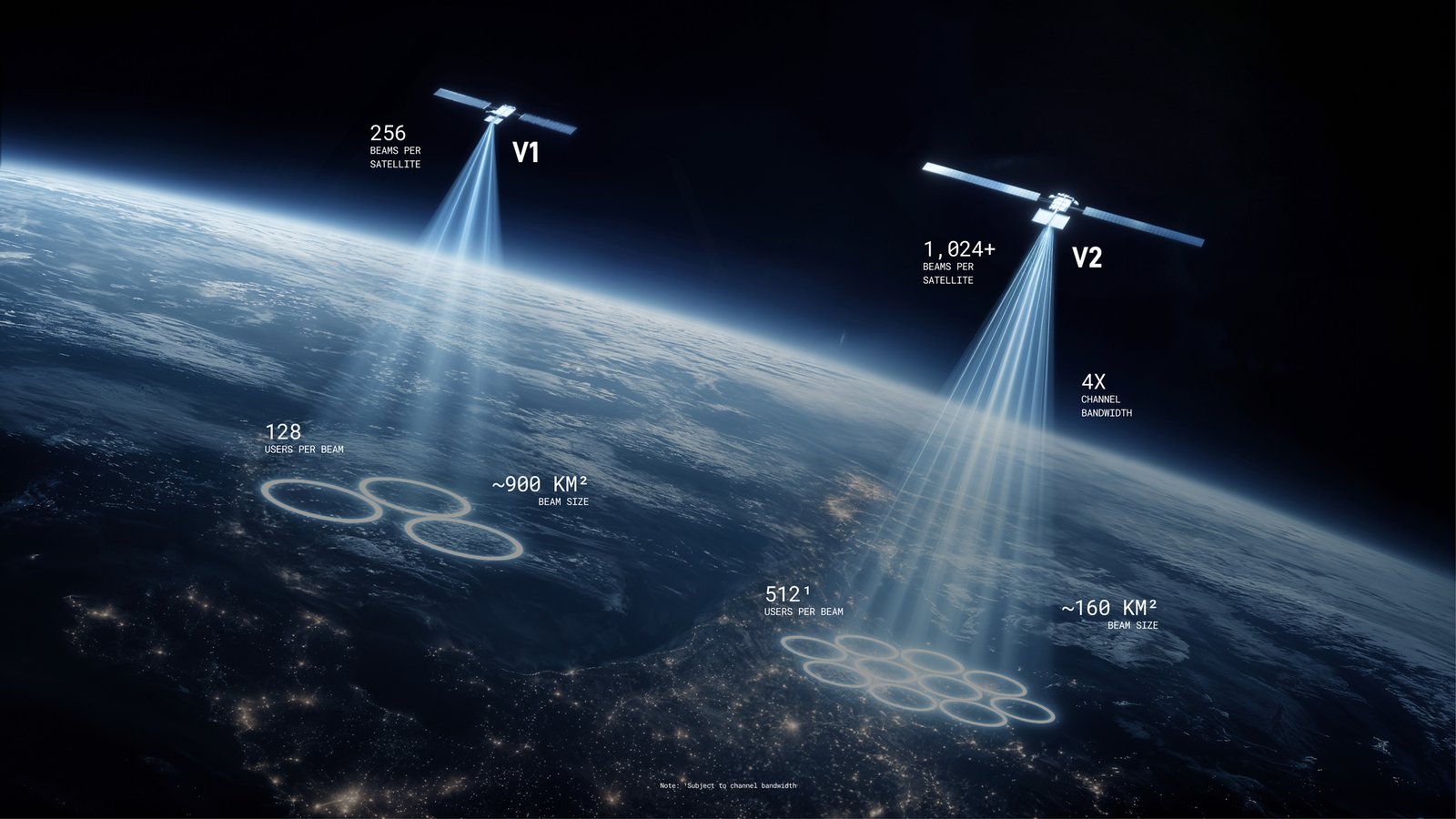
Industry powerhouse SpaceX proposed by far the largest number of new satellites: 100,000 for a Gen 3 network geared toward an age of AI that it said had taken hold since applying for roughly 30,000 Gen 2 spacecraft six years earlier.
There are already more than 10,000 Starlink broadband satellites in orbit, which SpaceX builds, launches and operates itself. Separately, it is seeking FCC approval for up to 1 million orbital data centers to support AI computing.
Amazon was included through an earlier filing and has already secured permission to add more than 4,500 Gen 2 and Polar satellites to its fleet. The internet giant has so far deployed more than 390 of its 3,232 approved Gen 1 satellites, enough to start commercial services in the coming months.
Blue Origin, the launch-focused company owned by billionaire Jeff Bezos, is also part of the group, seeking permission for more than 5,400 TeraWave satellites aimed at enterprise and government users.
Europe’s Eutelsat and SES joined with filings for follow-on satellites to complement smaller NGSO networks already in orbit, while Telesat is there for design changes for its Lightspeed constellation, as the Canadian operator prepares to start deploying the initial 198 satellites needed for global services in 2028.
In contrast to these established players, the remaining applicants — Logos, Rivada, CesiumAstro, Astra, LTS Systems/Theia and SpinLaunch’s SN Space subsidiary, accounting for more than 13,700 satellites — are starting from scratch as constellation operators. Each has also broadly outlined ambitions to provide secure and private connectivity for enterprise and government customers.
Defensible niches
“SpaceX’s progress and Amazon’s determination make it difficult for other broadband entrants in the U.S. and U.S.-allied countries,” said Armand Musey, a satellite industry analyst and founder of Summit Ridge Group.
While there may be niche enterprise applications, he said it’s not obvious whether an upstart could sustain another network.
Simply targeting niches that Starlink or Amazon are not serving today is also unlikely to be a durable long-term strategy, according to Grace Khanuja, senior manager at Novaspace.
If a niche proves attractive, she said these hyperscalers have the capital, manufacturing prowess and launch access to enter quickly and compete aggressively, including on price.
“The more compelling opportunity is to identify structural gaps where the hyperscalers are less well positioned, rather than temporary gaps in market coverage,” Khanuja said.
But while shifting geopolitics appear to be creating more room for entrants as governments grow increasingly wary of relying on a single provider, price will remain a major consideration.
Meanwhile, Musey flagged China as an international wildcard, with megaconstellations coming out of the country threatening to disrupt Western operators turning to developing countries for a critical mass of subscribers.
“The real competition will likely be driven by geopolitical forces as opposed to rational economic behavior,” he said. “Countries aligned with China will likely put regulatory barriers that favor the Chinese options and foreclose the use of U.S. options, and the U.S. is likely to do the same with Chinese providers.”
Ultimately, Khanuja said opportunities for newcomers lie in occupying parts of the market where differentiation comes from sovereignty, security and mission-specific capabilities, rather than building another sprawling Starlink network.
“The winners are more likely to complement the hyperscale operators than compete with them head-on for broadband subscribers,” she said.
This article first appeared in the August 2026 issue of SpaceNews Magazine.
