


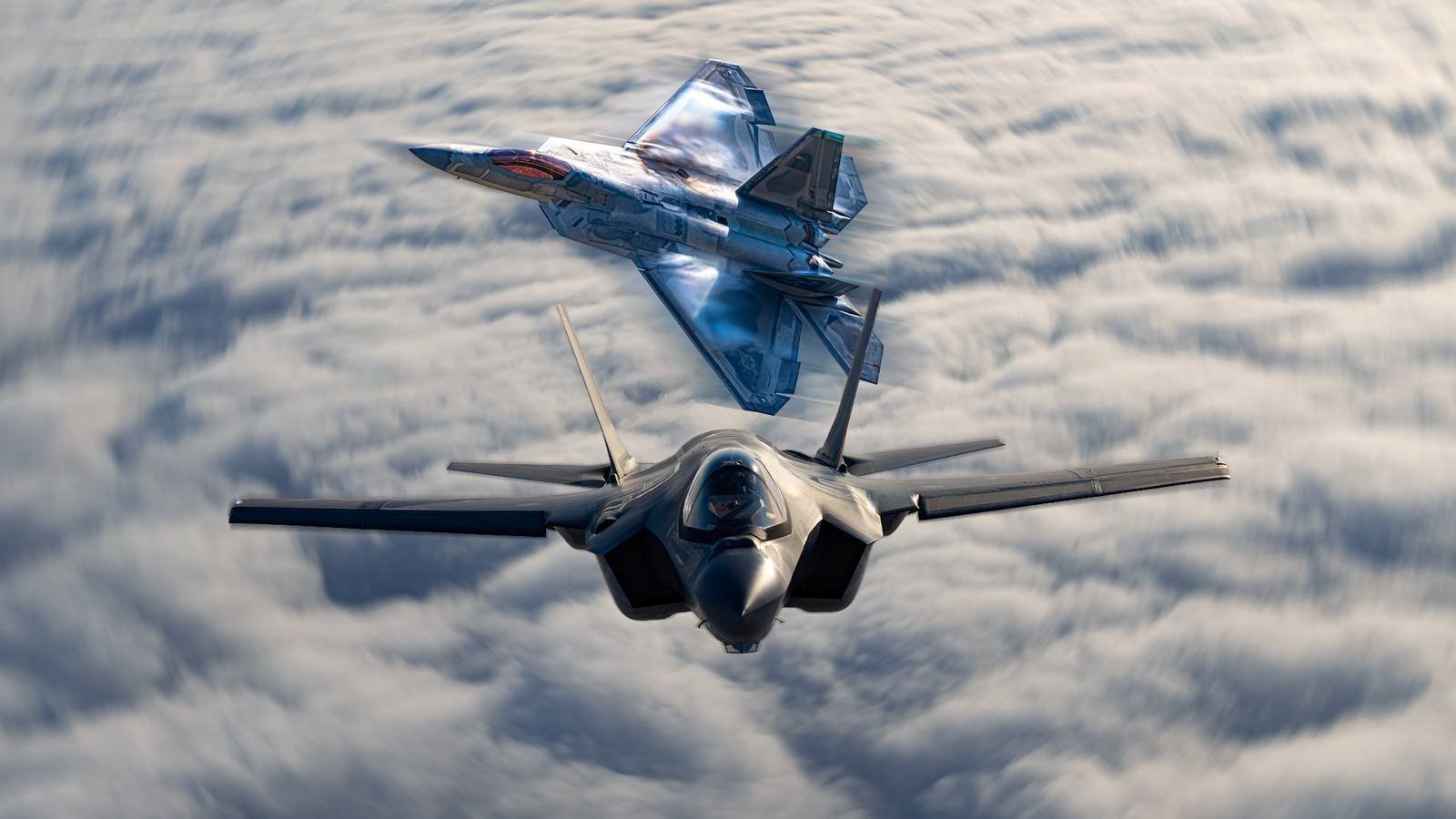
The Lockheed MartinF-22 Raptor and F-35 Lightning II are both fifth generation stealth fighters, yet they process and respond to airborne and ground threats in almost opposite ways. The United States Air Force describes the F-22 as an air-dominance platform built around a combination of stealth, supercruise, maneuverability, and sensor fusion to give pilots a first-kill opportunity before an enemy fighter even knows a threat is nearby. The Lightning II arrived roughly ten years later with a far broader brief, striking ground targets, jamming enemy radars, and feeding a fused picture of the battlespace to an entire strike package, all while still holding its own in the air. Those different missions pushed Lockheed Martin’s engineers toward very different answers to the same basic question: how should a fighter see, evade, and engage a threat?
This list breaks down five specific engineering choices, covering airframe shaping, sensor fusion, radar design, propulsion, and weapons-bay geometry, that explain why these two jets fight so differently despite sharing a manufacturer and a stealth pedigree. Some of the gaps favor the Raptor, whose airframe and engines remain tuned almost entirely for air-to-air combat against other fighters, described by the Air Force as designed to project air dominance rapidly and at great distances, and defeat threats attempting to deny access to friendly forces. Others favor the Lightning II, whose sensors and mission computers were built to fuse a wider picture of the battlespace and hand threat data to the whole formation. None of these five choices makes one jet simply better than the other; each one reflects the specific threat environment each aircraft was actually built to survive.
The F-22’s Airframe Was Designed For All-Aspect Stealth
A marble-sized radar signature versus a golf-ball-sized compromise
Every curve of the F-22 was drawn around a single target set: the X-band fire-control radars carried by enemy fighter jets. Designers aligned the wing and tail edges to reflect radar waves in only a few predictable directions, buried the engine inlets, and coated intakes, panel seams, and access doors in radar-absorbent material. The result is a frontal radar cross-section estimated at roughly 0.001 to 0.005 square feet (0.0001 to 0.0005 square meters), a signature commonly compared to that of a marble or a bumblebee by the USAF. Because the Raptor’s mission never called for it to carry large ground-attack weapons, its shape could be optimized almost entirely around that one number, and it still runs strict emissions control, only using its radar when the mission truly requires it.
The F-35’s airframe had to satisfy a much longer list of requirements, including a vertical-landing variant for the US MarineCorps, larger internal bays sized for 2,000-pound bombs, and export-friendly production costs. Those compromises show up in the numbers: the Lightning II’s frontal radar cross-section is generally quoted at around 0.015 square feet (0.00015 square meters), closer to a golf ball, and its shaping is optimized mainly for the front and side aspect rather than the all-aspect coverage built into the Raptor. Both jets remain extremely difficult to detect compared with fourth-generation fighters, but the gap between them is real, and it is the direct result of the specialization of the F-22 against the F-35, that has to balance several numbers for its multirole vocation, as examined by The National Interest.
The gap extends beyond radar. The F-22’s exhaust nozzles are flattened and insulated to shield hot engine parts from infrared sensors, and its dedication to strict emissions control means the jet’s radar, data links, and other emitters stay off unless a mission genuinely requires them. The F-35 leans the opposite way by design: it is meant to stay networked, constantly exchanging sensor data over its secure Multifunction Advanced Data Link with other aircraft, ships, and ground units, which reveals far more electronic activity, even though that activity is encrypted and difficult to intercept.
The F-35 Fuses Six Infrared Cameras Into One 360-Degree Threat Picture
The Distributed Aperture System gives the Lightning II a sensor-fusion edge the Raptor still lacks

As previously covered by Simple Flying, the F-35’s AN/AAQ-37 Distributed Aperture System uses six infrared sensors mounted around the airframe to give the pilot unobstructed, spherical coverage with no need to point a sensor at a target. DAS tracks missile launches, flags nearby aircraft, and pipes real-time infrared video straight onto the pilot’s helmet visor, letting a pilot look through the floor of the jet to watch a threat below. In testing, the system has demonstrated the ability to detect and track objects at distances beyond 800 miles (1,287 kilometers).
Working alongside DAS is the Electro-Optical Targeting System, mounted under the nose behind a sapphire window. According to Lockheed Martin, EOTS was the first system to combine forward-looking infrared imaging with infrared search and track in one low-drag unit, feeding target data into the same mission computer as the radar and DAS. The F-35’s computer fuses all three sensor streams into a single threat picture, rather than leaving the pilot to mentally combine separate displays. The F-22 has no internal equivalent to EOTS. It relies on the classified AN/AAR-56 Missile Launch Detection system for 360-degree warning of missile launches, and Air Force officials have said there simply is not enough internal space in the Raptor to add a DAS- or EOTS- style sensor without a significant redesign. That leaves the F-22 pilot with a narrower, radar-centric threat picture compared with the fused, multi-sensor view available in the F-35 cockpit.
The gap shows up in how the Air Force itself talks about the two jets. When the service’s 13th Fighter Squadron transitioned from F-16s to F-35As, its commander, Lt. Col. John Widmer, described the Lightning II as “built from the ground up as a sensor platform with the sensor fusion and quarterback capability we bring to the fight.” The Raptor, built years earlier, was never designed around that same networked, quarterback role.
The Raptor’s Bigger Radar Trades Networking For Raw Detection Range
A larger antenna gives the F-22 a first-look advantage against non-stealth threats

Northrop Grumman describes the F-22’s AN/APG-77 as the key to achieving “first look, first kill” capability. It is a physically larger active electronically scanned array when compared to the radar fitted to the F-35, and that extra aperture translates into more raw transmitting power. Estimates from Deagel.com suggest the APG-77 can track non-stealth targets at ranges in excess of 130.5 miles (210 kilometers), built specifically to win beyond-visual-range engagements under a first-look, first-shot doctrine, while also running low-probability-of-intercept modes, so the Raptor can search without giving away its own position.
The F-35’s AN/APG-81 uses a smaller antenna of roughly 1,676 transceivers, and its estimated raw tracking range against small radar cross-section targets runs closer to 90 to 100 miles (145 to 161 km). What it gives up in pure detection range, it makes up in versatility: the APG-81 adds high-resolution ground-mapping modes, jamming functions, and a secure multifunction data link that shares targeting data with other aircraft and ships in real time. According to Simple Flying, the F-22’s radar holds a 17 percent longer effective range against equal targets simply due to its larger aperture, a modest but real edge that reflects each radar’s original design task.
Both radars share the same underlying transmit/receive technology and, on later production lots, even run some of the same processing hardware, but the mission each was written for never changed: the APG-77 exists to win a duel against another fighter, while the APG-81 exists to build and share a wholesome picture of the battlespace.
Thrust-Vectoring Engines Let The F-22 Out-Maneuver Threats At Close Range
Supercruise and 2D vectoring nozzles versus a single, sensor-focused engine

The F-22 is powered by twin Pratt & Whitney F119 engines, each in the 35,000-pound (155-7 kN) thrust class according to the US Air Force data, paired with 2D thrust-vectoring nozzles that pitch up to 20 degrees up or down. According to the Air Force’s own fact sheet, that combination lets the Raptor supercruise, sustaining supersonic flight above Mach 1.5 without afterburner, reach a top speed in the Mach 2 class, and operate with a ceiling above 50,000 feet (15,240 meters), all from an airframe weighing roughly 43,340 pounds (19,700 kg) empty. In close combat, the vectoring nozzles let pilots point the nose at angles that would push a conventional fighter beyond its aerodynamic limits, a post-stall maneuvering regime that remains difficult for most operational fighters to match.
The F-35A, instead, relies on a single Pratt & Whitney F135 engine producing about 43,000 pounds of thrust(191.3 kN) with afterburner, but with no thrust vectoring for maneuvering: the F-35B’s nozzle vectors only straight down, purely to support vertical landing. Top speed tops out at Mach 1.6, noticeably behind the Raptor, as examined by Simple Flying. The F135 is also an evolution of the F119, retaining its six-stage high-pressure compressor and single-stage high-pressure turbine while adding a new low-pressure spool. The F-22 therefore combines two high-thrust engines with mechanically vectored exhaust, while the F-35A relies on conventional aerodynamic control surfaces and its flight-control system to maneuver.
The result is a fundamental difference in propulsion philosophy: the Raptor’s engines were integrated into the aircraft as part of a system optimized for thrust, supercruise, and extreme maneuverability, while the F-35A’s single-engine configuration prioritizes a different balance of thrust, range, weight, and commonality across the three Lightning II variants.
Internal Weapons Bays Reveal Two Different Threats—Engagement Doctrines
Six air-to-air missiles built for dogfights versus a bay sized for 2,000-pound bombs

The F-22 carries four internal bays: two main bays, each sized for up to three clipped-fin AIM-120 AMRAAMs, as documented by Aerospaceweb.org, plus two smaller side bays for one AIM-9 Sidewinder per bay, for a maximum stealth loadout of six AMRAAMs and two Sidewinders. Every internal weapon on the Raptor is built for air-to-air engagements: four external pylons exist mainly for ferry flights and fuel tanks, since using them operationally would compromise the jet’s low-observable profile.
The F-35A and the F-35C carry only two internal bays that were purposefully sized around large, 2000-pound (907 kg) air-to-ground weapons, such as the GBU-31 JDAM and AGM-154 JSOW, not around packing in extra missiles. In the standard stealth configuration, each bay holds one AIM-120 alongside a bomb, for two air-to-air missiles total, well below the Raptor’s stealth loadout. As per TWZ, a new rack called Sidekick now lets the F-35A and the F-35C carry three AMRAAMs per bay, six in total, finally matching the F-22’s stealth air-to-air capacity, though the adapter is not compatible with the F-35B, whose bays sit roughly 14 inches (36 centimeters) shorter to make room for its vertical-lift fan. The gap illustrates the core difference between the two jets in one hardware detail: the Raptor’s bays were built around missiles from day one, while the Lightning II’s were built around bombs first, and grew into a comparable missile load only years into service.
