


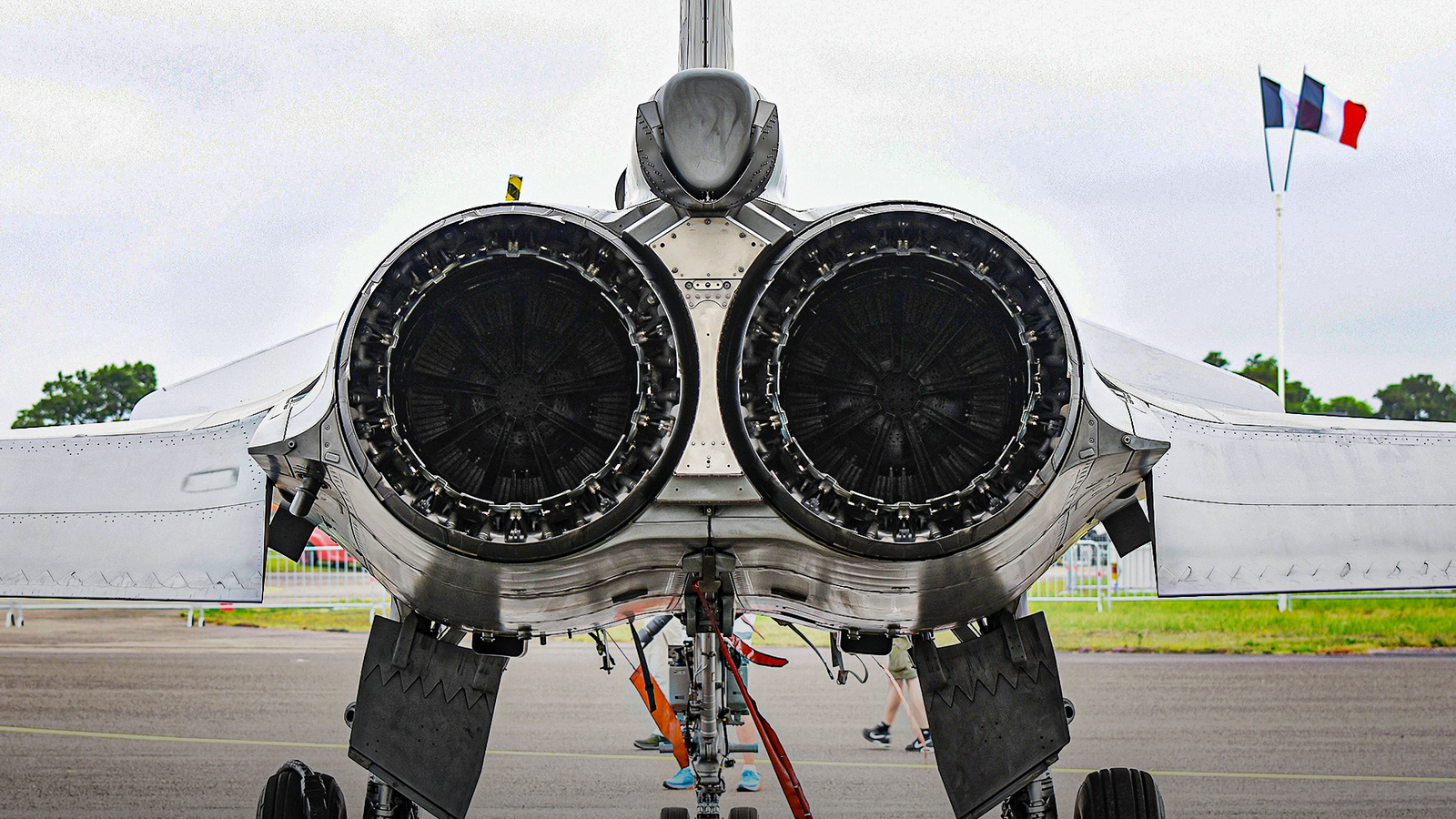
Paris is committing a colossal amount of money to a fighter jet whose basic design is roughly 40 years old. It is also investing in an airborne nuclear mission that will depend on that jet into the 2040s. The primary reason for the prolonged service of the Dassault Rafale is the collapse of the joint French, German, and Spanish sixth-generation fighter program in June.
Yet, the €3.4 billion figure attached to France’s Rafale F5 upgrade is not merely the price of the upgrade. According to Defence Matters, the sum is additional funding for a comprehensively revised military doctrine for combat aviation, which covers the launch of the F5 standard and a new set of long-range weapons. At the same time, the full bill for the F5 alone is speculated to be closer to €5 billion.
Many European air forces are chasing sixth-generation stealth airframes that have yet to fly. France has chosen instead to upgrade the aircraft it already operates in both its Air Force and Navy. The next tranche of the 4.5-generation Rafale will have a new radar, a more powerful engine, and even a hypersonic nuclear missile. The question is, will that be enough to carry French air power through the 2040s, or will it only postpone a harder transition later?
What the €3.4 Billion Actually Pays For
The F5 program itself costs more than what most headlines suggest. Eurasian Times reported that the United Arab Emirates had weighed contributing about €3.5 billion to a project of roughly €5 billion before walking away in April 2026. It reported that the UAE backed away because France would not share technology, particularly concerning sensor devices.
France therefore carries the development cost alone. The contracts announced so far are only the first slice of that bill. The Directorate General of Armament, known as the DGA, announced the first F5 awards on September 9 to Dassault Aviation, MBDA, Safran and Thales without disclosing their values.
Meanwhile, Defence Matters reported on September 14 that the revised programming law adds billions for combat aviation. The Defence Ministry says the extra funds will finance the F5 and its new long-range weapons. Those include the STRATUS Rapid Strike missile, intended for deep strike, suppression of enemy air defenses and anti-ship missions. Army Recognition dated the Defense Ministry statement to 10 September and said the contracts were placed during the summer.
Head-to-Head With France’s Finest

Risk reduction awards are meant to secure long lead technologies ahead of a full development contract, which the DGA expects by the end of 2026. The reporting also differs in scope. Below is a table of technical comparisons between the F4 and F5 variants as compiled from manufacturer data as well as coverage by AeroTime and The National Interest:
Technical Feature | Rafale F4 Standard (Current Production) | Rafale F5 “Super Rafale” (Upcoming Variant) |
|---|---|---|
Projected Service Entry | 2023 – 2027 (Phased Increments) | 2033 – 2035 |
Engine Model | 2× Safran M88-2 | 2× Safran M88 T-REX |
Max Thrust (Per Engine) | 16,860 pounds-force (~7.5 metric tons) | 21,000 pounds-force (9.0 – 9.5 metric tons) |
Thrust Increase | N/A | 20% more power output |
Radar System | Thales RBE2 AESA (GaAs-based) | Thales RBE2-XG AESA (GaN-based) |
Electronic Warfare | SPECTRA (Analog/Digital Hybrid) | SPECTRA F5 (Fully Digital Architecture) |
Drone Teaming | Basic data-linking with friendly assets | Direct command of Loyal Wingman UCAVs |
Nuclear Weapon Compatibility | ASMPA-R Cruise Missile | ASN4G Hypersonic Scramjet Missile |
Primary Conventional Strike | SCALP-EG / Exocet AM39 | Future Cruise Missile (FCM) / FASM |
Jane’s listed the primary upgrades as the inertial navigation unit, engine, radar, and countermeasures suite. It also noted the addition of connectivity for collaborative combat aircraft, or loyal wingman drones. This would introduce the concept of crewed Rafales working alongside advanced drones for the first time. Most of the money is still to be committed, but the F5 was never meant to carry this much equipment. It was first conceived as a technological bridge to the next-gen fighter of the Future Combat Air System, a plan that depended on a partner aircraft that no longer exists.
What Changes Inside the Aircraft

The F5 is recognizably a Rafale on the outside; however, with extensively changed systems throughout, it is closer to a reconstruction than an iterative upgrade. The centerpiece is the RBE2 XG radar, an evolution of the current RBE2 AESA, or active electronically scanned array. That is a radar that steers its beams electronically without moving the antenna, which will be faster, more powerful, and better at detecting both stealth planes and small aircraft like drones.
Higher output power is meant to extend detection range and improve identification of targets with very low radar cross-sections. To achieve that, the radar is expected to use gallium nitride semiconductors, which raise power without enlarging the array. Greater processing capacity will also let the sensors cooperate with less pilot involvement, according to Army Recognition, a critical function of data networking on the 21st-century battlefield.
Electronic warfare and communications are being enhanced in parallel. The DGA said the SPECTRA self-protection suite from Thales and MBDA France moves to a fully digital architecture to counter a denser electromagnetic spectrum and more complex threat waveforms expected by 2035.
Thales is also developing the IVDL, the Inter Vehicle Data Link, on a high-bandwidth waveform designed to be discreet and resistant to jamming, while Dassault works on a very low-drift inertial navigation system, and the F5 will be the first Rafale with fiber-optic wiring.
Then comes the engine. Safran’s M88 T-REX increases maximum thrust by 20%. Safran maintains the M88’s modular architecture and low fuel consumption while changing the low-pressure compressor, high-pressure turbine, and nozzle. The extra thrust is important because the aircraft is getting more powerful sensors, electronic warfare equipment, and heavier weapons. None of this changes the airframe’s radar signature, leaving the more difficult question of how it would perform in the most highly protected airspace.
How The F5 Fares Against Stealth Aircraft

The F5 is, of course, not a stealth fighter. The Rafale is considered the highest-performance and most lethal legacy ‘omni-role’ jet. Defence Security Asia, discussing French pilot feedback on fighting fifth-generation stealth aircraft, argued that the Rafale has real advantages in payload, range, electronic warfare, weapons diversity, maintainability, and mid-mission flexibility.
The Rafale remains highly relevant in missions that do not require deep penetration of a near-peer adversary’s airspace. Against mature stealth aircraft protected by integrated air defenses, however, the outlet said success increasingly depends on sensing from other platforms, passive detection, electronic attack, uncrewed teammates, long-range weapons, careful emissions control, and exceptionally resilient networks.
France’s answer to tomorrow’s air warfare is to combine the F5 with CCA drones. The Loyal Wingmen are therefore central to the design. The stealth combat drone will draw on technology from the nEUROn demonstrator. Initial experiments are planned around 2028, and an operational demonstrator is expected by about 2035.
Dassault Aviation CEO Éric Trappier has said the drone would weigh more than ten tons. Its potential roles include reconnaissance, contributing sensors to a shared targeting picture, carrying weapons or EW payloads, and acting as a kind of ‘missile sponge’ to sacrifice itself. The drone, like the American program, would be attritable, which means it could be sacrificed to protect a piloted plane in the worst-case scenario.
The fleet’s scale matters as much as the equipment itself. France plans to field 225 combat aircraft by 2035, including at least 47 Rafales built or upgraded to the F5 standard. The split between the Air and Space Force and the Navy has not been announced. Out of 225 aircraft, that is about 21%.
How the Joint Fighter Fell Apart

Breaking Defense reported on June 8 that the Future Combat Air System, or FCAS, had collapsed after industrial mediation between Dassault and Airbus failed to settle disputes over leadership, work share and the design of the jet, in a project it had valued at €100 billion since its launch in 2017. AeroTime traced the final months. Chancellor Friedrich Merz questioned publicly in February whether one platform could satisfy both countries, since France requires a nuclear-capable, carrier-compatible aircraft and Germany does not.
A mediation process begun after a Macron-Merz dinner on March 18 collapsed on April 18, when the German mediator concluded that a jointly built, crewed fighter was no longer feasible. Dassault chief Eric Trappier kept insisting on a prime contractor role for his company and rejected parity with Airbus, and Merz’s personal attempt to change his mind also failed.
Not everything ended. Paris and Berlin will keep working on the wider system of systems, including the combat cloud, the network meant to link crewed jets, drones and sensors, and that Emmanuel Macron said in July that the joint aircraft and its engine had stopped. Germany, for its part, declared in a national aviation strategy that Airbus must co-lead any future German combat aircraft.
The Enduring Need For Strategic Deterrence

The nuclear requirement is what makes the split permanent rather than temporary. A French fighter has to carry the airborne deterrent and operate from a carrier, and neither is a German priority. Airbus had earlier supported a two-fighter approach precisely because France needs an aircraft able to carry nuclear weapons. With no common successor and only a national demonstrator in prospect, the Rafale has to absorb the requirements of the next decade.
On paper, then, the F5’s qualification around 2033 lands ahead of GCAP’s 2035 target date. The comparison is uneven, though, because it sets an upgraded version of an existing design against a completely clean-sheet stealth fighter.
The F5 remains an extensive evolution of an existing airframe rather than a true sixth-generation fighter, leaving Paris to prepare for the post-Rafale era while GCAP and the American program advance.
The F5 looks like a credible bridge that keeps high-end strike capabilities and the airborne deterrent alive through the mid-2030s. France will fund it entirely after the Emirati exit, leaving it dependent on a drone, a missile, and a successor demonstrator that has not yet flown. The first test is close. The DGA expects to launch full F5 development by the end of 2026.
Catch what other trackers miss
Emergency squawks, holds, NOTAMs — live signals, no signup.
Open tracker
Catch what other trackers miss
Emergency squawks, holds, NOTAMs — live signals, no signup.
Open tracker
