


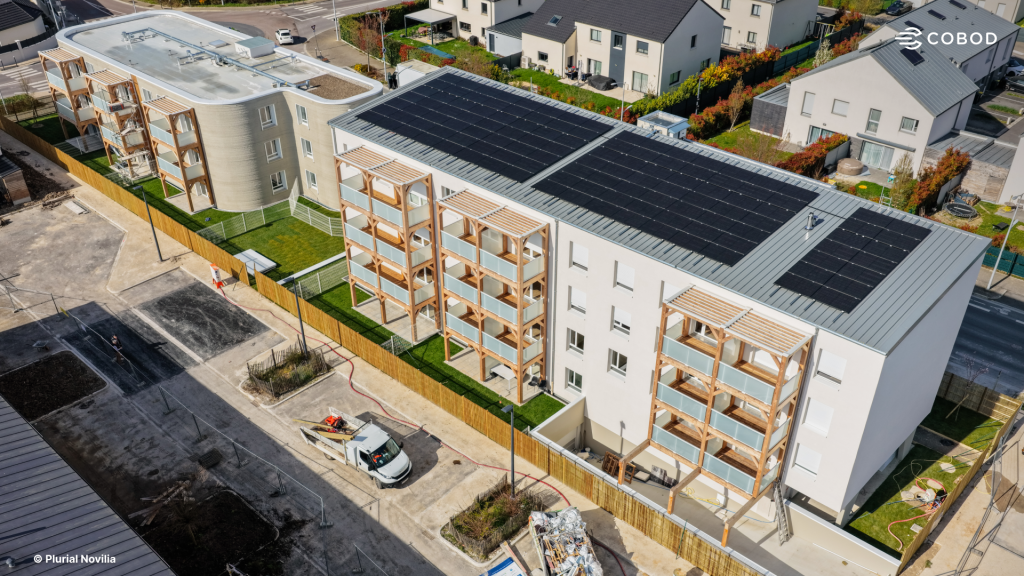
A social housing development in Bezannes, France has set a new benchmark for 3D construction printing in Europe. The project, called ViliaSprint², delivers 12 apartments across three floors and roughly 800 square meters of livable space, making it the continent’s largest 3D printed multi-family residential building to date. The structure was brought to life through a collaboration between PERI 3D Construction, Danish printer manufacturer COBOD, concrete supplier Holcim, and developer Plurial Novilia, a subsidiary of Action Logement.
What made the build stand out was the pace. The printing phase, which covered the entire load-bearing structure and all walls directly on-site, wrapped up in 34 days, well under the 50 originally projected. That translated into a three-month reduction in overall project timeline compared to an equivalent building constructed using conventional methods on the same site.
Fewer Workers, Less Waste, More Design Freedom
The efficiency gains extended well beyond speed. Where traditional shell construction required six workers on site, the 3D printed building needed only three, with operators managing the COBOD BOD2 gantry printer via tablet rather than handling heavy materials manually. That reduction in physical labor carries particular weight in a construction sector already stretched thin by skilled workforce shortages.
On the materials side, waste dropped from 10% to 5%, and the curved geometry made possible by additive manufacturing allowed for roughly 10% less concrete overall, savings that would have been economically unviable with conventional formwork. The rounded façade and floorplan aren’t aesthetic flourishes; they’re a direct result of what 3D printing makes cost-effective that traditional methods don’t.
The building was also designed with energy performance in mind, integrating perlite insulation, timber balconies, 500 square meters of photovoltaic panels, and a hybrid heating system, achieving approximately 60% energy self-sufficiency in line with France’s RE2020 2025 standards.
What the Numbers Actually Prove
Plurial Novilia made a deliberate decision to construct a nearly identical building on the same site using conventional techniques, creating a direct, controlled comparison rather than relying on projections. The side-by-side results confirmed the shell construction time was cut in half, and pointed to additional gains that may grow as the technology matures.
“We are proud to have supported this project as technology partner and print executor. The result shows vividly what is already possible in 3D building printing today, faster construction, fewer workers, and fully load-bearing structures. This is an important milestone and motivation to push this technology further,” said Dr. Fabian Meyer-Brötz, Managing Director of PERI 3D Construction.
COBOD’s founder Henrik Lund-Nielsen noted that even greater speed was within reach. “ViliaSprint² is a great example of how 3D construction printing can cut construction time, material consumption and waste and limit the amount of labor used, also for quite large buildings. Had the print been done with 5 cm (2 in.) layer height, which was technically possible, the printing and execution time could be cut even further down from 34 days to just 14 days for the printing of all of the 800 m²,” said Henrik Lund-Nielsen, Founder and General Manager of COBOD International.

What Comes Next
The partners are already planning a follow-on development of around 40 apartments, this time deploying two printers simultaneously. The target is a fourfold reduction in print time, with costs expected to approach parity with conventional construction as scale and process maturity improve.
“ViliaSprint² is a significant step in testing new construction methods and demonstrates the potential of 3D printing for faster and more sustainable housing,” said Johnny Huat, Managing Director of Plurial Novilia.
When Speed Becomes the Argument
A key challenge 3D construction printing has faced isn’t whether it works, it’s whether it works faster. ViliaSprint² makes that case more concretely than any previous European project. PERI 3D Construction and COBOD didn’t just deliver a larger building; they delivered it ahead of schedule, against a side-by-side conventional benchmark, with half the workforce. That’s the proof point the industry has been building toward.
The precedents are already stacking up. PERI’s DREIHAUS development in Heidelberg, Germany’s first serial 3D printed housing project, saw the walls of its largest building printed in just 26 working days, with the COBOD BOD2 completing one square meter of wall every five minutes.
In the US, Alquist 3D printed the exterior of a three-bedroom, 1,200-square-foot home in just 28 hours using the same BOD2 system, with its CEO framing the technology as a direct answer to two simultaneous housing crises: rising costs and slow delivery. CyBe’s modular PPVC approach took a different route, printing finished units off-site around the clock and shipping them for on-site assembly, reducing labor, noise, and dust while keeping production continuous.
ViliaSprint² doesn’t just add to that list, it raises the bar. A three-month timeline reduction on a 12-apartment, three-story building, confirmed against a real control group, is the kind of result that moves the conversation from pilot project to policy consideration.
3D Printing Industry is inviting speakers for its 2026 Additive Manufacturing Applications (AMA) series, covering Energy, Healthcare, Automotive and Mobility, Aerospace, Space and Defense, and Software. Each online event focuses on real production deployments, qualification, and supply chain integration. Practitioners interested in contributing can complete the call for speakers form here.
To stay up to date with the latest 3D printing news, don’t forget to subscribe to the 3D Printing Industry newsletteror follow us on LinkedIn.
Explore the full Future of 3D Printing and Executive Surveyseries from 3D Printing Industry, featuring perspectives from CEOs, engineers, and industry leaders on the industrialization of additive manufacturing, 3D printing industry trends 2026, qualification, supply chains, and additive manufacturing industry analysis.
Featured image shows Aerial view of ViliaSprint. Photo via COBOD.
