


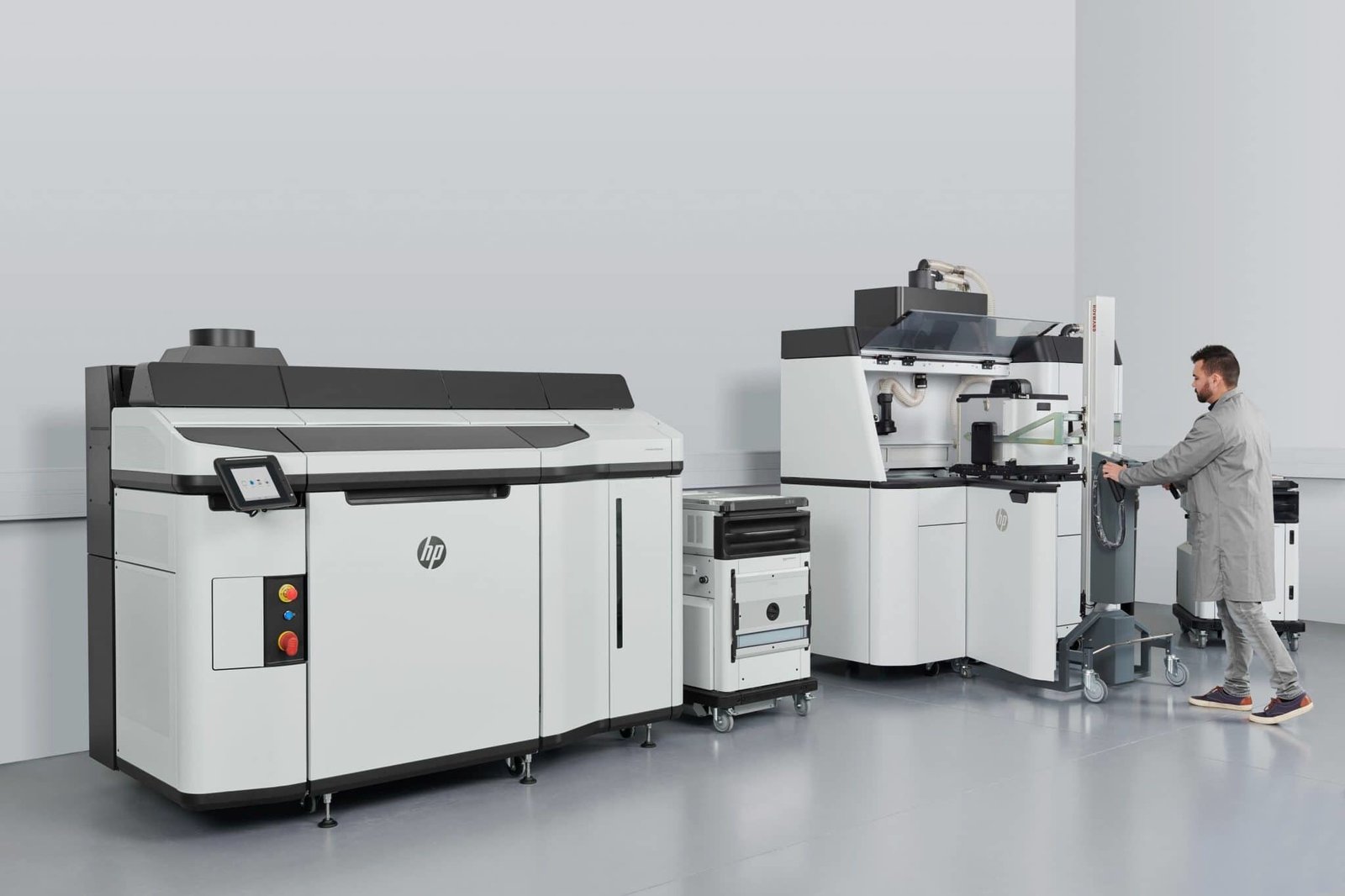
Future Form, a U.S. manufacturer producing precision-engineered components for the data center, medical, defense, nuclear, and aerospace industries, has introduced plastic 3D printing services to its manufacturing portfolio. The company will use an HP Multi Jet Fusion (MJF) system to support functional prototyping and final part production. This addition places the firm among a select group of U.S. manufacturers offering advanced 3D printing services.
The new service uses HP’s MJF platform, which Future Form says supports scalable manufacturing workflows ranging from prototype development to production parts. According to the company, the system enables parts to be produced without the tooling required for injection molding, allowing customers to manufacture components without the long lead times typically associated with mold creation.
“We specialize in plastic additive manufacturing, focusing on where it delivers the greatest value,” said Ben Thomas, CEO of Future Form. Thomas added that continuing supply chain disruptions have contributed to increased interest in domestic manufacturing capabilities capable of producing parts on demand.

Company leadership says the service expansion reflects the broader shift of additive manufacturing from a prototyping tool to a production technology. “For low- to mid-volume production and/or prototyping, plastic 3D printing is quickly becoming a smarter alternative to traditional manufacturing methods,” Thomas said. “By adding these services, we’re ensuring we can deliver high-quality parts to our customers when they need them without costly transportation fees or exorbitant mark-ups.”
Industrial adoption of 3D printing continues to expand across several sectors. Aerospace and defense companies increasingly manufacture flight-certified parts using additive manufacturing rather than limiting the technology to design models. Data center construction has also begun adopting 3D printing in areas including modular construction, liquid-to-chip cooling components, and high-temperature alloy components used in gas turbines. According to the Wohlers Report 2026, 3D printing services now account for approximately 48% of the global 3D printing market, reflecting increased demand for digital inventory, complex geometries that cannot be manufactured with conventional machining processes, and production methods that generate less scrap material than subtractive manufacturing.
Future Form has operated for more than 50 years as a manufacturing partner for enterprise-scale production programs. Capabilities include CNC machining, engineering, sheet metal fabrication, tube laser cutting, automated bending, welding, powder coating, assembly, and logistics services alongside the newly introduced 3D printing operations. The company states that these services support product development, manufacturing, and final assembly across the data center, medical, defense, nuclear, and transportation industries.
Industrial additive manufacturing capacity expands to support certified production
Aerospace and defense supply chains increasingly depend on qualified additive manufacturing providers capable of producing certified components at scale. In Portugal, Hypermetal, a metal additive manufacturing supplier operating under EN9100 and ISO 9001 quality standards, recently installed a Nikon SLM NXG XII 600 system to expand its certified production capacity. Developed by Nikon SLM Solutions, the platform uses twelve lasers and a 600 × 600 × 600 mm build chamber to enable serial production of large aerospace components using laser powder bed fusion. Supported through Portugal’s Portugal 2030 Productive Innovation program, the installation strengthens European manufacturing capability for propulsion components, lightweight structures, and thermal-management systems used in aerospace and space programs.
Regional manufacturing ecosystems are also expanding additive manufacturing infrastructure to support industrial production. In Ohio, Youngstown Business Incubator (YBI), a nonprofit accelerator focused on advanced manufacturing, recently installed an XJet Carmel 1400M metal 3D printer at Humtown Products, a member of the America Makes public-private partnership. The system uses NanoParticle Jetting technology, a powderless process that deposits liquid nanoparticle inks to produce metal components with ±50 micron accuracy. The platform complements an existing Carmel 1400C ceramic printer installed in 2018 and strengthens additive manufacturing capabilities supporting aerospace, defense, medical, and electronics sectors across North America, reinforcing the Youngstown region’s role as an emerging hub for high-precision additive manufacturing.

3D Printing Industry is inviting speakers for its 2026 Additive Manufacturing Applications (AMA) series, covering Energy, Healthcare, Automotive and Mobility, Aerospace, Space and Defense, and Software. Each online event focuses on real production deployments, qualification, and supply chain integration. Practitioners interested in contributing can complete the call for speakers form here.
To stay up to date with the latest 3D printing news, don’t forget to subscribe to the 3D Printing Industry newsletter or follow us on LinkedIn.
Explore the full Future of 3D Printing and Executive Survey series from 3D Printing Industry, featuring perspectives from CEOs, engineers, and industry leaders on the industrialization of additive manufacturing, 3D printing industry trends 2026, qualification, supply chains, and additive manufacturing industry analysis.
Featured photo shows Future Form is now using this HP Multi-Jet Fusion (MJF) 3D printing system, a cutting-edge scalable platform that supports functional prototyping to final part production. Photo via Future Form.
Featured image shows Future Form is now using this HP Multi-Jet Fusion (MJF) 3D printing system, a cutting-edge scalable platform that supports functional prototyping to final part production. Photo via Future Form.
