


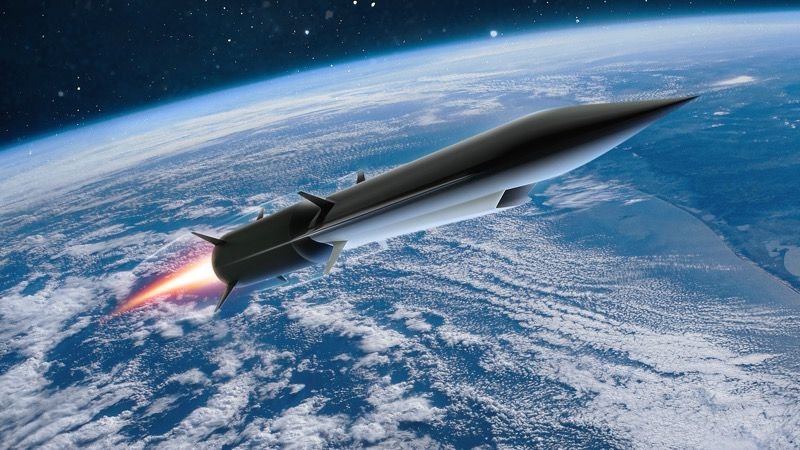
GE Aerospace has won a US Defense Innovation Unit contract to advance a liquid-fueled hypersonic test bed, taking the project into full integration and initial qualification testing.
The award falls under the Defense Innovation Unit’s (DIU) Hypersonic and High-Cadence Airborne Testing Capabilities (HyCAT) program, launched in 2023 to develop low-cost, high-cadence airborne platforms for testing hypersonic technologies. In this phase, GE Aerospace will design and develop a combined booster and cruiser that together form an all-up-round (AUR) test bed.
Bringing the booster and cruiser together as a single all-up-round lets the complete system be flight-tested, rather than validating components in isolation.
The cruiser is powered by an air-breathing, dual-mode ramjet designed for flight at around Mach 5, and the wider effort – reported by Aviation Week as being called the Derecho project – is targeted for a first flight test in 2028. It would be GE Aerospace’s first in-flight demonstration of the ramjet technology.
Steve “Doogie” Russell, vice president and general manager of Edison Works at GE Aerospace said, “Acceleration in this type of hypersonic testing are critical to advancing next-generation capabilities at speed and scale. This work with DIU builds on years of investment and progress, and we are proud to help deliver a flexible, responsive test solution to support national defense priorities.”
The program has moved through several stages since 2023, from concept development to subsystem refinement in 2024 and a preliminary design review of the all-up-round in 2025. The 2026 phase covers full integration of the AUR and the first qualification and component-level testing of key subsystems.
HyCAT is intended to give the hypersonic community faster, cheaper flight-test options, and DIU has placed contracts with several companies, including Hermeus and GE Aerospace subsidiary Innoveering. Australia’s Hypersonix is also supplying a test vehicle under the program.
The award reflects a wider effort to expand US hypersonic flight-test capacity, which has struggled to keep pace with demand for flight data.
Air-breathing hypersonic vehicles are among the hardest systems to test, requiring sustained flight at extreme speed and temperature. GE Aerospace has been advancing its ramjet and rotating-detonation work through ground testing, and the HyCAT contract moves that toward a flight demonstration.
