


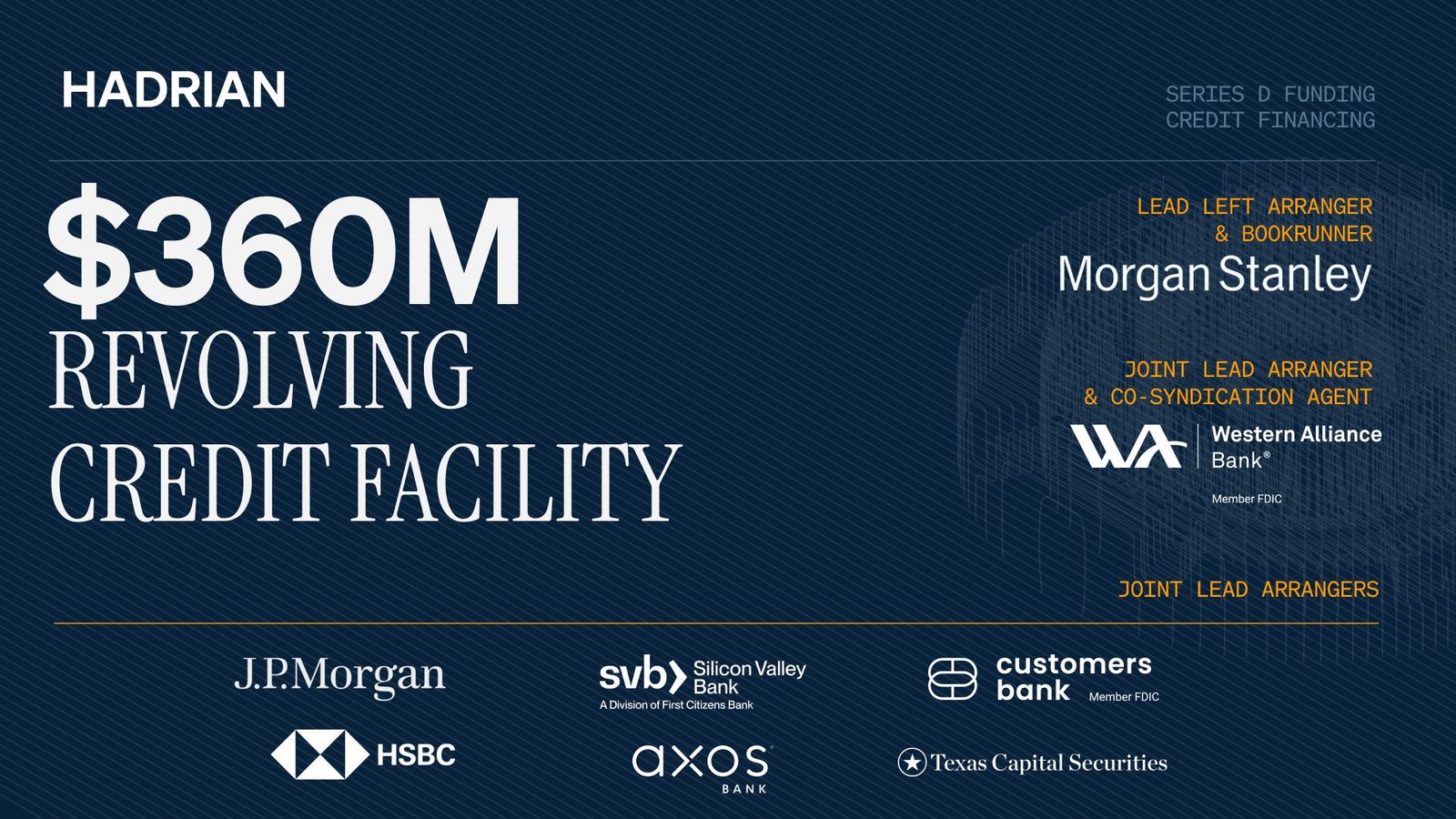
Automated manufacturer Hadrian has raised $1.37 billion in Series D equity financing at a $7.87 billion valuation, roughly five times where the company stood a year ago. The round is aimed at expanding Hadrian’s factory network and pushing the company beyond precision parts toward delivering complete mission-critical systems for munitions, shipbuilding, and autonomous systems programs.
From Precision Parts to Full Systems
The Series D was co-led by WCM Investment Management, Washington Harbour Partners, Valor Equity Partners, 137 Ventures, and Baillie Gifford, with JPMorganChase’s Strategic Investment Group joining as anchor co-lead through its Security and Resiliency Initiative.
Other participants included 1789 Capital, Morgan Stanley Wealth Management, funds managed by Apollo, accounts advised by T. Rowe Price Associates, CapitalG, Andreessen Horowitz, Founders Fund, Lux Capital, Altimeter, and Construct Capital, alongside existing investors.
Founder and CEO Chris Power framed the raise around industrial urgency rather than product roadmap detail. “Production is now the frontline of deterrence,” said Chris Power, founder and CEO of Hadrian. “America’s ability to lead will depend on whether we can build, train, and scale faster. This financing allows Hadrian to accelerate building the Factories of the Future, expand into new mission-critical production capabilities, and invest in the technicians and engineers who will rebuild America’s industrial base.”
Hadrian operates under a “Factories-as-a-Service” model, pairing its proprietary Opus software platform with robotics and skilled technicians inside highly automated facilities. The company says the new capital will fund additional factories, expanded R&D, and new production lines, with the stated goal of shipping full mission-critical systems rather than individual components.
Rapid Footprint Growth Since Series C
A year of momentum has followed Hadrian’s Series C funding round. New sites went live in Mesa, Arizona and Muscle Shoals, Alabama, pushing Hadrian’s combined plant space to nearly 3 million square feet spread across four locations, with each addition chosen for its strategic role in rebuilding domestic industrial capacity.
Looking ahead, the company intends to break ground on further sites while branching into fresh product categories, munitions and autonomous systems among them, as it works to become the manufacturing backbone the nation’s highest-priority defense programs depend on.
This expansion is reshaping how American factories are staffed, too. Rather than automation replacing workers, Hadrian is recruiting and developing operators, engineers, and technical staff to run facilities where robotics, software, and human skill operate side by side. The company is pairing that hiring push with an ownership stake for technicians, so the workforce actually assembling this manufacturing surge shares directly in what it produces.
Additive Manufacturing Now Built Into the Factory Stack
The Series D follows a February 2026 move that folded 3D printing directly into Hadrian’s production model: the launch of Hadrian Additive, a division dedicated to production-ready, scalable additive manufacturing for U.S. defense customers and allied partners. Led by Vice President of Additive Manufacturing Matthew Parker, the division was designed as a production system from day one, integrated with Hadrian’s factory stack and built to scale as demand grows. Power said the goal was additive manufacturing that works in real production, not just in prototypes, engineered for qualification, throughput, and speed.
That additive capability is already being extended to outside partners. In late July 2026, spacecraft developer Fortastra signed a memorandum of understanding with Hadrian to apply the company’s precision machining and additive manufacturing capabilities to Fortastra’s satellite programs. The agreement covers a broad range of processes for joint evaluation, metal and polymer 3D printing, directed energy deposition, and binder jetting on the additive side, alongside precision CNC machining, EDM, and laser cutting, plus emerging methods such as cold spray, friction stir welding, and composite layup. Hadrian will also participate in Fortastra’s design reviews and engineering milestones, while Fortastra contributes spaceflight qualification expertise, including MIL-STD standards knowledge, to help push Hadrian’s processes toward space-grade reliability.

Part of a Broader Push Toward Domestic, Automated Defense Manufacturing
Hadrian’s strategy is to close the design-to-production gap by running software, robotics, and trained technicians inside its own factories, rather than relying on the fragmented traditional supplier base. Folding in Hadrian Additive, and now extending it to Fortastra, shows 3D printing being treated as production infrastructure, not a prototyping tool, the same thinking behind its push into munitions, shipbuilding, and autonomous systems.
Other parts of the U.S. defense-industrial base are converging on the same model. The U.S. Army stood up a 50-printer facility to speed battlefield manufacturing, treating distributed, on-demand production as defense infrastructure rather than a research exercise. At the federal research level, ORNL and the Applied Research Corporation launched an “AI Foundry” that runs simulation, production, and qualification in parallel, attacking the same qualification bottleneck Hadrian Additive was built to solve, backed by a DoD FY2026 budget that raised additive manufacturing funding 83% year over year.
Hadrian’s Series D is capital following a strategy already underway across U.S. defense manufacturing, not creating it. The company is scaling into a production model the rest of the domestic industrial base is racing to build too.
3D Printing Industry is inviting speakers for its 2026 Additive Manufacturing Applications (AMA) series, covering Energy, Healthcare, Automotive and Mobility, Aerospace, Space and Defense, and Software. Each online event focuses on real production deployments, qualification, and supply chain integration. Practitioners interested in contributing can complete the call for speakers form here.
To stay up to date with the latest 3D printing news, don’t forget to subscribe to the 3D Printing Industry newsletter or follow us on LinkedIn.
Explore the full Future of 3D Printing and Executive Survey series from 3D Printing Industry, featuring perspectives from CEOs, engineers, and industry leaders on the industrialization of additive manufacturing, 3D printing industry trends 2026, qualification, supply chains, and additive manufacturing industry analysis.
Featured image shows Hadrian Raises $1.37B Series D. Image via Hadrian.
