



The Airbus A350 is the world’s second-best-selling modern widebody aircraft after the rival Boeing 787 Dreamliner and is one of the main workhorses of ultra-long-range routes. One of the A350’s advantages over the Dreamliner is its longer range, although all three 787s have the range to service the vast majority of routes. After the cancellation of the A380, the A350 remains Airbus’ flagship airliner.
So far, Airbus has only developed two variants (the A350-900 and A350-1000), plus the freighter sub-variant. However, Airbus has considered or is considering a total of four variants: the canceled A350-800 and the extra-stretched A350-2000, which is currently under study. Here is what to know about how much longer the A350-1000 is compared with the A350-900.
The Airbus A350 Family
Like most modern commercial airliners, the Airbus A350 comes in two variants, although Airbus is studying the possibility of developing a third. The A350 is a mid-sized to large widebody aircraft sized between the smaller A330neo and Boeing 787 Dreamliner and the larger Boeing 777. It was developed in response to the Boeing 787 and inadvertently contributed to the demise of the A380 Superjumbo.
By having two variants, Airbus is able to exploit different segments of the market without the enormous costs of developing cleansheet specialized aircraft. Aircraft variants need to retain the same flight envelopes and share the same wings. One drawback is that wings are typically optimized for a particular variant, and while they may be good enough for other variants, they are not ideal. For example, the Dreamliner’s wing is optimized for the 787-9, while the Airbus A380-800’s large wing was optimized for the stretched A380-900 variant that never came.
The smaller A350-900 variant tends to compete with the Boeing 787-9/-10, while the stretched A350-1000 variant was built to compete with the Boeing 777-300ER. This forced Boeing to upgrade its Triple Seven into the Boeing 777X, with the 777-9 variant designed to compete with the Airbus A350-1000. The emergence of the 777-9 is prompting Airbus to explore stretching the A350 into the so-called A350-2000 to better compete with the 777X.

Airbus A350-900 Vs A350-1000: Features Compared
Comparing and contrasting the modern widebody variants.
How Much Longer Is The A350-1000

The standard A350-900 measures 219.2 feet (66.8 meters), while the stretched version adds 23 feet (seven meters) and measures 242.1 feet (73.79 meters). The extended fuselage is the main difference between the aircraft, although the A350-1000 also comes with some modifications to its landing gear and maximum take-off weight. Both aircraft have the same wingspan of 212.4 feet (64.75 meters), and their height only differs by a bit over an inch (three centimeters).
Both variants are exclusively powered by the Rolls-Royce Trent XWB turbofan a bespoke engine developed specifically for the A350. But here is a notable difference: the two variants are powered by different sub-XWB variants with different thrust ratings. The -900 has the standard XWB-84 engine with 84,000 lbf, while the -1000 has the higher thrust XWB-97 (97,000 lbf) variant.
A350 family (per Airbus) | A350-800 (canceled) | A350-900 | A350-1000 | A350-2000 (proposed) |
|---|---|---|---|---|
Length | 198.3 feet (60.45 meters | 219.2 feet (66.8 meters) | 242.1 feet (73.79 meters) | 255+ feet (78+ meters) |
Engine | RR Trent XWB | RR Trent XWB | RR Trent XWB | RR Trent XWB/UltraFan derivative |
Typical seating | Approx. 279 | Approx. 325 | Approx. 369 | 400+ |
It is uncommon for modern commercial jets to have different certified thrust engine variants for different aircraft in a family. For example, both the 777-9’s and 777-8’s GE9X engines will be certified for 110,000 lbf. Should Airbus develop an extra-stretched A350-2000 variant, it is unclear if Rolls-Royce would produce a higher thrust engine subvariant.
The A350-900 Market Niche

The 440-maximum seat capacity A350-900 is the primary variant of the A350, having attracted 1,111 of the A350’s 1,579 orders. The remaining orders are split between the A350-1000 and the A350F, which is based on the A350-1000. The -900 was designed to replace the aging Airbus A340-500 quadjet and compete with the 777-200LR and the 787-10, although it also competes with the 787-9, particularly on range.
Catch what other flight trackers miss
Emergency squawks, holds, NOTAMs — live signals, no signup.
Open tracker
Catch what other flight trackers miss
Emergency squawks, holds, NOTAMs — live signals, no signup.
Open tracker
Airbus claims it offers a 25% improvement in fuel consumption compared with the aircraft it replaces. The A350-900 also comes with an impressive advertised range of 8,500 nautical miles. This makes it one of the most fuel-efficient and longest-range widebody aircraft on the market, capable of serving most of the world’s longest ultra-long haul routes. Singapore Airlines’ A350-900ULR sub-variant has an advertised range of 9,700 nautical miles, the longest commercial airliner in the world.
The range enables the A350-900 to serve longer routes than the extra-stretched Boeing 787-10, which has an advertised range of 6,330 nautical miles. The Boeing 787-9 competes better on range at 7,565 nautical miles. The Boeing 787-9 and Airbus A350-900 are the two most popular modern widebody airliners on the market and have become the backbone of global ultra-long-haul efficient air travel.
The Airbus A350-1000 Market Niche

The stretched 480-maximum seat capacity A350-1000 occupies a different market niche compared with the A350-900. It was developed to replace the A340-600 and compete with the Boeing 777-300ER and upcoming 777-9. Whereas the -900 targets thinner, long-range routes, the -1000 extends the range further to 9,000 nautical miles and boosts the seat capacity. Qantas’ upcoming A350-1000ULRs will increase this to an advertised range of 9,700 nautical miles.
Design choices mean the 787–10 loses range in its stretch, while the -1000 gains range in its stretch. Being a high-capacity, ultra-long-range aircraft also makes its use case more niche, although sales are aided by the A350F freighter variant being a modified -1000. Airbus has accumulated a total of 367 orders for the passenger variant and 101 orders for the freighter, giving the variant a total of 468 orders. The A350-1000 also boasts a much wider customer base than its upcoming 777-9 competitor.
The 777-9 has attracted a total of 521 orders, placing it ahead of the -1000 even before it enters service in 2027 (the A350-1000 entered service in 2018). However, the 777-9 has a similar vulnerability to the A380 in that it is largely dependent on one or two airlines. Boeing lists the 777X program as having a total of 652 orders, of which 270 are from Emirates and 124 from Qatar Airways, meaning two airlines account for 60% of the orders. By contrast, the two top A350 customers (Singapore with 65 and Qatar Airways with 61) account for 8% of A350-900/-1000/F orders.
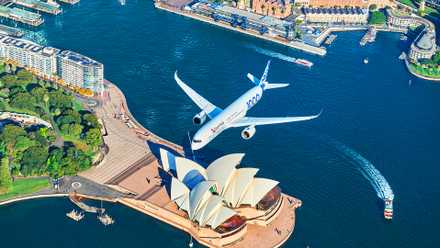
Why The Airbus A350-1000 Is The Only Jet That Can Fly Sydney To London Nonstop
At 10,573 miles (17,015 km), the journey is no mean feat.
The Potential A350-2000 stretch

A future A350-2000 stretch would be to better enable the A350 to compete with the Boeing 777X. Most industry reporting converges on it being around 13 feet (four meters) longer than the -1000, which would make it a similar length to the Boeing 777-9. Notably, the 777-9 is already longer than the 777-300ER it replaces. That said, some more aggressive stretches suggest 20–32 feet (six to ten meters) is physically possible for an A350-2000 stretch.
The Trent XWB engines are seen as the biggest issue. It is already the most powerful Trent engine built, but a stretch may require a significantly upgraded XWB or even a new engine core. It is unclear whether Rolls-Royce could provide a higher thrust XWB variant or if the aircraft would be forced to incur a range penalty. Alternatively, it’s unclear if Rolls-Royce could deliver a variant of its UltraFan demonstrator. Such a stretch could add 40 to 70 more seats.
For now, the stretch is under study, but it has not been officially launched by Airbus. Airbus was stung by the failure of its flagship A380 program, although its A350 has proven successful. It can be argued that the significant demand for the 777X shows that the A380’s failure was less about airlines not wanting large aircraft and more about not wanting quad-engined jets. That said, the market would be fairly niche, and it is unclear whether there is any demand in North America, which has largely rejected large aircraft.
The A350-800 Variant That Never Was

Initially, Airbus had planned to build the short 198.3-foot (60.45-meter) A350-800 variant. The aircraft would have had a typical seating capacity of 276 passengers (typical three-class configuration) and a range of 8,245 nautical miles. The order backlog for the jet reached 182 in 2008, but then fell as airlines started converting their orders to the larger A350-900. Airbus decided to cancel the A350-800 in 2014 and upgrade the A330 to the A330neo instead.
The A330neo was developed with two variants, the A330-800 and the A330-900. The A330-800 turned out to be a dismal failure, while the A330-900 is a considerable success. Airlines that had ordered the A350-800 largely switched their orders to the A330-900 or the A350-900. One notable exception was Hawaiian Airlines. Hawaiian operates a fleet of legacy A330s and ordered the A350-800 in 2008.
When the A350-800 was canceled, Hawaiian was set to switch to the A330-800, but then got cold feet as it saw the variant become unpopular. In aviation procurement, unpopularity and popularity are similarly contagious. Hawaiian wanted to abandon the A330-800 and purchase the A330-900 or A350-900. Then Boeing came and offered its extremely popular 787-9 at very competitive pricing, enticing Hawaiian to jump ship. As fate would have it, Hawaiian was not to operate any of these as it was acquired by Alaska Airlines. Alaska is taking over its incoming 787-9s and leaving Hawaiian with its legacy A330 fleet.
