


Honeywell Aerospace intends to emerge from parent Honeywell with intense focus on operational efficiency, product investment and growth, executives say.
Four Honeywell Aerospace test jets sat on the tarmac of Phoenix Sky Harbor International airport on 2 June, baking under a scorching desert sun.
The line-up included a Boeing 757, Embraer 170, Gulfstream G550 and Dassault Falcon 900. Nearby was Honeywell’s Leonardo AW139.
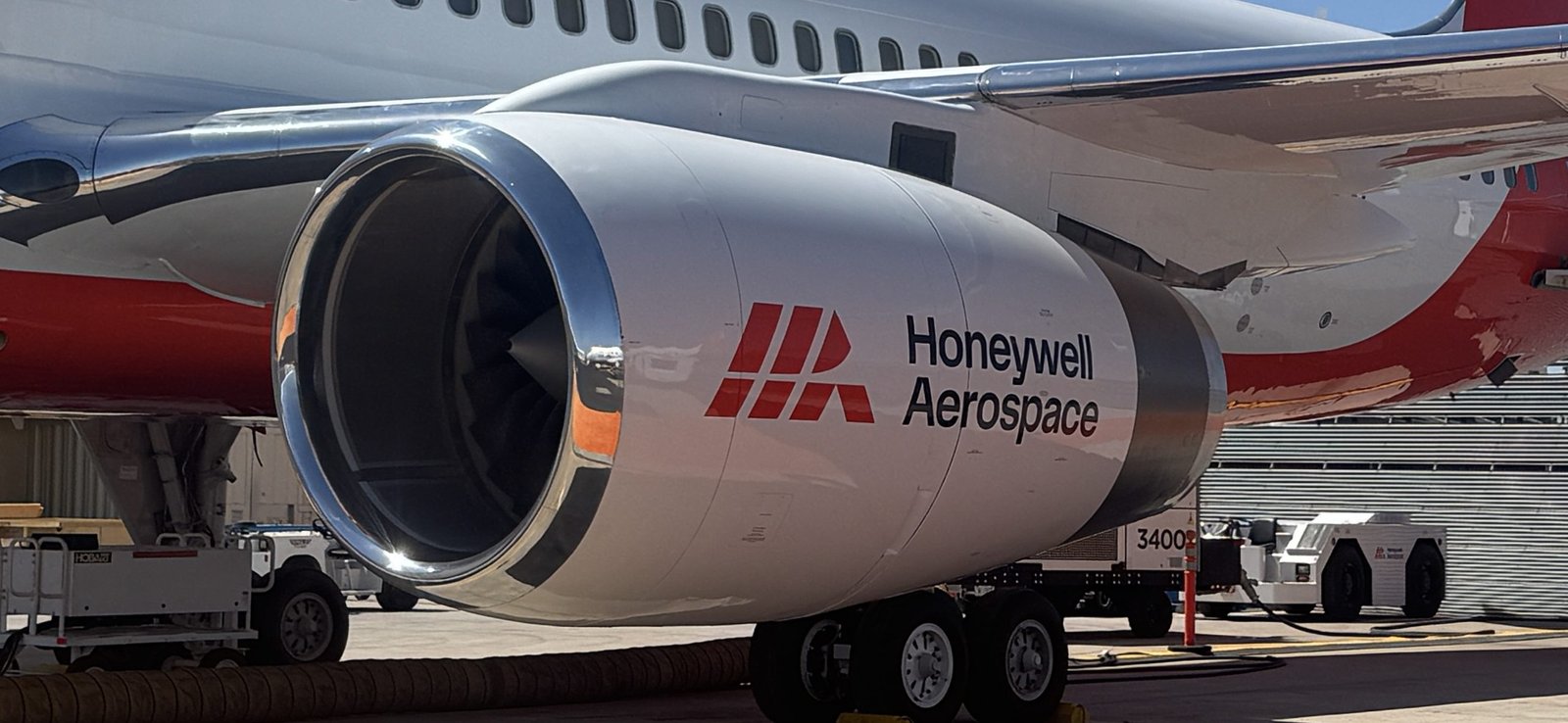
The aircraft all wore fresh paint, adorned with new branding Honeywell Aerospace revealed the day prior. The tarmac temperature topped 100°F (38°C), but the jets’ cabins were cool and refreshing.
Inside, test pilots and engineers discussed the various Honeywell Aerospace systems they evaluate in flight – from HTF7000 turbofans carried on the 757’s fuselage, to a camera system installed through the E170’s ceiling that calculates location based on star angles – useful to military pilots when enemies jam GPS.
Honeywell Aerospace, based in Phoenix, produces a variety of systems for all manner of civilian and military aircraft. Most of its systems, excepting the turbofans, are largely unseen, working in the background to enable modern aviation.
The test aircraft do a fine job of demonstrating the company’s capabilities, which is why Honeywell Aerospace assembled the fleet on 2 June and opened them to reporters and investors.
The company is seeking to distinguish itself and showcase its technologies ahead of 29 June, when parent Honeywell plans to spin Honeywell Aerospace into an independent public firm.
Speaking to investors in nearby Scottsdale on 3 June, executives insisted the split will leave Honeywell Aerospace better positioned to address supplier stress, invest in technology and operations, improve efficiency and respond to market forces.
“We will support our path forward with a fit-for-purpose aerospace operating system built from a strong Honeywell legacy, and it will be executed by an experienced and motivated leadership team,” Honeywell Aerospace chief executive Jim Currier says. “As an independent company, we will be uniquely positioned to innovate faster, move with greater agility and shape the next era of aviation.”
BREAK UPS
Charlotte-based conglomerate Honeywell in 2024 began the process of breaking into three firms. Last year it divested its advanced materials business. It plans on 29 June to complete the process by spinning off Honeywell Aerospace, a 36,000-employee company with $17.4 billion in 2025 sales. The aerospace business will then trade on the Nasdaq exchange under the symbol “HONA”.
Some analysts say Honeywell Aerospace has long suffered under a corporate parent that focused too heavily on investor returns and that made decisions not in subsidiaries’ best interests. They cite under investment and customer service shortcomings.
Currier describes the spin as addressing such issues.
“We see incredible power in having a dedicated industry focus rather than competing for attention against unrelated opportunities and threats,” he says. “Across the entire organisation, we will have 100% alignment in our purpose.”
“The separation removes layers between key stakeholders and leadership,” Currier adds. “We will have the ability to allocate capital for our top strategic priorities.”
Financial and industry analysts are largely optimistic.
“This is a very welcome development,” says AeroDynamic Advisory managing partner Richard Aboulafia.
“Honeywell neglected aerospace far more than any of the [subsidiaries]. This resulted in underinvested products and technologies, and very unhappy customers.”
Honeywell’s split follows a broader industry trend. Numerous US conglomerates fractured in recent years, including those having no aviation holdings. United Technologies sold off businesses and in 2020 merged its aerospace division into Raytheon to form RTX, while General Electric spun non-aviation businesses to become pure-play GE Aerospace in 2024.
Honeywell Aerospace is predicting the move will pay off. It anticipates 6-8% annual sales growth through decade-end and to turn a $6.5 billion adjusted profit by 2030. The business earned a $4.3 billion adjusted profit last year.

Upon the split, Honeywell Aerospace will emerge with three divisions: Engine & Power Systems, Control Systems and Electronic Solutions.
The Engine division, with $5.4 billion in 2025 revenue, produces a variety of powerplants. Its HTF7000 turbofans power business jets including Bombardier Challenger 300 and 350s, Cessna Citation Longitudes, Gulfstream G280s and G300s, and Embraer Praetor 500s and 600s. Honeywell expects the HTF7000 fleet will increase an average 9% annually between 2020 and 2030.
The Engine business also makes F124 and F125s turbofans for jet trainers, turbines for uncrewed air vehicles, T55 and CTS800 turboshafts for helicopters, and auxiliary power units (APUs) for aircraft including large commercial jets. The company last week added another APU assembly line in Phoenix to help meet demand as Airbus and Boeing accelerate aircraft production.
The Control business, with $5.2 billion in 2025 revenue, makes environmental, motion control, anti-ice, lighting, braking, cabin pressure and other systems. And the $6.8 billion Electronic Solutions division produces avionics, air data systems, radios, navigation equipment, electromagnetic defence products and space components.
For years, parent Honeywell’s “Accelerate” operating model guided the strategies of Honeywell Aerospace and the other subsidiaries.
On 3 June, Currier described that framework as being “about expanding margins, at the end of the day”.
He also revealed the standalone company’s new operating model. Called the “Honeywell Aerospace Operating System”, it prioritises planning, operational performance, efficiency, productivity and growth, says Currier. “We are talking about a back-to-basics approach.”
Subscribe to gain access to all news
Already have a subscription? Log in.
Choose your subscription
Considering a corporate subscription? Contact us to find out more.
