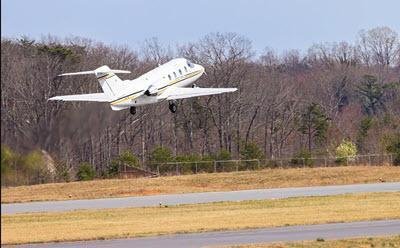
NBAA Report Says Bird Strikes Accounted For The Most Common Event Type In Its Safety Data Analysis
For decades, operators have relied on vigilance, wildlife management and pilot reports to reduce the risk of aircraft bird strikes and now experts say artificial intelligence could add a new layer of operational awareness for business aviation airports and flight operations, the National Business Aviation Association (NBAA) reports.
Bird strikes are among the most unpredictable hazards, particularly at the diverse mix of U.S. airports that serve helicopters, turboprops and business aircraft. A newly released NBAA safety data analysis showed that bird strikes accounted for 18% of 66 reported incidents and accidents from April to June of this year – the most common event type reported in the study, overall.
While wildlife management programs have evolved over decades, advances in artificial intelligence are opening new possibilities for detecting and predicting bird activity before it affects flight operations.
For Kevin Singh, an instructor pilot for Bombardier’s Global Vision program and founder and president of Icarus Jet, the risk is very real, even if it rarely dominates conversations on the flight deck.
Bird strikes, he says, are generally treated as low-probability events, but they demand constant awareness, particularly during departure and arrival.
“There has not been much development on reporting birds in the vicinity other than NOTAMs,” Singh said, “but there have been several developments using technology to deter the birds from the airport environments.”
He adds that AI can sort through large data sets, and that is a great help, but wonders if birds can be stopped from crossing the path of an approaching aircraft.
“Unless there is a way to see a flock of birds displayed in real time on the flight deck, I am not sure how AI will come into play here,” Singh said.
That question is precisely what developers of next-generation wildlife detection systems are trying to answer.
Cristobal Esteban, founder of Aerial Guard, an AI-powered real-time wildlife monitoring platform developed by Cambrian Intelligence, said the system’s artificial intelligence is not intended to replace existing wildlife management practices, but to provide airports and operators with earlier, more actionable information.
“I believe smaller airports may benefit even more from this technology because they often have fewer people and resources dedicated to wildlife management,” Esteban said. “AI can provide continuous monitoring and help airport teams focus their time and attention on the moments and areas where the risk is greatest.”
For technology to make a meaningful contribution to bird strike prevention, it must address the operational realities described by pilots.
Singh notes that birds have migration paths which AI can predict and introduce much more caution in the flight deck, yet the aircraft not meeting the flock of birds in its path is still a see-and-avoid procedure.
“The white swirls painted on the cones of the jet engine were also designed as a bird deterrent and a visual safety for the ground crew to see that the engines were running. Flashing landing lights are also a bird deterrent,” he said.
The challenge, therefore, is not replacing these established practices but enhancing them.
Photo courtesy NBAA.
FMI: www.nbaa.org