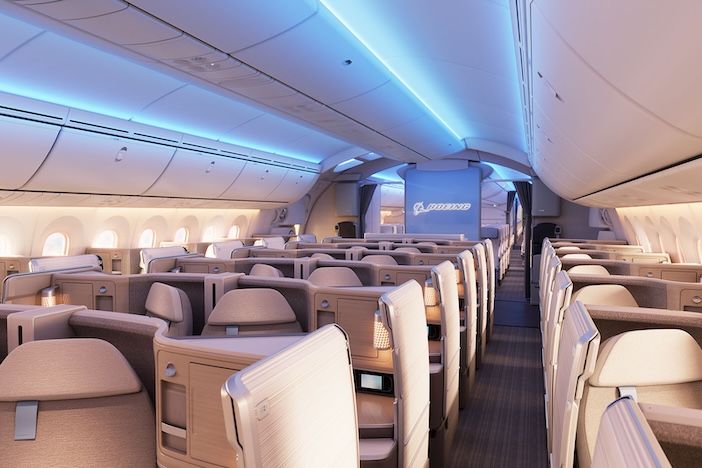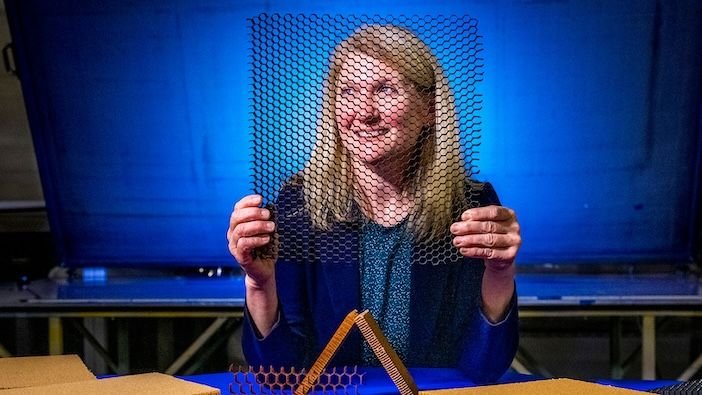
Materials engineers at Boeing regard their recent approval to use a version of a honeycomb core made from aramid paper in their aircraft interiors as more than a materials win – they also see it as a victory for human ingenuity. This newly qualified flame-resistant honeycomb core can be applied in several areas of the cabin, such as the overhead stowage bins, ceilings and sidewalls, but curiously the key ‘eureka’ moment didn’t happen in the lab: it was while skydiving.
For Eileen Kutscha, a materials and process engineer in Tukwila, Washington, who helped lead the effort, the project bridged two worlds she cares about deeply: the laboratory and the sky. The latter explains her passion for skydiving.
“This qualification effort spanned the whole spectrum of what I do,” said Kutscha. “From scouting new materials, to screening candidates and writing the specification that others will use for years. It was rewarding technically, but it also meant something personal. I could see the link between the materials I certify and the people who rely on them.”
Innovation in the air
Kutscha has been working to find an alternative material for a honeycomb core since 2020, but the effort to identify the right material goes back to 2015. She has more than 200 paraglider 200 flights under her belt, and Federal Aviation Administration (FAA) P3 certification to fly in challenging conditions.
The strong, lightweight lines that attach to her paraglider’s wing are made from similar aramid fibres to those she applied in Boeing’s newest honeycomb core, giving her a direct, tangible connection between the equipment she trusts in the air and the materials she qualifies in the lab.
Her paragliding experience shaped how she thought about qualifying a material that can be applied across platforms, from airplane interiors, including overhead stowage bins, ceilings and sidewalls.
“Before learning to paraglide, I had no idea what flight felt like,” she said. “Very rarely do materials engineers get to be involved in wing design, where materials are stressed in flight. Being in the air made me realise how important it is that every material we put on an aircraft is high quality and helps ensure safety. Engineers typically aren’t the pilot, but when paragliding, I get to be the pilot. And that changes how I think about the final product.”
Back to basics
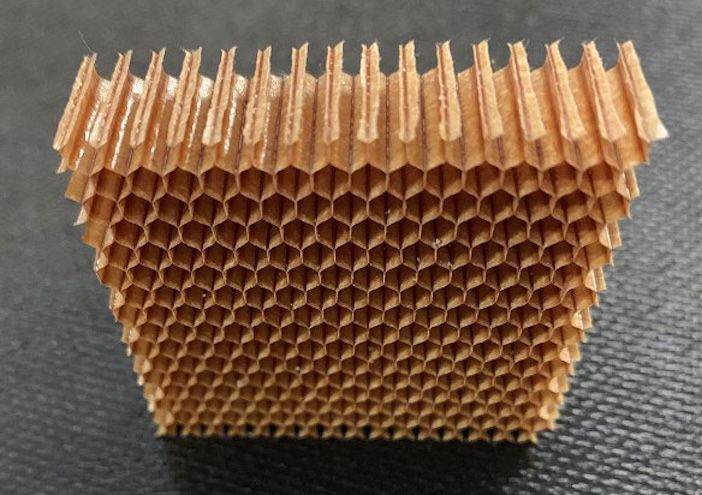
The new aramid paper version of the honeycomb core brings practical advantages. The aramid fibres that make up the core have flame-resistant properties, helping to make them more suitable than many traditional materials for use in interiors applications where safety is critical.
“Honeycomb cores have to meet strict requirements for structural performance and flammability,” explained Kutscha. “We didn’t simply swap materials. We went back to basics, screening the core at its raw form, running mechanical tests like single-cantilever beam evaluations for crack propagation, and using advanced flammability tools such as microscale calorimetry so we could compare candidates side-by-side with existing materials.”
Disciplined decisions
That engineering rigour reflects lessons Kutscha draws from paragliding: Evaluate conditions, make conservative decisions, and know when not to fly.
“Safety is critical in the air,” she said. “Before every flight, I assess cloud level and wind conditions. If something doesn’t feel right at launch, you don’t go. The same mindset applies to materials.
“What’s satisfying is knowing this isn’t just a one-off test,” Kutscha said. “We set a foundation so materials can be ready when new aircraft or new needs arise. It gives engineers and designers options, and that can translate into safer, more efficient manufacturing.”
The newest aramid paper honeycomb cores, which are expected to be used in aircraft interior components like stow bins and ceilings, combine lightweight strength with flame resistance.
Material matters
For Kutscha, the project reinforced that materials aren’t abstract properties on a data sheet. They are the fibres that help keep people safe, whether strung into a paraglide line or formed into a honeycomb core in a cabin panel.
“Once I realised the lines on my wing were made from similar aramid fibres to the ones I test every day, I recognised that these are the materials people are trusting to keep them aloft,” she stated.
Her advice to engineers and hobbyists alike is rooted in the same discipline: Keep learning, stay curious, and respect safety.
“If paragliding were easy, I wouldn’t do it,” she said. “You get better by enjoying the process, not just the destination. Material development takes time, but the payoff is helping to design a stronger, safer product that people can trust.”