


Ukraine’s drone attacks created a problem for Russia’s pro-war commentators: how to reconcile accounts of military progress abroad with visible vulnerability at home. Reporting advances can sustain a sense that Russia retained the initiative. But strikes on warehouses and industrial facilities raised a different question—whether those directing the war could protect the country. Using AI-assisted tools Bohdan Tierokhin, one of the authors of the Aletheia platform (see final paragraph), analyses, how Russia’s media, influencers and government are responding to the challenge.
After Ukraine’s drone attacks inside Russia, pro-war commentators questioned whether the country was protected. The state media responded.
In June 2023, Wagner fighters seized military headquarters in Rostov-on-Don and advanced towards Moscow, shooting down Russian military aircraft along the way. The short-lived mutiny exposed a tension within Russia’s pro-war camp: support for the invasion of Ukraine did not necessarily mean confidence in those commanding it. That tension also ran through the community known as voenkory—frontline reporters, military veterans and Telegram commentators whose channels circulate battlefield footage and interpret the war. Their affiliations vary, and some work for state broadcasters. Previous sympathy for Wagner’s leader, Yevgeny Prigozhin, did not translate into unanimous support for his rebellion. Some condemned it, others remained cautious or silent.
These overlapping worlds of institutional media and pro-war commentary help shape how Russian audiences understand the conflict. Official statements circulate through both, but commentators can also question military decisions and demand stronger action. The mutiny exposed those divisions dramatically. Ukrainian attacks inside Russia offer another way to examine them: when the war reaches home, do these outlets judge the country’s protection by the same standards?
The events of 15–16 August 2026 brought that question into focus. Smoke rose over a Wildberries warehouse south of Moscow after an overnight Ukrainian drone attack. Russia’s Defence Ministry claimed its air defences had destroyed 822 drones—an official interception tally, not an independently verified count of weapons launched. Yet interceptions had not prevented damage. Moscow regional authorities reported strikes in Podolsk and Domodedovo, two cities south of Moscow. Reuters footage showed smoke above Wildberries’ Koledino logistics complex, around 45 kilometres south of the capital. Ukraine had accused the retailer of handling military goods.
Ukraine’s navy subsequently said it had also used Neptune missiles against the Kamensky plant in the Rostov region, which produces solid rocket fuel. Ukrainian military officials reported two workshops destroyed and four damaged. The attacks placed two measures of defensive performance side by side: the weapons Russia reported intercepting and the damage it failed to prevent. Which measure received emphasis could shape whether readers saw an effective defence or inadequate preparation.
To investigate, we used Aletheia to examine Telegram coverage from 16 selected Russian pro-war channels and six institutional media channels over those two days. We compared which stories received attention, how Russia’s defences were assessed, and whether those assessments came from the channels themselves or the officials they quoted. The comparison explores how supporters of the same war can offer different accounts of its consequences—and where reassurance about Russia’s protection gives way to demands that its authorities do more.
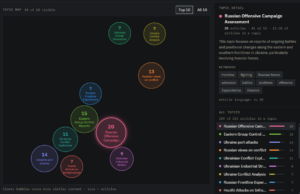
Figure 1 shows the wider setting behind the challenge of reconciling accounts of military progress abroad with visible vulnerability at home
Accounts of Russian offensive operations formed the largest displayed topic cluster. Battlefield developments remained prominent even as Ukrainian drones reached facilities inside Russia. Readers were encountering the attacks within a continuing account of Russia’s military campaign. That context matters because criticism of protection did not necessarily challenge support for the war. It could instead strengthen demands to prosecute it more forcefully. The map helps locate the critical passages within that broader coverage.
Figure one: The 16 pro-war Telegram channels selected for analysis. Source: Aletheia. For the interactive version please visit
The sharper challenge came when commentators moved from describing events to judging responsibility. Rybar, a Russian pro-war military blog and Telegram channel, questioned whether Russia’s preparations matched the growing threat. On 15 August, the channel argued that increasing Ukrainian attack volumes were overloading air defence and allowing more strikes through. The following day, it connected the resulting economic consequences to time wasted organising protection. Rybar was therefore proposing a demanding test of success. Intercepting drones was not enough if repeated attacks continued to damage economically important facilities. Its criticism shifted attention from individual interceptions to whether the defensive system could cope over time. This distinction has political consequences. An interception bulletin presents an immediate achievement: a weapon was detected and destroyed. A discussion of repeated damage invites questions about planning, resources and responsibility. Rybar’s argument brought those questions into pro-war coverage without abandoning the demand for Russian victory.
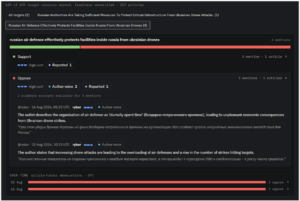
Figure two. Assessments of air-defence effectiveness: three critical mentions. The two displayed author-voice criticisms both come from Rybar. Source: Aletheia. For the interactive version please visit
The figure also prevents an exaggerated reading of dissent. Two critical posts from Rybar do not demonstrate a collective break with the authorities. They identify a specific argument within the material: support for the campaign could coexist with frustration at its management.
Figure 3 reveals how official reassurance circulated alongside that frustration. Alexander Kots’s channel reported an account of Defence Minister Andrei Belousov’s inspection, highlighting an analytical centre, expanding anti-drone capabilities and a unified information system. Such announcements can offer an answer to criticism by showing that problems are receiving attention and improvements are underway. Their possible communication value is clear: they can preserve confidence in the leadership while acknowledging the need to adapt. But describing an initiative does not establish its results. The displayed passage also does not explicitly connect those measures to the protection of domestic infrastructure. Treating it as proof that factories and warehouses were adequately defended would go beyond the evidence. Rybar’s response demanded more than activity. Strengthening air defence was a priority, it argued, but recurring attacks required greater creativity and efforts to weaken the adversary. Boris Rozhin’s discussion of attacks on Black Sea shipping and ports extended the concern to maritime vulnerability. His remarks involved both aerial drones and uncrewed boats, so they illustrate a broader anxiety about protection rather than air-defence performance alone.
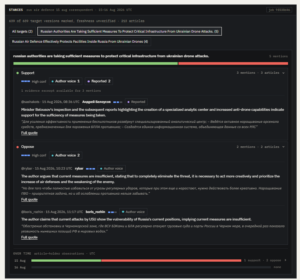
Figure three. Assessments of the authorities’ protective measures, including an official account carried by Kots and criticism from Rybar and Boris Rozhin. Source: Aletheia. Switch targets with the tabs above the card. For the interactive version please visit
Russian authorities could answer criticism by announcing new air-defence equipment, showing ministers inspecting military units and describing improvements underway. Such reports tell the public that the leadership recognises the threat and is taking action. They could also provide evidence of results—for example, whether facilities suffered less damage during subsequent attacks or experienced fewer disruptions. This would address the critics’ central question: are the measures actually making Russia safer? The two approaches can work together, but they make different claims. Announcing equipment shows that resources are being committed; demonstrating reduced damage shows what those resources have achieved. A possible aim of the messaging is to preserve public trust and support for the war by presenting defensive failures as problems the authorities understand and are working to fix.
The most revealing divide is therefore over what counts as an adequate response. Official accounts describe capabilities being developed. Critical commentators ask why vulnerabilities persist. Following both the subject of a post and the person making its claims exposes a tension that simple positive-versus-negative counts would miss: the same pro-war discussion can circulate reassurance while demanding evidence that reassurance is deserved.
For Russia’s major news outlets, the drone assault presented a question of how to report vulnerability without undermining confidence in the state. Smoke rising over a warehouse near Moscow made the consequences visible. Interception bulletins offered another account of the same night: Russian forces detecting threats, destroying drones and continuing to defend the capital.
Coverage from NTV, RIA Novosti, RT, TASS, Vesti and Zvezda shows how these accounts could coexist. Figure 6 places attacks on Russian territory firmly within the news agenda, alongside diplomacy, military operations and everyday news. The assault was being reported. The more revealing question is what readers were encouraged to take from that reporting.
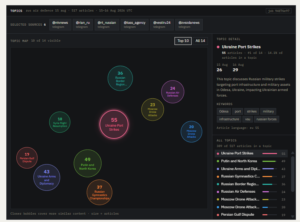
Figure four. Attacks inside Russia feature prominently alongside military, diplomatic and general news. Source: Aletheia For the interactive version please visit
That distinction matters politically. Acknowledging an attack allows an outlet to address an event its audience may already know about. Emphasising the response can turn that acknowledgement into reassurance: danger exists, but the authorities are confronting it. A plausible objective is to preserve confidence in protection even when complete security cannot be promised. Figure 5 shows that attention to attacks inside Russia increased on 16 August. Coverage grouped under border-region attacks tripled, while one Moscow drone-attack cluster rose sharply. The news agenda responded to the assault; the reassuring account developed through that increased coverage.
Vesti’s short updates illustrate the approach. Reports that another eight drones had been shot down approaching Moscow, or that seven had been destroyed, gave readers successive accounts of defensive action. Each announcement offered a concrete achievement. Taken together, such bulletins can make interception the running measure of success, keeping attention on what Russian forces stopped as reports of damage emerged.
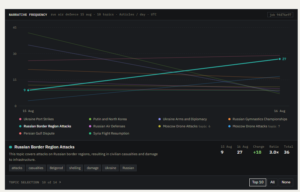
Figure five. Daily topic counts show increases in coverage grouped under border-region attacks and one Moscow drone-attack cluster. Source: Aletheia. For the interactive version please visit
This helps explain why extensive coverage need not translate into scrutiny of preparedness. An outlet can publish frequently about an attack while repeatedly returning to the authorities’ preferred evidence of competence. The number of drones reported destroyed becomes central; whether the facilities under attack remained safe becomes a separate question. Vesti’s coverage made that reassuring interpretation explicit. On 16 August, it described Ka-52 helicopters as successfully destroying drones attempting to attack Moscow. Other passages presented air-defence systems as protecting the region’s skies every day and called the capital’s defensive network “an example for the whole country”—an English translation of the displayed excerpt. The language in Figure 6 turns equipment and organisation into reasons for confidence. Moscow’s defences are presented as something to admire and emulate. This is particularly significant after an attack near the capital: the same event that exposed vulnerability also became an occasion to showcase the state’s protective power.
Across the institutional sample, all 18 identified assessments of air-defence effectiveness were classified as supportive. Four appeared in the outlets’ own voices; 14 relayed other speakers’ claims. That distinction reveals how reassurance was constructed through both official announcements and affirmative journalism.
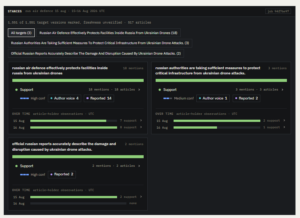
Figure six Air-defence assessments in institutional coverage: 18 supportive mentions, including four attributed to author voice and 14 to reported speakers. Source: Aletheia. For the interactive version please visit
The contrast with Rybar is direct. Rybar treated increasing attack volumes and economic damage as reasons to question preparation. Vesti’s examples directed attention towards successful engagements and the capabilities protecting Moscow. These accounts offered audiences different standards for judging the authorities: the effort and achievements of the defenders, or the consequences of attacks that reached their targets.
Figure 7 adds another element to the account of competence: visible leadership. Zvezda and RIA Novosti reported Defence Minister Andrei Belousov’s inspection of the Vostok grouping, highlighting radar coverage, analytical capabilities and expanding anti-drone measures. Vesti described Pantsir systems and Ka-52 helicopters protecting the capital. An inspection makes the leadership visible, announcements of new capabilities suggest adaptation. Together, they can offer an answer to demands for action: commanders are engaged, resources are being committed and the military is improving. Their communication value lies in presenting the authorities as actively managing the threat. This also changes the terms of accountability. A question about why damage occurred can be answered with an account of what is being done. That may reassure readers that shortcomings are being addressed, while leaving the effectiveness of the response to be judged later.
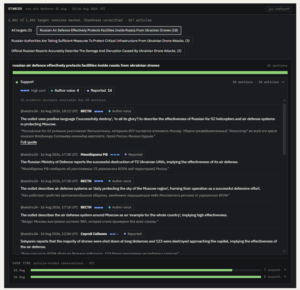
Figure seven. Vesti’s coverage combines official interception claims with its own affirmative descriptions of Moscow’s defences. Source: Aletheia.
Kots carried a similar inspection account in the correspondents’ sample. Official messaging therefore travelled through both groups. The difference emerged in the judgements alongside it: Rybar pressed for stronger preparation, while Vesti presented existing defences as grounds for confidence. For the Russian leadership, coverage of this kind could serve two connected objectives: sustain belief in the military’s competence and prevent anger over domestic damage from becoming distrust of those directing the war. The implied message is that attacks demonstrate the seriousness of the threat, while interceptions and new measures demonstrate the state’s determination to meet it. The political tension remains. A public asked to trust the defenders may still judge protection through damaged workplaces, disrupted services and casualties. Vesti’s reassurance and Rybar’s criticism meet at that point: whether visible defensive effort is enough to sustain confidence when the consequences of vulnerability are also visible.
Two measures of success
This is the story of one particular night within a much wider campaign. Ukraine has launched dozens of attacks against Russian facilities, repeatedly bringing the war to warehouses, refineries and airports far from the front. Each new attack gives Russian media fresh material to amplify the threat, justify further escalation and portray the state’s response as necessary and effective.
The coverage examined here points to different priorities within a shared commitment to Russia’s war. State media turned interception tallies, military hardware and ministerial visits into a reassuring picture of a state in control. Critical military bloggers focused on whether those efforts were enough. Their dissatisfaction supported demands for better preparation and a stronger campaign, rather than a withdrawal of support for the war. Their objectives therefore overlap without being identical. State media’s reassuring account can help maintain confidence in the authorities. Critical bloggers seek to press those authorities to improve performance, while reinforcing their own standing as commentators willing to discuss uncomfortable developments. Both can sustain commitment to the war, even as they disagree over whether its leadership deserves trust.
Following them across successive attacks could reveal whether official reassurance continues to answer the concerns voiced within the pro-war camp—or whether repeated damage produces sharper demands for accountability. The value of studying this coverage lies in identifying where support for the war remains firm while confidence in its management comes under pressure. That is a more revealing measure of political tension than the volume of criticism alone.
The Aletheia platform
The Aletheia platform uses AI to collect, search and analyse large volumes of content from Telegram, social media platforms and news websites. It enables semantic search across text, images and video in 33 languages, regardless of the language used for the original content or the search query. For example, a search for “burning building” can identify relevant written reports, photographs and specific sections of videos across multiple languages. The AI can also group content into emerging topics and narratives, track how their prominence changes over time, identify relevant entities, events, emotions and positions, and produce English-language summaries of multilingual material.
| About the data Samples Telegram posts published 15–16 August 2026 (UTC). Pro-war correspondents: 16 channels, 213 articles. Institutional media: six channels (@ntvnews, @rian_ru, @rt_russian, @tass_agency, @vestiru24 and @zvezdanews), 517 articles. Topics Aletheia groups articles by content similarity and labels each group automatically. Not every article joins a topic: 159 of 213 correspondent articles and 389 of 517 institutional articles did. Four correspondent articles could not be processed for topic modelling. On the maps, distance reflects similarity; the axes have no units. Stances Every article was assessed against three statements. A mention is one position, support or opposition, held either by the channel itself (author voice) or by someone it reports (reported). No correspondent article took a position on the third statement, “official Russian reports accurately describe the damage and disruption caused by Ukrainian drone attacks”, so it is not shown for that sample. Evidence The platform returns evidence excerpts separately from mention counts, and not every mention has one: this export has 5 excerpts for 9 correspondent mentions and 20 for 23 institutional mentions. Each widget says when fewer excerpts than mentions are available. Quotes are in the original Russian; the English summaries are machine-generated. Over time Daily stance counts are article–holder observations, a different unit from mentions, so the two need not match. Export Figures are drawn from Aletheia results exported on 28 Sep 2026. Job IDs are shown in each widget’s header. Analysis by Aletheia: agentic open-source intelligence
|
Main image: AI generated image sourced from Shutterstock
