


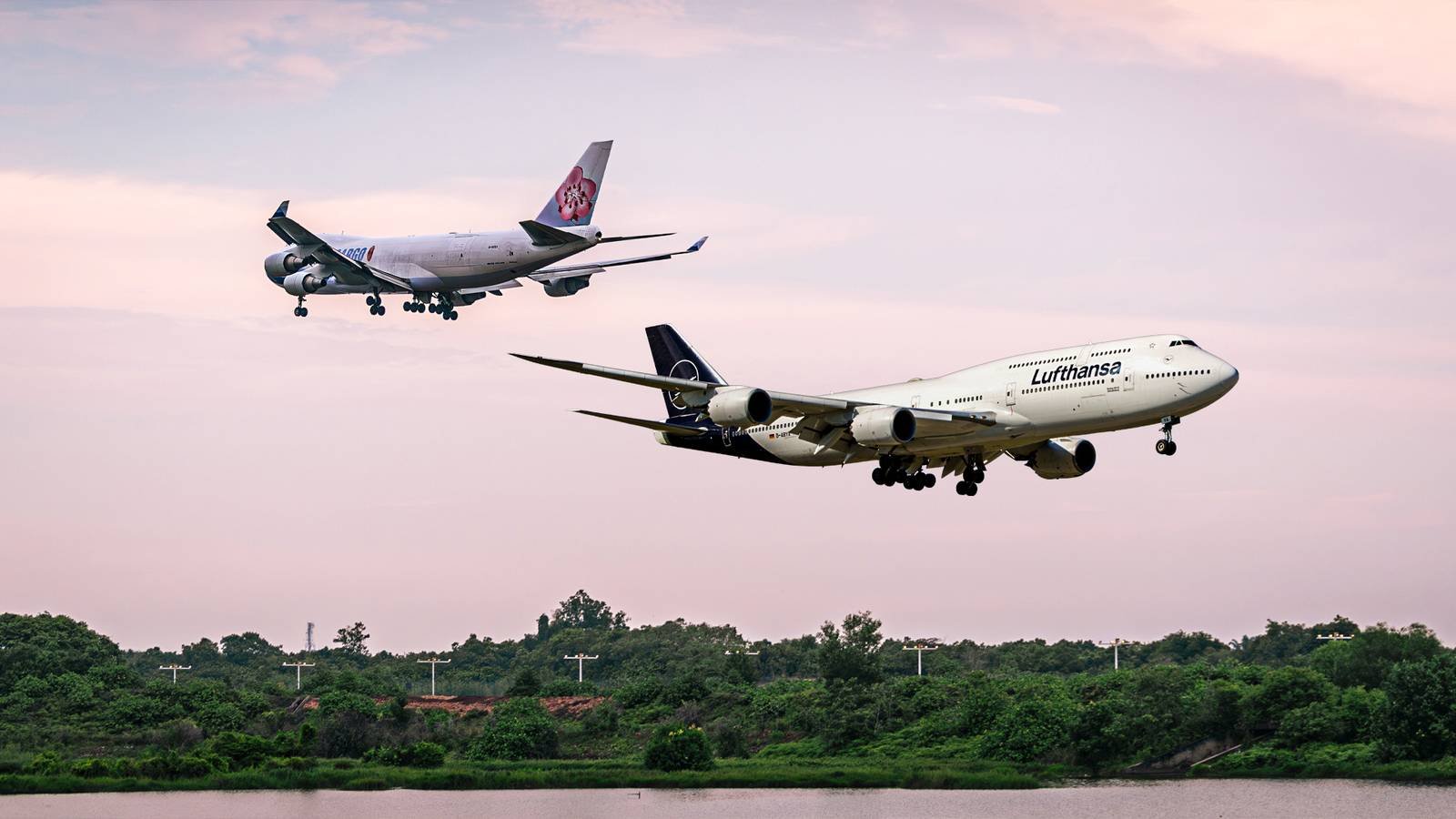
For more than half a century, the Boeing 747 has served as the flagship of the global aviation industry, shaping long-haul travel as we know it today. Since entering commercial service with Pan Am in 1970, the four-engined, partially double-decked jet has become one of the most recognizable aircraft in aviation history. Over the years, Boeing continued to develop the type, introducing multiple different variants, each with their own unique features and characteristics.
The last two generations of the jet were the 747-400 and 747-8, which entered passenger service in 1989 and 2012, respectively. Although both share the 747’s distinctive hump and overall design, the 747-8 was substantially different from its predecessor, incorporating new engines, wings, and other technical improvements. Interestingly, however, the older 747-400 proved considerably more commercially successful than its successor.
The Boeing 747-400 Became The Most Successful Jumbo Variant
After introducing the original 747-100 in 1970,  Boeing continued to develop the aircraft to meet airlines’ changing requirements. This resulted in several variants, including the 747-200, the shortened 747SP, and the 747-300, which introduced the stretched upper deck that would become standard on the 747-400 passenger version.
However, the introduction of the 747-400 marked one of the most important developments in the aircraft’s history. The aircraft made its first flight on April 29, 1988, before entering commercial service with Northwest Airlines in February 1989. Compared to earlier variants, the 747-400 featured a revised wing design with six-foot-tall winglets, more efficient engines, and a redesigned two-pilot glass cockpit, eliminating the need for a flight engineer. The aircraft was also available with engines from three different manufacturers: General Electric, Pratt & Whitney, and Rolls-Royce.
Boeing eventually delivered 694 aircraft from the 747-400 family, including passenger, freighter, and combi variants, making it the best-selling 747 generation. Boeing delivered the final passenger aircraft to China Airlines in April 2005, while production of the freighter variants continued until 2009. By then, Boeing had already launched the aircraft’s successor, the 747-8.
The Boeing 747-8 Is Almost 20 Feet Longer Than The 747-400

Although both aircraft look very similar, the most noticeable difference between the 747-400 and 747-8 is their size. The 747-400 measures 231 feet, 10 inches (70.66 meters) in length, while the 747-8 is considerably longer at 250 feet, 2 inches (76.3 meters). Boeing achieved this by stretching the fuselage ahead of and behind the wings, creating additional space for passengers and cargo. The passenger version, officially known as the 747-8 Intercontinental, also features a longer upper deck than its predecessor.
The 747-8 also has a larger wingspan: 224 feet, 5 inches (68.4 meters), compared to 211 feet, 5 inches (64.4 meters) on the 747-400. However, the most recognizable difference is the aircraft’s wingtips. While the 747-400 features traditional upright winglets, the 747-8 uses raked wingtips similar to the 787 Dreamliner that extend backward from the wing, improving aerodynamic efficiency.
Specifications of the Boeing 747-400 Vs. 747-8 | ||
|---|---|---|
Specification | Boeing 747-400 | Boeing 747-8 Intercontinental |
Entry into passenger service | 1989 | 2012 |
Length | 231 feet, 10 inches (70.7 meters) | 250 feet, 2 inches (76.3 meters) |
Wingspan | 211 feet, 5 inches (64.4 meters) | 224 feet, 5 inches (68.4 meters) |
Typical three-class capacity | 416 passengers | 467 passengers |
Range | 7,285 nautical miles (13,490 km) | 7,730 nautical miles (14,310 km) |
Engines | GE CF6, Pratt & Whitney PW4000, Rolls-Royce RB211 | GE GEnx-2B |
Wingtip design | Upright winglets | Raked wingtips |
Total deliveries (all variants) | 694 | 155 |
According to Boeing’s original announcement, the 747-8 Intercontinental was designed to accommodate 467 passengers in a typical three-class configuration, compared to 416 passengers on the 747-400. However, these figures depend heavily on the configuration selected by each airline. For example,  Lufthansa currently operates its 747-8s with 364 seats, including eight First Class and 80 Business Class seats. Its older 747-400s have a total capacity of 371 passengers.
New Engines & Wings Made The 747-8 More Efficient

Besides the increased size, the 747-8 incorporated substantial technical improvements over the 747-400. One of the most important changes was the introduction of four General Electric GEnx-2B engines, developed using technology from the 787 Dreamliner program. Unlike the 747-400, which was available with engines from three manufacturers, Boeing offered the newer generation exclusively with General Electric engines.
Furthermore, Boeing redesigned the aircraft’s wings, incorporating new airfoils, improved high-lift devices, and an increased wingspan. The 747-8 also introduced fly-by-wire technology for certain flight controls, including the spoilers and outboard ailerons. According to Boeing, these improvements allowed the 747-8 Intercontinental to achieve approximately 16% lower fuel consumption per seat than the 747-400, while generating a 30% smaller noise footprint. The manufacturer also claimed that the newer aircraft offered almost identical operating costs per flight, resulting in 13% lower costs per seat-mile.
Actual fuel consumption per passenger depends, of course, on the cabin configuration, passenger load factor, flight distance, and operating conditions. Moreover, while the 747-8 was considerably more efficient than its predecessor, it still required four engines, making it more expensive to maintain than newer twinjets with similar passenger capacities.
Furthermore, the 747-8’s larger capacity also disadvantaged routes with insufficient passenger demand. While the newer aircraft offered lower costs per available seat-mile, airlines still needed to fill enough seats at profitable fares to benefit from these improvements. Smaller twinjets offered greater flexibility, allowing carriers to adjust capacity to individual markets without operating a four-engined airplane.
The Cockpit Remained Familiar Despite The Technical Improvements

While the 747-8 incorporated several technologies developed for the 787 Dreamliner, Boeing deliberately retained much of the 747-400’s cockpit design. This allowed airlines already operating the older aircraft to introduce the 747-8 without requiring lengthy pilot retraining. The 747-400 had already introduced a glass cockpit, replacing many analog instruments on earlier variants with electronic flight displays.
The newer 747-8 retained the same basic flight deck layout, while incorporating updated liquid-crystal displays and several improvements to its avionics. Additional features included a new flight management computer, electronic checklists, improved navigation systems, and an airport moving map. Both jets also share the same pilot type rating, allowing pilots qualified on the 747-400 to transition to the 747-8 through an approved difference training program.
NEAR YOU NOW
What’s that plane overhead?
See every flight within 20 miles of you right now and where they’re
all going.
From an airline perspective, this was an important advantage, particularly for carriers operating both versions simultaneously. Lufthansa, for example, has operated the two types alongside each other for more than a decade. The passenger cabin, however, received a more substantial redesign, incorporating features from the 787 Dreamliner, including larger overhead luggage bins, revised cabin architecture, and improved lighting.
Why The 747-400 Was Far More Successful Than Its Successor

Despite all the improvements introduced with the 747-8, the aircraft never came close to its predecessor’s commercial success. While Boeing delivered 694 aircraft from the 747-400 family, only 155 examples of the 747-8 were produced, including just 48 passenger aircraft. This was partly because the newer generation entered a market where demand for quad-jet passenger jets was already declining.
When the 747-400 entered service in 1989, airlines had relatively few alternatives capable of transporting large numbers of passengers over intercontinental distances. However, by the time the 747-8 entered service in 2012, the 777-300ER had already established itself as a popular alternative. Furthermore, the introduction of the Boeing 787 and Airbus A350 allowed airlines to operate long-haul services with smaller aircraft and lower operating costs. Lufthansa became the launch customer for the passenger 747-8, introducing the plane in June 2012, while Korean Air and Air China also ordered the type.
The 5 Largest Boeing 747 Operators In 2026 | |||
|---|---|---|---|
Airline | Boeing 747-400 | Boeing 747-8 | Total |
Atlas Air | 47 | 16 | 63 |
UPS Airlines | 12 | 29 | 41 |
Cargolux Group | 16 | 14 | 30 |
Lufthansa | 8 | 17 | 25 |
Kalitta Air | 20 | 20 | |
Planespotters.net
Although Boeing ended production of the 747 in late 2022, both generations will continue to operate commercially in 2026. Lufthansa currently operates 18 747-8s and eight 747-400s, making it the largest remaining passenger operator of the aircraft. Korean Air and Air China also continue to operate the 747-8, while Rossiya Airlines remains an operator of the older 747-400. However, with airlines increasingly replacing their remaining 747s with newer twinjets, the number of passenger aircraft in service continues to decline.
Interestingly, the freighter version of the 747-8 proved considerably more successful than its passenger counterpart, accounting for 107 of the 155 aircraft produced. Cargo carriers such as  UPS Airlines, Cargolux, and Atlas Air continue to operate the newer generation alongside older 747-400 freighters. In addition to its increased payload capacity, the 747-8F retains the 747’s distinctive nose-loading capability, allowing airlines to transport oversized cargo that cannot be loaded through conventional side doors. The last 747 ever produced was a 747-8F delivered to Atlas Air on January 31, 2023, ending more than five decades of production.
