


Before Sother Teague got cocktail famous—before he opened Amor y Amargo in New York City, and became known as one of the leading global experts on all things bitter liqueurs—he was a chef.
While this isn’t all that uncommon, it is a load-bearing fact. Many a cook has looked, through heat-rippled air, out the swinging kitchen door at the (comparatively) glamorous and (again, comparatively) lucrative world of the bar, and reasoned that combining ingredients according to a recipe is something they already know how to do. The ones that have the social gifts for front-of-house work often do make the jump, and even if they love it—even if they become full-fledged bartenders and bar managers and bar owners—their culinary training tends to express itself through their drinks. It never leaves them.
Which brings us back to Sother Teague, and a cocktail called the Blackberry Buck. “I often say, ‘I used to cook food, now I just make chilled soup’” writes Teague in his delightfully titled cocktail book I’m Just Here For the Drinks, “that’s why I’m particularly drawn to the more savory recipes in the cocktail canon.” Paging through his book confirms these instincts—there are savory tweaks everywhere, from subtle (e.g. a few cilantro leaves to spice some mango) to overt (e.g. a raw egg yolk, drenched in hot sauce, presented as a shot).
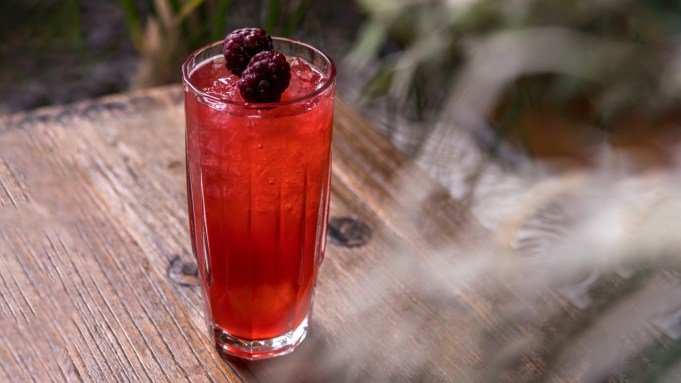
The Blackberry Buck has both. It begins fairly straightforward, combining bourbon, blackberries, lemon, and ginger beer, very similar to a Kentucky Buck and really the kind of thing that could be invented by anyone. But Teague changes it in two ways: First, he puts a crack of black pepper on top, and second, he accents the acid profile with a dose of balsamic vinegar.
We have, in this space, extolled the virtues of vinegar in cocktails before, but it’s usually presented as homework—mash up a cup of fruit, add vinegar and sugar, wait 3 days, etc. And one of the many wonderful things about the Blackberry Buck is that it’s right now; balsamic vinegar needs no pre-softening, you already have some at home, and it slides into the profile of blackberries, bourbon, and ginger like a dream. When you taste it, you immediately understand. Is the cocktail good without balsamic vinegar? Sure. A little plain, but certainly good enough. But with the balsamic it takes on new levels of depth and resonance, opening with pepper and blackberry up front, bourbon rising almost immediately, and then the midpalate is a stage for the balsamic, which plays with both the fruit and oak before yielding the floor to ginger’s building spice.
It’s a “deeper, more complex flavor,” writes Teague. “Embrace the savory—you won’t look back.”
Blackberry Buck
- 2 oz. bourbon
- 0.75 oz. lemon juice
- 0.25 oz. ginger syrup
- 0.25 oz. balsamic vinegar
- 2 blackberries
- Ginger beer
- 2 cracks black pepper
Add blackberries to cocktail shaker and muddle (smash) them. Add bourbon, lemon, ginger, syrup, and vinegar, and shake with ice for eight to 10 seconds. Strain into a tall glass over fresh ice and garnish with a blackberry and/or the cracks of pepper.
NOTES ON INGREDIENTS
Bulleit
Ratios: The above is presented as Teague wrote it, and is delicious. For my palate, though, I must say that I preferred to reduce the lemon to halfway between 0.75 oz. and 0.5 oz. (the balsamic will bring acidity), skip ginger syrup, and add simple to the tune of 0.5 oz. That’s just me.
Bourbon: All bourbons tested for this recipe are delicious, but I narrowly preferred the spicier end—I think the rye spice complements the tingling ginger on the finish nicely—so if you have many options at your disposal, grab a “high rye” bourbon like Bulleit or 1792.
Ginger Syrup: Ginger Syrup is a bit of a pain in the ass, and honestly, depending on your ginger beer, you may not even need it. Grab a spicy ginger beer like Cock n’ Bull, Blenheim Ginger Ale, or Badger, and you can replace this with good old simple syrup. But if you need ginger syrup or love that extra kick, make some by either juicing fresh ginger and mixing the juice 50/50 with white sugar (spiciest) or blending 6oz ginger with 6oz sugar and 4oz hot water, then straining.
Balsamic Vinegar: One variable I tried is to side-by-side test some commodity balsamic vinegar with some 18 year old artisanal stuff, and I was surprised that I actually preferred the cheaper version. High quality balsamic has much more complexity, which presents on the midpalate and draws a bunch of attention to itself. It certainly still tastes good, but I personally felt that it came at the cost of overall cocktail cohesion.
Black Pepper: Helps with the nose, and deepens the experience of spice. It’s nice. But if it’s too much for you, feel free to skip it, the drink is still good without.
Authors

Jason O’Bryan

