


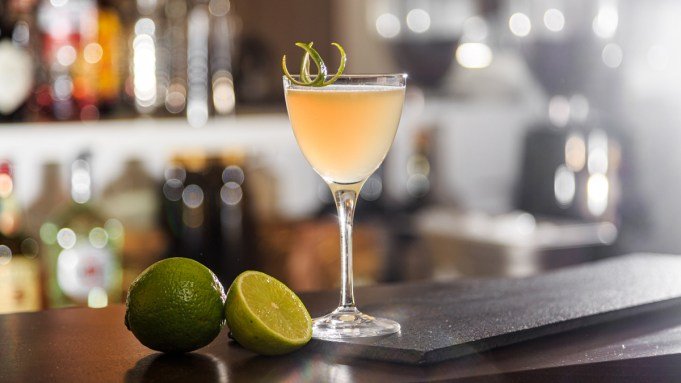
Two things I know about the Pegu Club—first, that there is more history, more influence, more forces shaping the cocktail world in that name than in almost any other drink you could think of. The second is that you’ve probably never had one. In this way it’s a bit like a great-grandfather, forgotten and overlooked in the corner during family events, but pull up a chair and you’ll find that it’s got quite a story to tell.
It’s 1871, and the Pegu Club is a private gentleman’s club, founded in Rangoon, in British-controlled Lower Burma. Today the city is called Yangon and the country is called Myanmar, but it was, to put it mildly, the habit of 19th century British colonialism to do things their own way, no matter where in the world they happened to be. The club had extensive manicured lawns, tennis courts, billiards, and card rooms to say nothing of a handsome banquet hall and impressive bar, a two-story palace of teak that was meticulously maintained by the same “natives” who would’ve been denied membership on account of their skin-color. It functioned as the private social headquarters for the British colonial establishment.
It’s 1923, and the Pegu Club is a cocktail. The drink is first published (as far as we can tell) in Harry of Ciro’s ABCs of Mixing Cocktails, as a combination of gin, orange curaçao, and sweetened lime juice, with Angostura and orange bitters. Who created this, and when, and how? No one knows. Cocktails exist in drinkable form before they’re ever written about, so we can’t say—does it actually take 52 years for this gentleman’s club to come up with an eponymous cocktail? One tends to doubt it. Nonetheless, by 1930 it’s everywhere—no less of an authority than Harry Craddock writes in his Savoy Cocktail Book that the Pegu Club Cocktail “has traveled, and is asked for, round the world.”
It’s 1948, and the Pegu Club is fading fast. Two things happen that year. First, David Embury publishes his influential The Fine Art of Mixing Drinks featuring several hundred cocktails, and while it includes similar drinks (like the White Lady and the Gimlet), the Pegu Club is conspicuously absent. Also, and far more significantly, Burma declares its independence. The Pegu Club (the club) would limp on for another 14 years, the staff polishing the brass on this titanic monument to British colonialism, but its days were numbered. Following the military coup in 1962, the building was seized by the army, and the club ceased to be.
It’s 2005, and the Pegu Club is a dream, specifically the dream of a talented young bartender named Audrey Saunders. Saunders saw the future of mixology as clearly as anyone, but at the time the cocktail world was still stuck in an abusive relationship with vodka. She planned to open her own cocktail bar on the edge of SoHo in Manhattan, one that was devoted to gin (vodka’s more flavorful cousin, which makes boundlessly better cocktails), and one where she’d buck the current conventional wisdom by barely carrying any vodkas at all. As for a name, she chose something that embodied this bold and fresh turn, naming her bar after an old forgotten drink that was, she’d say much later, “bracing [and] sophisticated… everything that I wanted in a gin cocktail:” The Pegu Club.
It’s impossible to overstate the influence that Pegu Club (the bar) had on the drinking world it would help to create. Many of the great bartenders of our time got their first real foothold there, as did many modern classics, like the Old Cuban, the Earl Grey MarTEAni, the Little Italy, the Intro to Aperol, I mean it goes on and on. It thrived for 15 years but was killed, like so many others, by the COVID pandemic, an unsurvivable blow amid the other myriad challenges of operating a bar in New York. It shut its doors in March 2020 and never re-opened them.
As for the cocktail—the Pegu Club survived its namesake club and the bar that revived and rehabilitated it, and remains an aged and noble cocktail. It is, as mentioned, bracing and sophisticated, tart and strong, with a balance that evokes an earlier time; the Pegu Club from the first sip announces that it is a serious drink. It is a White Lady but more seductive, a gin Sidecar with a side of spice, and is always there to be revisited, whenever you wish to pull up a chair.
Pegu Club
- 2 oz. London dry gin
- 0.75 oz. lime juice
- 0.75 oz. orange curaçao
- 0.25 oz. simple syrup
- 1 dash Angostura Bitters
- 1 dash orange bitters
Add all ingredients to a cocktail shaker, add ice, and shake good and hard for eight to 10 seconds. Strain up into a cocktail glass, and garnish with a lime peel or perhaps nothing at all.
NOTES ON INGREDIENTS
Fords Gin
Balance: This is a tricky drink to get right. As tricky as drinks get, really. Brands matter a lot. I couldn’t test everything, so feel free to tinker, but I’ll just say up front that if you stray from the below recommendations and make something you’re not in love with, it doesn’t mean there’s not a great drink in there somewhere. Feel free to lower the measure of gin to 1.75 oz. or even 1.5 oz. if it’s too alcoholic for you, that will also give some much-needed perception of the sweetness (though not all gins have the power to still assert themselves).
Gin: The universal recommendation is for London dry gin, which is to say a stout, juniper-forward bottling. I agree. The soft charm of things like Hendricks or Monkey 47 or even Plymouth don’t punch through the way I think they need to.
It’s worth noting that Tanqueray is what Saunders herself called for, and I think it’s great, but I narrowly prefer Ford’s Gin, which functions roughly the same but gives off less excess heat than Tanqueray.
Orange Liqueur: History and Saunders herself call for orange curaçao (brandy-based) as opposed to Cointreau or triple-sec (vodka-based) orange liqueur. Again, I agree—the round, supple oak in the liqueur is essential to the cocktail’s charm—for brands here I recommend Pierre Ferrand Dry curaçao, which is all-purpose excellent. Grand Marnier is ok but it works less well in cocktails generally.
And I’ll just say that smart and talented people, like Jeffrey Morganthaler and the Death & Co. folks (in their Cocktail Codex book) call for Cointreau nonetheless. It’s a stylistic choice. For me, Cointreau too strongly reminds me of a White Lady, or otherwise doesn’t stake a sufficiently unique claim. For me, the Pegu Club is a curaçao drink, but your feelings may vary.
Simple Syrup: Neither the original recipe, the Attaboy crew (via their Bartender’s Choice app) nor Saunders herself called for simple syrup. Saunders used an orange liqueur that is both sweeter and lower proof than the Pierre Ferrand, so maybe the effect was the same; in any case, I think it absolutely requires a touch of excess sweetness—without it, the cocktail is dramatically austere. Just a kiss, a scant quarter ounce.
To make it, combine equal parts sugar and water, and stir until the sugar dissolves.
Orange Bitters: One small dash, use whatever you like. Adds zest and a brush of bitterness to the palate.
Angostura Bitters: The spice from the bitters is part of what makes this drink what it is.
Authors

Jason O’Bryan

