


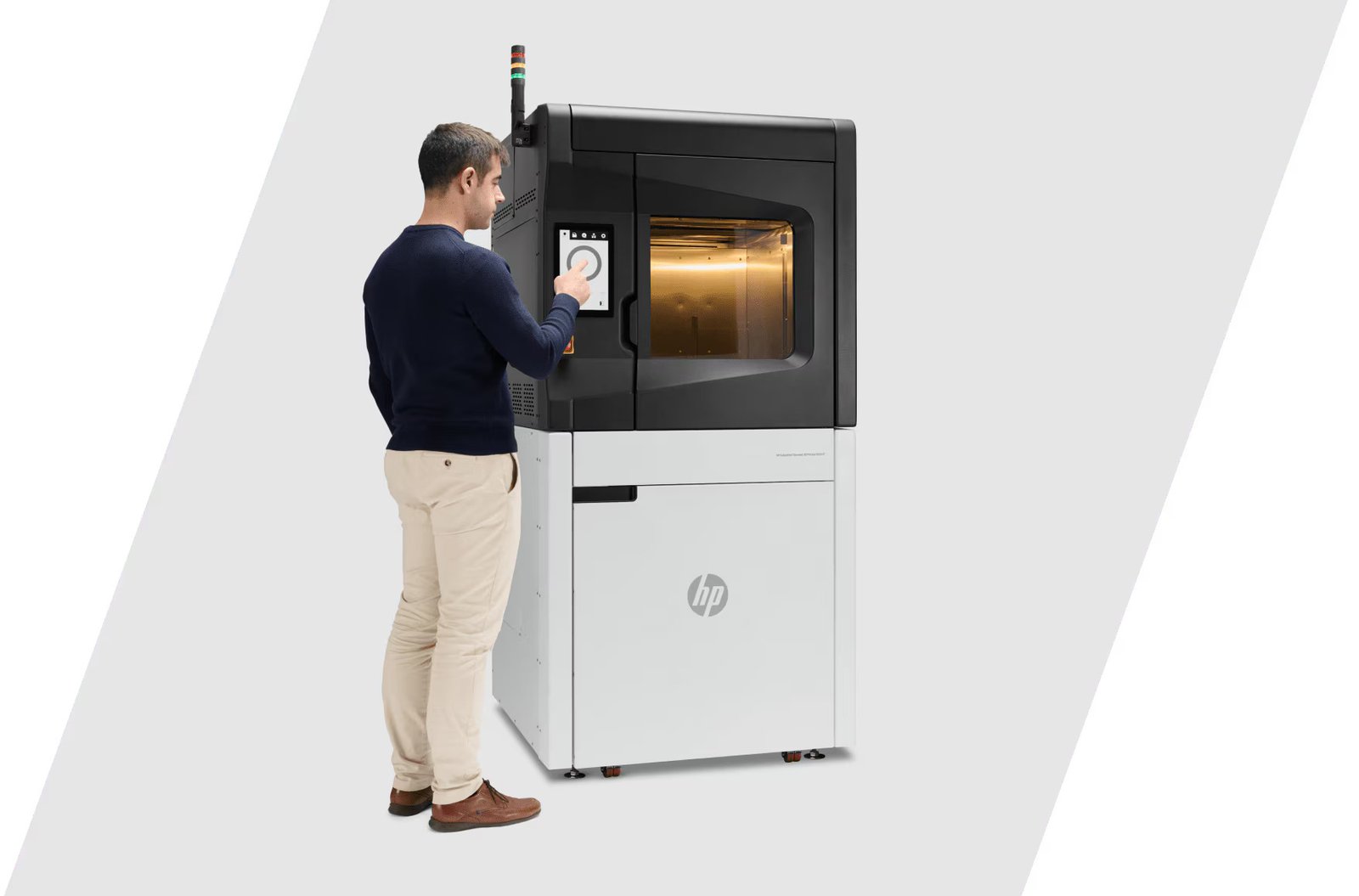
After more than a decade pioneering powder-based additive manufacturing with its Multi Jet Fusion (MJF) technology, HP is now entering the Fused Filament Fabrication (FFF) space. The HP Industrial Filament (IF) 3D Printer 600 High Temperature (HT) is HP’s first FFF platform, a move rooted in the company’s conviction that high-temperature filament printing unlocks a new class of production applications.
The expansion brings HP’s trusted reliability and deep application expertise to the high-performance filament market at a moment when advanced polymers like PEEK, PAEK, PEI, and carbon-fiber reinforced materials are fundamentally expanding what’s possible with filament-based additive manufacturing.
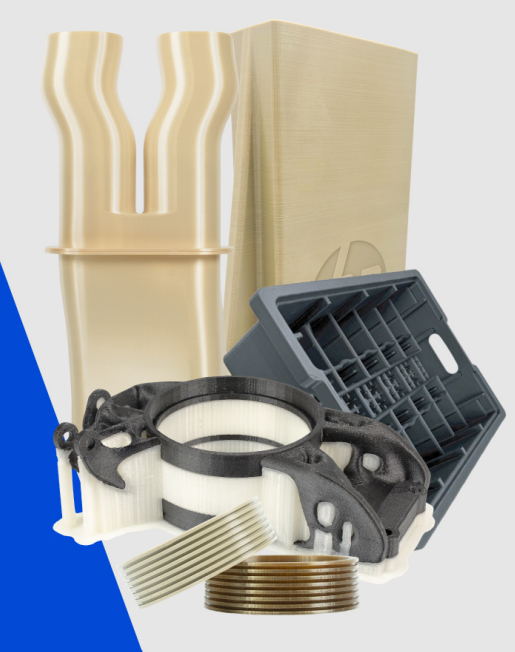
Aerospace companies are 3D printing certified cabin interior ducts, medical device firms are producing sterilizable surgical guides and instruments, and automotive teams are using topology-optimized PEEK-CF to replace aluminum components under severe operating conditions, all functional parts going into service.
HP now empowers customers across these sectors, along with oil and gas, railway, and education, to produce such high-value, production-grade applications with confidence.
However, getting there has not always been easy. Printing with these polymers demands purpose-built, industrial-grade hardware. Materials like Ultem 9085 (PEI) and polycarbonate require carefully controlled thermal environments, while PEEK pushes nozzle temperatures to 500°C and demands a thermally stable chamber to avoid warping, delamination, and failed overnight builds.
Most filament 3D printers were never engineered for this kind of sustained thermal demand, and the machines that could handle it have historically locked buyers into proprietary material ecosystems, limiting procurement flexibility and driving up per-part costs.
What the HP IF 3D 600 HT Printer actually delivers
The HP IF 3D 600 HT Printer tackles the thermal challenge first. Its fully enclosed, actively heated build chamber maintains up to 195°C throughout the entire print, and for anyone who has watched a multi-day PEEK build warp at hour nineteen because of thermal drift, this is not a convenience feature.
Consistent chamber temperature is what delivers reliable layer adhesion and dimensional accuracy.
That thermal foundation supports a modular extruder architecture, which is the system’s most distinctive design choice. Three interchangeable print modules rated at 280°C, 360°C, and 500°C allow a single 3D printer to cover a broad spectrum of material requirements. The 280°C module handles engineering-grade ABS and carbon-fiber nylon. The 360°C module covers Ultem 9085 by Sabic (PEI) and polycarbonate.
And, the 500°C module opens up PEEK, PAEK, and PEEK-CF. All three support dual high-speed extrusion and work with carbon-filled materials. In practice, a manufacturer printing Ultem 9085 air ducts can swap modules and run PEEK seals for an oil and gas client on the same platform, without needing a second dedicated machine.
Though, this material flexibility extends beyond the hardware itself through an open materials platform. HP sells its own filaments, but the system also accepts third-party materials, and HP offers support to help customers with the adoption and qualification of those materials. This avoids the vendor lock-in that has been a persistent frustration for buyers of other industrial 3D printers.
Where HP’s own filaments do add distinct value is in traceability and process control. Each HP spool carries an NFC tag that enables automated material identification, registration, and tracking from raw material through to finished part. For regulated industries like aerospace, rail, and medical, where every component must be traceable back to its exact filament batch, print conditions, and post-processing parameters, that documentation chain is not optional.
The accompanying Material Management System extends this further, handling automated drying, storage, and integrated post-annealing with pre-programmed cycles for PEEK and PAEK that measurably improve mechanical strength, heat resistance, and chemical durability. Having annealing built into the workflow instead of requiring a separate oven removes a manual step that often introduces batch-to-batch inconsistency.
One practical observation worth noting is the 0.4mm nozzle on the 360°C and 500°C modules favors surface quality and dimensional accuracy over raw deposition speed. For teams prioritizing large-volume tooling where throughput matters more than fine detail, that tradeoff is worth discussing with HP’s applications engineering group before committing.
The HP IF 3D 600 HT Printer carries UL 2011 and CE compliance and includes enterprise-level cybersecurity features, positioning it squarely on factory floors and regulated production lines. HP is also offering expert consultancy for application development, materials selection, and custom print profile creation, along with structured care packs that include remote diagnosis, replacement parts, next-business-day onsite response, and periodic service check visits.
Technical specifications and pricing
For manufacturers ready to move high-temperature filament printing from occasional lab trials into traceable, repeatable production, the 600 HT makes a credible case. Interested readers can learn more here.
| Print technology | Fused Filament Fabrication (FFF) |
| Build volume | 380 x 380 x 420 mm (15 x 15 x 16.5 in) |
| Minimum layer height | 50 µm |
| Number of printheads | 2, printhead purging system |
| Filament diameter | 1.75 mm |
| Printhead temperature (max.) | 500°C |
| Buildplate temperature (max.) | 190°C |
| Chamber temperature (max.) | 195°C (active heating) |
| Filament chamber temperature (max.) | 50°C |
3D Printing Industry is inviting speakers for its 2026 Additive Manufacturing Applications (AMA) series, covering Energy, Healthcare, Automotive and Mobility, Aerospace, Space and Defense, and Software. Each online event focuses on real production deployments, qualification, and supply chain integration. Practitioners interested in contributing can complete the call for speakers form here.
To stay up to date with the latest 3D printing news, don’t forget to subscribe to the 3D Printing Industry newsletter or follow us on LinkedIn.
Explore the full Future of 3D Printing and Executive Survey series from 3D Printing Industry, featuring perspectives from CEOs, engineers, and industry leaders on the industrialization of additive manufacturing, 3D printing industry trends 2026, qualification, supply chains, and additive manufacturing industry analysis.
Featured image shows an operator monitoring Industrial Filament 3D Printer 600 HT through its built-in color touchscreen interface. Image via HP.
