


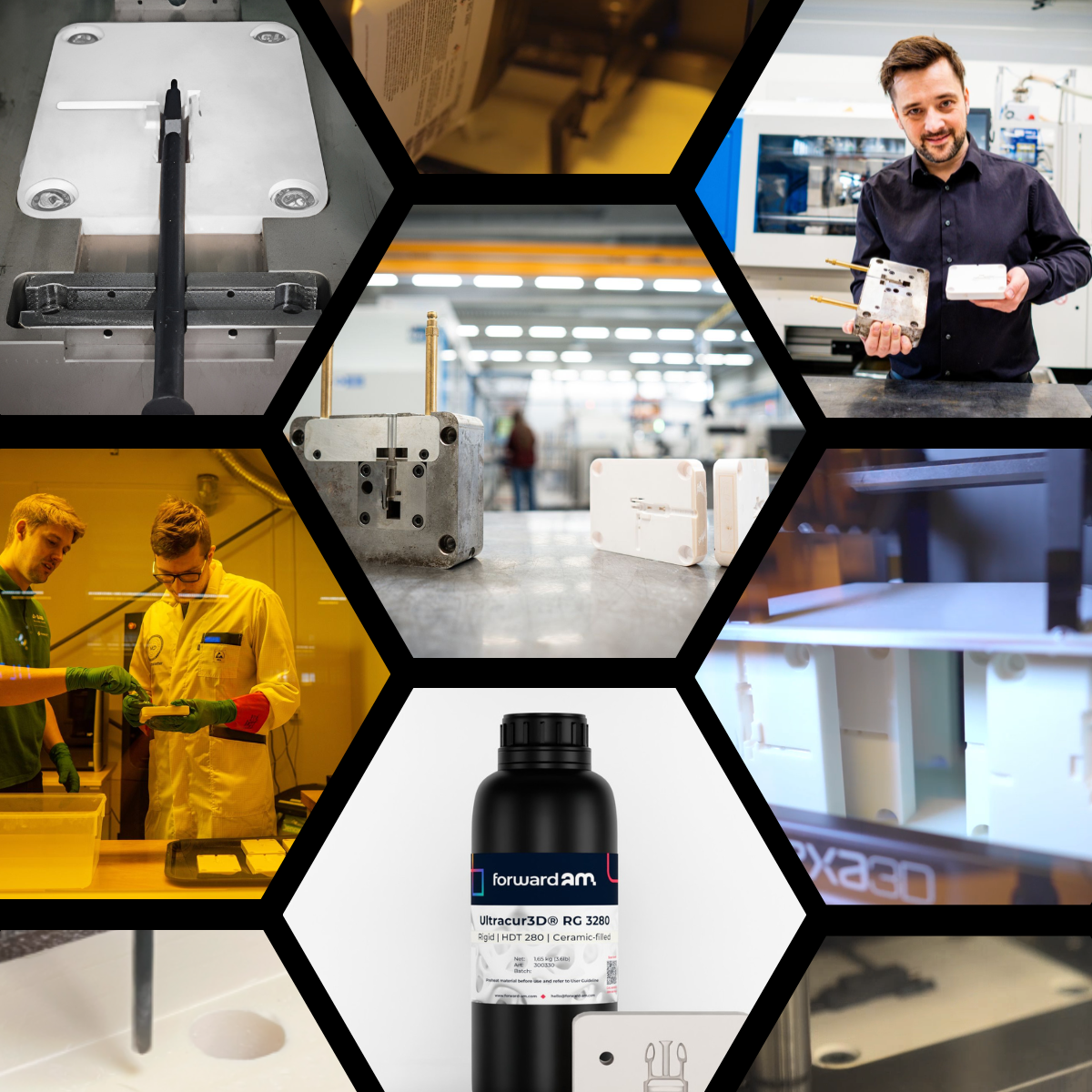
Live polypropylene molding and examples of dissolvable xMOLD tooling will show how printed molds can support product development in intended thermoplastics.
iAM Marketplace will demonstrate injection molding with 3D printed Ultracur3D RG 3280 tooling at Formnext 2026, using an APSX-PIM V3 to mold polypropylene parts. Alongside the live process, the company will display examples of Ultracur3D xMOLD, a dissolvable tooling resin intended for geometries that are difficult to release from rigid molds.
The demonstration addresses a practical development question: how can engineers test a design in its intended thermoplastic before committing to conventional production tooling? Printed inserts offer a route to molded prototypes and faster design iterations, allowing teams to investigate part geometry and behavior while design changes are still relatively inexpensive.
Visitors will see injection molding with RG 3280. The xMOLD display will include empty molds, molds containing injected parts, and recovered final injected parts.
Testing designs in the intended thermoplastic
For iAM Marketplace, the development value lies in testing properties that a directly printed prototype may not adequately represent. Speaking to 3D Printing Industry, the company identified flexural behavior, snap-fit fatigue and sealing performance as examples of questions engineers can investigate using molded parts in the final thermoplastic intended application.
The intended benefit is to bring material and manufacturing considerations into development earlier, while leaving application-specific validation to the engineering team.
RG 3280: reusable printed mold inserts
RG 3280 and xMOLD address different tooling requirements. RG 3280 is a ceramic-filled resin for rigid inserts that can be opened and reused. xMOLD provides sacrificial tooling that is removed chemically after molding, allowing developers to approach features such as undercuts and negative drafts without relying entirely on mechanical demolding.
For RG 3280, performance depends on the tool design and molding conditions as well as the resin. Forward AM’s injection-molding processing guide lists 1,000 shots for unfilled ABS, POM and PC, and 100 shots for glass-filled PP GF30 and PA 6.6 GF25 under the reported conditions.
The guide also emphasises support for the printed inserts, cooling and careful demolding. These operating requirements matter when assessing the workflow: printing a cavity is one stage in producing a functioning tool. iAM Marketplace says smaller components are generally the best fit, while larger parts requiring higher injection pressures and clamping forces, or substantially greater quantities, may favour aluminum or steel tooling.
MD ELEKTRONIK: cable-overmolding prototypes
A published application at automotive supplier MD ELEKTRONIK illustrates the development role of reusable printed inserts. The company used RG 3280 tooling for prototype cable overmoldings containing functional electronics and contacts.
According to Forward AM’s case study, the project reduced production time from six to ten weeks to three to four days. Eight mold components could be printed in two hours, and reported production-overhead savings exceeded €5,000.
The case also reports more than 60 molded parts produced in 90 minutes, with little or no insert wear. That describes the reported run; it does not establish the tooling’s full service life.
Markus Kaaserer, Expert Techno Polymers at MD ELEKTRONIK, said in the published case that the approach enabled the company to check geometry and identify potential failures before investing in a steel mold, reducing subsequent correction and optimisation work. The case used Nexa3D printing equipment, another example of a possible workflow in addition to the Form 4 arrangement planned for Formnext.
xMOLD: dissolvable tooling for complex geometries
With xMOLD, the tooling is consumed to release the part. iAM Marketplace described a buckle as an example of a development application in which undercuts and negative drafts can complicate conventional mold design. Its responses did not include a quantified customer result for that example, as the application is part of a development project. They will further showcase previously unpublished customer parts at Formnext 2026.
The company also outlined a combined arrangement: RG 3280 forms part of a conventional two-half tool, supplemented by smaller xMOLD inserts for features such as undercuts or threads. The sacrificial sections are intended for one molding operation each, while the rigid sections are intended for reuse. The responses did not establish repeated-use performance following exposure to the dissolution process, yet.
Removal time is an important part of the xMOLD workflow. The user guide linked from its product page describes dissolution in a 1 mol/L sodium hydroxide solution at 70°C. In a test using 30 mm cubes, heated agitation produced 80% dissolution after 16 hours and 97% after 24 hours. These results concern test specimens, rather than a guaranteed release time for a particular molded component.
Mold dimensions and bath conditions therefore need to be considered alongside printing and molding time. Compatibility of the injected polymer with the removal process also requires assessment; visitors to iAM Marketplace booth at Formnext will be able discuss the thermoplastic grades validated through both molding and dissolution for their desired application.
For printing, iAM Marketplace says its laboratory internally validated Form 4 profiles for RG 3280 and xMOLD using Formlabs’ Open Material Mode, which requires a license. Printing is followed by washing and post-curing before the inserts are prepared for molding. The company estimates 48 to 72 hours from CAD to molded parts, depending on complexity.
See the process at Formnext 2026
At Formnext, visitors will be able to inspect the printed tooling, watch RG 3280 inserts used to mold polypropylene, and discuss material selection, printer profiles and application support with iAM Marketplace.
Demonstrations are planned for 11:00 and 14:00 daily, November 17–20, at Hall 12.1, stand D61.
Featured image shows RG3280 MD Electronik Molds. Image via iAM Marketplace.
