


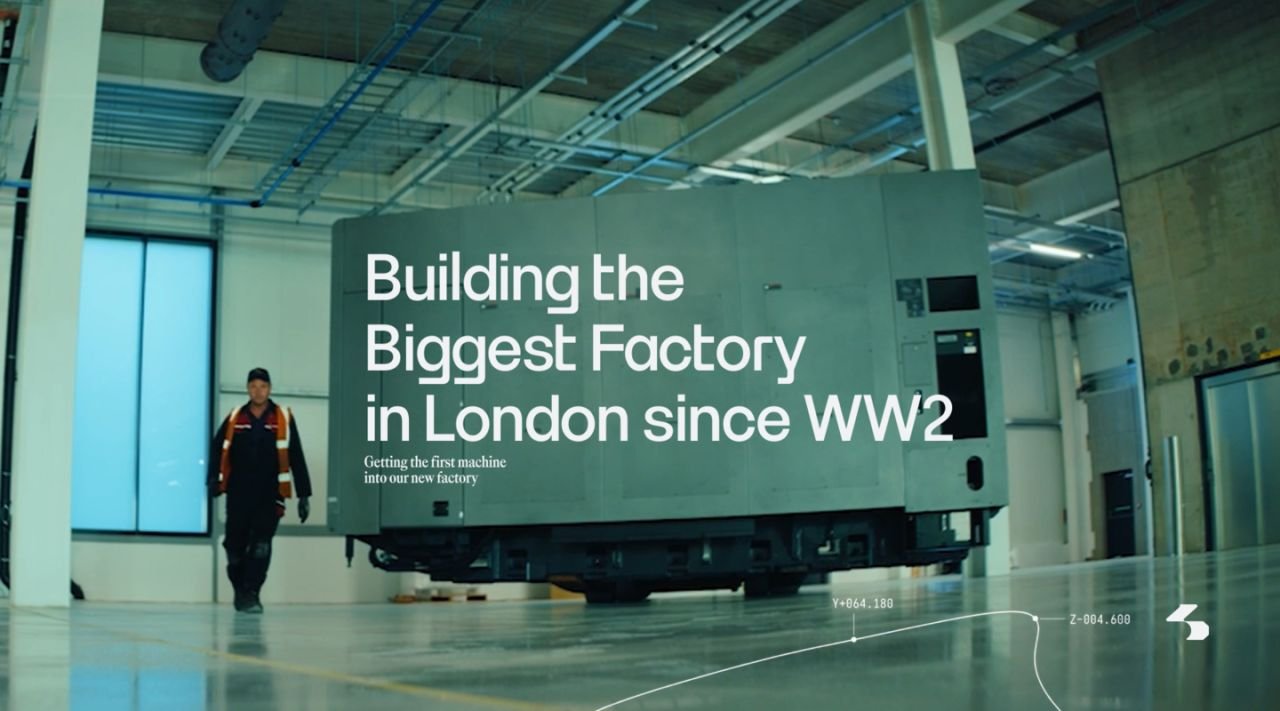
British software-first manufacturing startup Isembard opened its new global headquarters and factory in Southwark, central London, on September 14, 2026, calling it the largest factory to open in the capital since the Second World War. The launch caps a year in which the company grew from 4 factories to 16 across the UK, Europe, and the US, alongside a tenfold year-over-year revenue increase, and comes as Isembard prepares to raise additional funding to support further global expansion.
The Southwark site will serve as both Isembard’s head office and a working precision factory, producing components for aerospace, defence, and robotics customers including Anduril, Babcock, and Tekever.
Targeting a market small businesses are ageing out of
Isembard’s expansion is built around a specific structural problem in component manufacturing, a market the company values at $1.8 trillion a year but says is dominated by small businesses that account for 95% of production and are rapidly disappearing. The average owner in that segment is over 65, and 40% plan to retire within five years, a wave of retirements the company argues is colliding with rising demand from aerospace, defence, energy, and robotics firms driven by re-shoring and higher spending on critical industries.
Isembard’s response combines owned factories with a franchise model, layered with a proprietary operating system called MasonOS that automates quoting, scheduling, production, and quality control across the network. The approach is meant to let experienced operators run high-performance manufacturing businesses from day one, using Isembard’s technology, brand, engineering standards, and existing customer demand rather than building all of that from scratch.
Milling, turn-mills, and wire EDM, with software built on top
The Southwark factory houses 3-axis and 5-axis milling machines, turn-mills, and wire electrical discharge machines, alongside a climate-controlled metrology lab for precision inspection. Isembard designed the office to overlook the factory floor through floor-to-ceiling windows, giving its software and robotics engineers a direct view of production as they develop MasonOS and the company’s forthcoming robotics technology. Headcount at the Southwark HQ is expected to grow from 35 today to 200 by the end of 2027, spanning production, software, manufacturing, and robotics automation engineering.
The location itself carries some intentional symbolism: Southwark was historically one of London’s manufacturing centres, home to foundries, engineering works, printworks, and tanneries, and is where Isambard Kingdom Brunel, the company’s namesake, worked early in his career driving the Thames Tunnel out from Rotherhithe.
Isembard and Alloyed: a supplier inside an AM company’s supply chain
Isembard doesn’t 3D print itself, its confirmed equipment across factories is entirely subtractive, built around CNC milling, turning, and wire EDM. But it isn’t disconnected from the additive manufacturing industry either. Among the customer stories featured on Isembard’s own capacity page is Alloyed, the Oxford-founded metal additive manufacturing company, formerly OxMet Technologies, that designs alloys computationally and produces qualified metal components through its own AM production stack.
Alloyed’s Chief Engineer, Charlie Pearson, is quoted praising Isembard directly: “Isembard has proven to be an exceptionally capable manufacturing partner. Their team rapidly understood our technical requirements, iterated on solutions with pace, and delivered complex precision products to a standard we could trust.” That places Isembard as a precision-machining supplier inside at least one AM company’s broader manufacturing chain, even though the parts Isembard itself cuts are machined rather than printed.

Part of a wider UK reindustrialisation push
Isembard is targeting 100 owned and franchisee factories across the UK alone by the end of 2028, a plan the company says would create 2,200 high-skilled jobs. The announcement lands alongside the UK government’s Defence Investment Plan, which commits close to £300 billion and names sovereign capability, autonomous systems, and resilient supply chains among its priorities.
That push has increasingly leaned on additive manufacturing specifically as one of its core tools, not just conventional machining. The Ministry of Defence’s own Defence Advanced Manufacturing Strategy identified 3D printing as crucial to its roadmap, citing a DIU-commissioned finding that printing 15% of the defence inventory could save £110 million over 15 years.
That policy has already translated into hardware on the ground: Rheinmetall BAE Systems Land uses 3D printers extensively across Challenger 3 and Boxer production at its Telford site, backed by over £56 million in investment, while Rolls-Royce opened an MOD-backed Additive Manufacturing Development Cell in Bristol built around what defence officials have called a “factory to foxhole” logic.
Isembard founder and CEO Alexander Fitzgerald framed the Southwark opening in the same terms: “Manufacturing is the origin of our security, prosperity and sense of purpose as nations. No one has opened a factory like this in London since the Second World War, and that tells you how far our industrial base has been allowed to shrink.” Business Secretary Jonathan Reynolds welcomed the move as consistent with government policy: “This is exactly what reindustrialising Britain is all about. Bringing manufacturing back into the UK, backing our critical industries and creating highly skilled jobs across the country.”
Isembard’s own factory network is built on conventional precision machining rather than 3D printing, but it’s opening into an industrial base where additive manufacturing has become one of the load-bearing technologies of the reindustrialization effort and where at least one of its own customers is building that capability directly.
3D Printing Industry is inviting speakers for its 2026 Additive Manufacturing Applications (AMA) series, covering Energy, Healthcare, Automotive and Mobility, Aerospace, Space and Defense, and Software. Each online event focuses on real production deployments, qualification, and supply chain integration. Practitioners interested in contributing can complete the call for speakers form here.
To stay up to date with the latest 3D printing news, don’t forget to subscribe to the 3D Printing Industry newsletter or follow us on LinkedIn.
Explore the full Future of 3D Printing and Executive Survey series from 3D Printing Industry, featuring perspectives from CEOs, engineers, and industry leaders on the industrialization of additive manufacturing, 3D printing industry trends 2026, qualification, supply chains, and additive manufacturing industry analysis.
Featured image shows Isembard Opens London’s Largest Factory Since World War II. Image via Isembard.
