


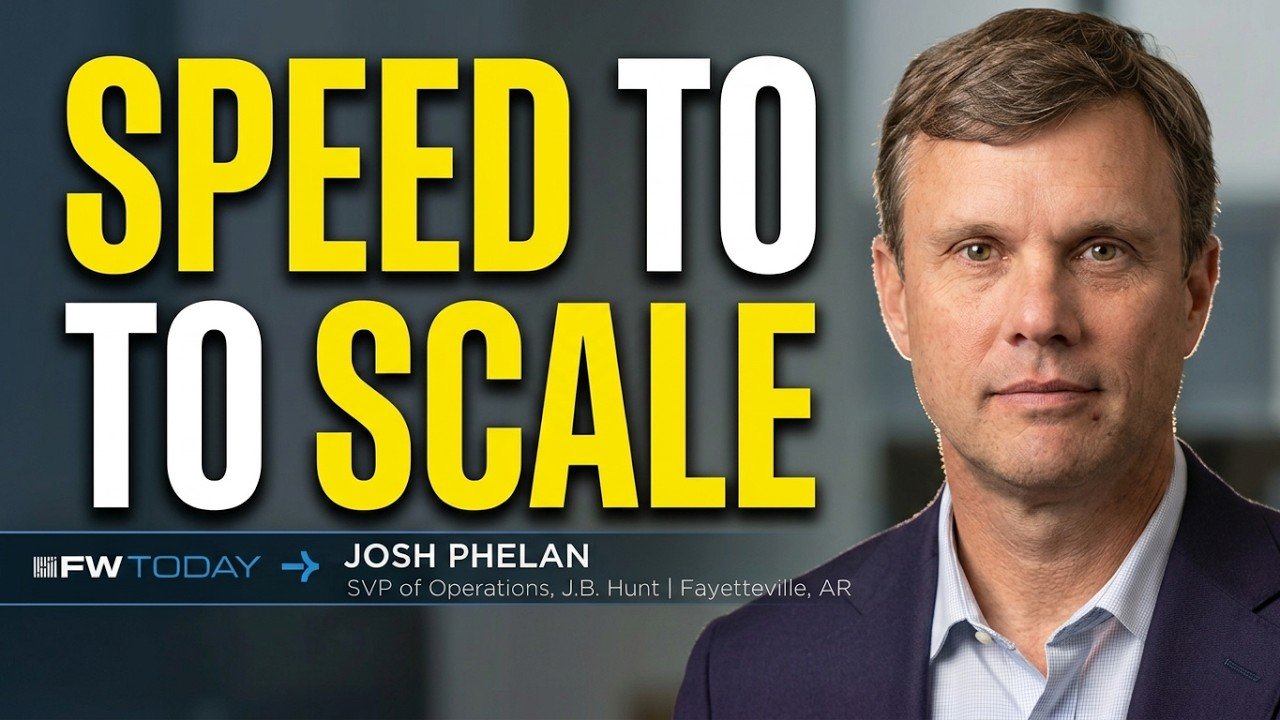
Speaker 1 [0:00] Uh, we have Josh Fellin up here. Uh, Josh, how are you, sir?
Speaker 2 [0:04] Good. How are y’all doing?
Speaker 1 [0:06] Well. So tell us, you run JB Hunt’s over-the-road business. We’ve been joking about the fact that you’re either the best operator in the business or they give you the stuff that needs the cleanup. So what, what is the— what’s the sentiment in a business that operates so efficiently?
Speaker 2 [0:21] Well, I, I think it’s certainly the latter, Craig. You know that. And by the way, y’all are getting really good at this. Um, it’s good to see y’all even though it’s on a really small screen for, for me. Um, you know, I think it’s, it’s obviously an interesting time for, for being in the media. Um, earnings season, it’s always a fun 3 to 4 weeks. And then, you know, if you compare it to maybe the past, uh, 8 to 12 quarters, maybe there’ll be some more new news this time around. You know, I’d say the trucking market, um, has certainly seen a significant change than where we were prior year. You know this, your audience knows this, spot capacity rates. I think if you look at the NTI measurement, Craig, in June, I think at one point was up 60% year over year, which is a drastic change. You know, from a JVT perspective, our over-the-road segment, we’ve been navigating that marketplace. So, you know, our model is a little different where we have a large fleet of independent contractors that are under our authority, but we also utilize third-party capacity. And so You know, providing drop trailer service for our customers in the heavily contracted marketplace. Obviously, that dramatic increase we saw in spot capacity rates had a negative impact on our short-term earnings. And I think what we’re seeing is, and we’ve talked about this before, certainly the change in the market is driven from the supply side. I think you were talking about how Adam at Knight mentioned that just the continued regulatory enforcement, And how much of that will continue and even strengthen. I think if you talk about the magnitude of the increase we’re seeing on the rate side though, I think that’s really driven from, you know, the direction of it is because of what’s going on with supply. The magnitude, if you go back and where the industry has been really for 4 years on very compressed margins, cost inflation has been up quite a bit. I think if you go back to ’19, you’ll see it quoted anywhere from 48% to 60% on a cost-per-mile basis to operate a truck. And the rate environment that we’ve been in inside the marketplace, same period comparison might be up 5% to 6%. So really compressed margins have led to a whole lot less investment. And then I really think is driving the magnitude of increase you’re seeing because quite frankly, the industry needs it to start reinvesting in their equipment.
Speaker 1 [2:48] So Josh, I think that’s a real important point, is just the lack of investment. And we got the report from Knight-Swift. They’ve talked about the fact that they would prefer to not expand the fleet right now, because they would prefer to operate their trucks more efficiently. We saw that their operating ratio in their over-the-road for-hire business dropped by 300-plus basis points. So significant improvement, but it seems like the The desire is all about operating efficiency. I mean, they’re at 30% tender rejection rates, if you take it twice the industry average, which does suggest that they’re being far more selective, but they’re not leaning into growth. I think a lot of what they’re talking about, what Knight-Swift talked about on the earnings call, was just the lack of driver availability, the inability to recruit drivers. What is it you’re seeing in the market compared to perhaps past upcycles in terms of driver recruiting?
Speaker 2 [3:43] Yeah, I mean, we are seeing the driver market tighten significantly. You know, the first thing we saw was, was the third-party capacity market tighten, and that quickly leaked into our available pool of drivers. I think we talk about our need quite frequently, and we’ve seen our need increase. Part of that’s self-driven, right? If you have growth, growth’s a good thing, that increases your need. But if you start to see more opportunity for drivers to, to jump around, you know, you might see turnover increase. I You know, I can’t speak tonight specifically, but if you go back and think about where we’ve been for 4 years, you know, our concern— and, and we’ve done a really good job of cutting costs, and we’ve talked about that publicly— you know, our concern was, you know, well, we never want to cut into the muscle. And you might have had carriers out there that actually did that because they had to, to survive. If you start cutting into muscle and cutting, it’s, it’s going to create more of a lag of your ability to, to grow when it’s time to grow. I think that’s could be one issue, you know, a carrier’s facing. You know, the second is we still got to get our returns at least on paper and a great line of sight of saying, okay, I have comfort and I have conviction that one, I can reinvest in any of my equipment that’s cycling out and I can get the returns to where they need to be, where I can add CapEx to this. And I still think we’re in that period. I know spot rates are up. I know contract rates are moving up based on the data that we see, but there’s still some room to go to get returns where I think they need to be to have a healthy appetite for growth in the truckload space.
Speaker 3 [5:19] And as part of that driver pay, I mean, as you’re seeing this recruiting and retention environment get significantly harder, are you guys looking at driver pay? What are you seeing in the industry? What are you hearing? Obviously, that increased cost, exactly to your point, before you’re ready to grow. So can you talk a little bit about that?
Speaker 2 [5:37] Yeah, we are seeing increased driver pay. I don’t think we’re— I can’t remember what that index was, Craig, that y’all were talking about a couple days ago. I don’t think we’re seeing it at that level, but we’re certainly seeing advertising pay go up. We do our own channel checks and talk to our friends. Um, how much driver pay is going to go up this year, I don’t know. I think if you went back and looked over the last couple years, that may be one cost that hasn’t increased as much as the rest, but what that would lead me to believe is, um, with supply where it’s at, with the driver pool shrinking as a— as an industry, you, you’re liable to see a pretty good step change, uh, needed in driver pay this year and into 2027, which again can kind of counteract, if you will, the amount of rate, uh, improvement that a carrier might need, because they need improvement to repair their margins. At the same time, uh, cost inflation continues. And so that just compounds the amount of relief we need to go get.
Speaker 1 [6:37] But I think that’s a positive thing, because I think one of the temptations that we see in every upcycle is that the industry overcorrects. They add way too much capacity. We can’t have nice things, as we like to say in trucking, because when the market is soft, you can’t find freight. You have plenty of drivers for your trucks. When the market is strong, you You can’t find drivers. You have plenty of freight, but you don’t have people to have seats. I think the temptation right now would be— and Dr. Jason Miller from Michigan State was on FreightWaves Today on Monday talking about the fact that he thinks that there’s going to be this very quick desire among large fleets to overcorrect. That’s not what we’re hearing as our channel checks. How are you guys thinking about just growth in terms of the business. Is this a market where you think carriers are gonna be far more conservative generally about adding trucks until they see sustained recoveries in driver availability? I mean, the employment number, Julie, I don’t know if you saw the headline this morning, but employment, we’ve had a couple of really great employment data points, which employment’s tight. Everyone’s predicting the AI apocalypse is gonna destroy employment. That’s not what the data says.
Speaker 2 [7:50] Yeah, I think there’s a couple of things to that. You know, we had some of our carriers in last week talking to them, and it was kind of a mixed bag. But the ones that want to grow, uh, there’s 2 things different, uh, well, maybe one thing different than the prior cycle is financing. Financing is way more expensive than it was in 2020, so they’re having a difficult time getting actually money to go invest in new equipment. The ones that have that have had trouble finding the tractors. So I think from a small carrier base, and not to mention what’s going on, Montgomery, and all the regulation impact, I think there’s going to be more headwinds this time on at least the small carriers or new carriers entering in the space and growing their equipment. You know, from a large carrier, again, I still think it will come down to the belief that we are on a more sustainable bull market, if you will, and that the returns can get to the level they need, I think you’ll be more cautious. You know, we— I think Shelley mentioned this when she was on, you know, we’re all about growth, but we’re all about disciplined growth. We’re not going to just grow our top line for sake of our bottom line. So we want to grow, we’re going to be very focused on where we do that, but we’re also going to make sure we put our CapEx in the right spot. So if it still doesn’t make sense to add capacity in the OTR market, we won’t. We’ll add it somewhere else. And I think you might see a little more cautionary investment from large carriers. Never know, you may not. And I think from those small carriers, there’s going to be much more headwind and more barriers to entry, if you were, than they have been in the past.
Speaker 1 [9:27] I mean, I do think it’s interesting that over the last decade, the largest carriers have not been adding trucks. Like, you can look at it as a general consensus. And we have this data inside of Sonar. In trucks above 1,000, if you take the cohort of 1,000 trucks or more in a fleet, That basically is almost flat. It barely has moved in the last decade. And it’s telling us that really large fleets are becoming far more disciplined. Now, some of it’s been the cycle itself has not encouraged them to add trucks. But companies that have all of the advantages, like a JB Hunt, like a Knight-Swift, like a US Xpress when it was an independent company, have chosen to sit out the market and drive operating efficiency. Where we are seeing growth is in the non-core over-the-road business. Josh, we’re giving you a little hard time about— you’re in the most difficult part of the entire enterprise. You guys had this amazing intermodal business that we joke that— I look at J.B. Hunt more as a railroad than I do a trucking operator. And I mean that as a compliment, by the way. It is interesting, because I think where the growth is coming from is in the non-solo OTR business. I think the large fleets have decided that that’s a market they’re willing to cede to some degree, and then focus on other areas of growth.
Speaker 2 [10:52] Yeah. After a long day, I get in my car, I go home, and I always tell myself, I work for intermodal. And it makes me feel better.
Speaker 1 [11:02] You have.
Speaker 2 [11:03] I mean, you haven’t seen much growth in the OTR market. You’ve seen larger carriers transition more to dedicated, which is a much more sustainable economic model. And I don’t know that that— I don’t know if that changes, quite frankly. If we could start to see less volatility in the pure OTR market, I don’t think you’re going to see that grow. Now, we always like to say this time’s different. And I’m not saying that, trust me. But if a few changes to how, you know, the market behaves in less wild swings, you can build a good business. And obviously there’s a lot of great carriers out there, Mike being one, that know how to run trucks. But if you want to see that start growing again, we’re going to have to see less volatility so you can actually plan a business around.
Speaker 3 [11:56] Trucking’s a great lifestyle business. I think that makes so much sense.
Speaker 1 [11:59] It’s a great lifestyle business, Julie. It’s not necessarily the over-the-road business as a public company is much more difficult, which is why I think the big public guys are looking for diversification.
Speaker 3 [12:09] Yeah, I mean, I think, well, so you mentioned earlier that you guys, even in your brokerage and in your over-the-road, highly contractual freight, right? With your large drop trailer network and your 360 boxes for your brokers. So what are you seeing when it comes to contract rates? You mentioned that you’re seeing them finally inch up after spot. What are your anticipations there? For the rest of this year and into 2027?
Speaker 2 [12:34] Yeah, I don’t think they would let me talk about rates. Maybe they would, but I mean, we are seeing—
Speaker 3 [12:39] You don’t have to give your numbers. Directionally, what do you see happening? What are you hearing?
Speaker 2 [12:44] We’re seeing contract rates move. You know, we call it a choppy market, and maybe that’s a cop-out. You know, we’ll have some successes or we don’t have some successes. What we’re focused on, honestly, is making sure that one, we’re taking care of our customers. So we’re going to do what we said we would do. And we’re focused on accepting what we were awarded and honoring our commitments, but doing the best we can to work with the customers where we need relief. And it’s not easy. It’s hard conversations. Shippers are really stressed right now. Obviously, their budgets are being blown up, one, because of what energy prices are doing, and two, what’s happening in the marketplace. And so we’re trying to navigate that the best we can. Obviously, we had We posted a loss inside Q2. We’ve had a successful run inside JVT, our OTR segment. We’ve grown double digits, I think, for the last 5 quarters. So we’ve taken share and our model that we use has really played out. We’re just caught in that flip, if you will, of the inflection in the market. And we’ve got to fix that. And that takes work all the way around, us removing costs, finding better ways to do it, trying to address business where we can the right way with the customer and still focus on creating value for them the best we can in what’s been somewhat of a turbulent market over the past several months.
Speaker 1 [14:08] Josh, one of the things that we had JP Hempstead, who has moved on to, we’ll say, better things than media, now on Wall Street, sort of the intermodal of what we do here, making a lot more money, I’m sure, than than being a— Where’d he go? He’s at Westbrow Capital, which is one of the largest funds, by the way, started by a former Freightways analyst, a market expert. Seth Holm went out and started, now one of the largest holders of trucking and logistics stocks in the entire world, based here in Chattanooga. But JP, his comment was that Hunt is viewed typically as a late cycle beneficiary because of the way that your business model has built. Intermodal tends to have less movement in price. There’s really a big spot market in intermodal. But that’s not what I would say is— I mean, it looks like we’re still in the early innings of the cycle. I mean, everyone— we heard from Knight-Swift about the fact that they’re anticipating continuation of tightening and tighter capacity. In terms of just overall cycle perception, where do you guys currently believe that we are? Are we early? Are we mid? Are we late?
Speaker 2 [15:25] I believe we’re early. Again, I can’t predict how it’ll play out. I think Spencer said on our call last week, the demand for our services is really strong, even though you can debate whether demand in the market is really strong. Um, you know, as you know, even from a spot-to-contract standpoint, that takes a little bit of lag. I think to fix pricing at current cost, um, levels, it’s going to take another bid season, uh, to, to get us there. So I, I think you’re in the early innings. Now, if you’re talking just about the spot market, who knows? Are you in the, uh, the mid, uh, mid innings of what the spot market’s going to do? You know, I know it’s cooled off a little bit, but still, I think, what, 40% higher than it was last year. We’ll see what happens back half of the year as we get into peak season. But I think as it relates to, to where we are, you know, with intermodal, it can be a laggard where we are with contract rates, where we are with dedicated, and really the economics getting back in favor for, for a shipper to dedicate capacity, which would be really good, uh, for our, for our DCS segment. I would say we’re, we’re in the early innings of hopefully what we see and and a freight economic recovery.
Speaker 1 [16:43] So Josh, our audience would like to know, there’s been a lot of conversation about Tesla’s electric semi. You guys have tested all sorts of technologies and powerframes— powertrains. What is your view on electric in terms of the over-the-road segment? Do you think that electric, purely pure-play electric, is going to be a big solution for the long-haul market? Or do you think we’ll see it more regional?
Speaker 2 [17:08] From the long haul, not right now. I think still quite a bit of work needs to be done from more on the capabilities and to the cost. We are testing several different technologies in the ZEV space, and we still think there’s quite— there’s certain applications where it can work and it can work today, and we’re going to continue to participate in those, but I still think it’s quite a ways off from being able to be, you know, a highly utilized piece of equipment specifically in the long-haul market.
Speaker 1 [17:43] Yeah, it feels like your last mile business might be the first, that or dray around the port.
Speaker 3 [17:48] Dray or localized dedicated, something where the infrastructure is readily available and easy and they’re hitting the same spots over and over again.
Speaker 1 [17:56] Years ago, I ordered some theater chairs for my home theater and a JB Hunt truck showed up at my house to deliver those, which I thought was kind of fun. Because it’s bringing not something you would have expected to see certainly 20 years ago. But you guys have a very large last-mile business. And these JB Hunt drivers got out and delivered, did an amazing job. So good. So it’s fun when, you know, we— because we focus on the freight market. It’s fun when you see the trucking, the traditional truckload guys sort of interact with your life.
Speaker 3 [18:30] So, oh, I love it.
Speaker 1 [18:31] Yeah.
Speaker 3 [18:31] And my kids are like, you’re so cringe, Mom. Leave them alone. They’re just here to do a job. And I’m asking them all the questions and want to hear all about everything.
Speaker 1 [18:38] And if you notice when you get in an Uber, I think like half the drivers, the Uber drivers that I get in, have some over-the-road experience.
Speaker 3 [18:45] Really?
Speaker 1 [18:46] Yeah. I mean, I think as my father, as Max has said on this show, is that one of the big competitions that they had for driver availability is just the for-hire Ubers and Lyfts and Instacarts that are competing for drivers, because frankly, you get to stay local, and you kind of set your own hours. A little different environment. But that is— that’s just one more constraint. I think, Josh, to sort of wrap up the conversation, I think the fact that the driver situation is so tight— first of all, drivers deserve more pay. I think everyone in the industry would love to see— when drivers are making more money, everybody’s making more money. So it’s something that I’m always happy to see when drivers make more. But I also think that creates a— a cap on how fast this expansionary cycle will overcorrect. It really will keep us honest, if you will.
Speaker 2 [19:38] Yeah, I agree with that. And again, I think there’s going to be more competition for qualified drivers than there has been based on all these changes. And, you know, driver pay took a really big step up. I guess that would’ve been in ’21 and ’22, which the industry needed. And at that time, the economics certainly supported it. And you’ve seen some gradual increases over the last few years. I do think, Craig, you’re right, it could be a limiting factor. And I do think pay will be addressed again this year to again attract the qualified talent that’s out there, but you just got to have the right economics to get them.
Speaker 1 [20:20] Well, Josh, appreciate you coming on and sharing your comments with us.
Speaker 3 [20:26] Always a good convo. I wish you’d be on once a month. We got to have him on once a month.
Speaker 1 [20:30] I think he’s got the blackout period. You know, we should do— we need to go to Arkansas.
Speaker 3 [20:33] We won’t talk about that.
Speaker 1 [20:34] We can go to— we should go to Arkansas and do it around a game.
Speaker 3 [20:40] I’m serious.
Speaker 2 [20:40] You don’t need to.
Speaker 1 [20:41] We should. We should go. Like, we’ll have to pick a date and we’ll come visit you and we’ll do a whole Northwest Arkansas, which is such a High concentration of fantastic supply chain. It’s sort of the epicenter of North America’s supply chain. You have J.B. Hunt that’s there. You have— and by the way, you have the Hunt School of Supply— I think it’s the Hunt School of Supply Chain at University of Arkansas. You’ve got Tyson Chicken. You have Walmart. And then just because Walmart has such an impressive footprint, you have hundreds of consumer product companies that have operations inside of Northwest Arkansas.
Speaker 3 [21:17] So we’re going to do that.
Speaker 1 [21:19] Put that on the list.
Speaker 3 [21:20] Josh, it was great. Thank you so much. We are going to take a quick break, then we have a little surprise, then we’ll get into the Sonar update.
