


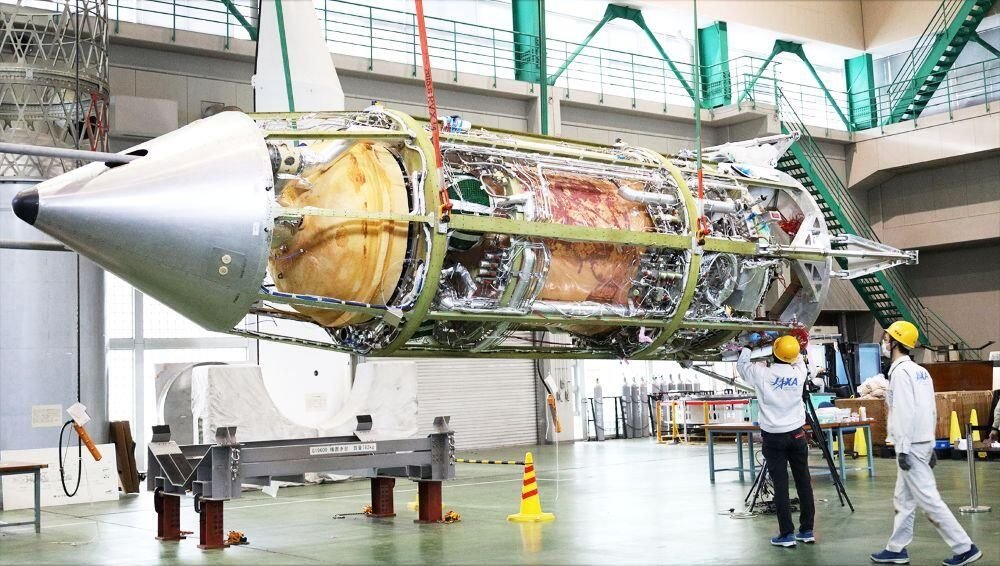
Japan’s space agency has flown and landed an experimental rocket built to demonstrate the technology required for a reusable rocket.
The Reusable Vehicle eXperiment (RV-X), developed by the Japan Aerospace Exploration Agency (JAXA) with Mitsubishi Heavy Industries, lifted off, hovered and returned to its pad during a flight lasting about 40 seconds. The test was conducted at the Noshiro Rocket Testing Center in Akita Prefecture, northern Japan.
The vehicle rose about 36ft (11m), then moved 52ft (16m) horizontally while holding a vertical attitude, before descending under control to land. JAXA reported no major issues with the vehicle after the landing and said it would analyze the flight data.
“We completed the test flight properly and obtained data that we had wanted,” Takashi Ito, research and development manager at JAXA, said at a press conference reported by Jiji Press. “We’re relieved after [the test rocket] properly took off and landed.”
The 24ft (7.3m) long, 5.9ft (1.8m) diameter vehicle burns liquid hydrogen and serves as a prototype for the reusable first stage of future large rockets. It uses an engine built for enhanced durability, which has withstood 165 combustion tests, and four shock-absorbing landing legs.
The RV-X is a vertical-take-off-and-vertical-landing (VTVL) demonstrator, a configuration first flown by the agency in March to establish the navigation, guidance and landing control logic absent from Japan’s expendable rockets.
The flight caps a program that ran ground firing tests at Noshiro from 2018 to establish basic vehicle operating procedures and confirm engine performance at various thrust levels, said JAXA. Those campaigns were followed by drop tests to characterize the shock absorbance and overturn-prevention behavior of the landing gear.
JAXA plans to fly the vehicle to an altitude of about 328ft (100m) in later tests, extending the flight envelope before attempting higher-altitude returns. Data from the program is intended to feed the Cooperative Action Leading to Launcher Innovation for Stage Toss-back Operation (CALLISTO), a larger reusable-stage demonstrator being developed by JAXA with France and Germany.
Reusable first stages, pioneered commercially by SpaceX, are central to efforts to cut launch costs and raise flight cadence. USA-based SpaceX and Blue Origin are currently the only country to have achieved rocket reuse, and Japan is pursuing the capability to stay competitive in the global launch market.
The agency’s stated aim is aircraft-like, high-frequency flights using the same vehicle, a goal it says requires fundamentally changing how expendable rockets are operated. Establishing that operating method with the RV-X is intended to underpin the development of a reusable flagship stage.
