



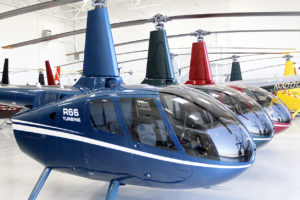
 KULR Technology Group, has announced co-development collaboration with Robinson Helicopter Company (RHC) to develop a next-generation, high-performance battery system for the eR66 battery-electric helicopter demonstrator.
The agreement between RHC and KULR establishes a comprehensive framework for joint research, engineering, and prototyping. By leveraging RHC’s California-based manufacturing and KULR’s Texas operations, the collaboration has set itself a number of goals including critical improvements in energy density, thermal stability, and operational efficiency specifically for the eR66 platform. Lower long-term operational costs and improve sustainability. Directly contribute to the realisation of zero-emission flight through innovative propulsion and battery technologies.
“The development of a battery electric R66 helicopter alongside KULR, represents an important shift in how we serve our global commercial and civil operators. By integrating electric propulsion, we aren’t just reducing our environmental impact; we are unlocking critical new capabilities for life-saving missions,” said David Smith, president and CEO of Robinson . “For use cases like rapid organ and tissue transport, the reduced acoustic signature and zero-emission profile ensure that time-sensitive, low-emission deliveries are faster, quieter, and more sustainable than ever before.”
The initiative complements RHC’s ongoing electrification program and supports the Company’s path toward a production-ready electric variant of the proven R66. The eR66 is positioned to deliver reliable, affordable, low-noise, and zero-emission performance for high-demand applications such as organ transport and short-haul transport. Michael Mo, CEO of KULR, added, “Robinson Helicopter has built more civil helicopters than any manufacturer on Earth, and their commitment to reliability is exactly the standard KULR’s battery architecture is designed to meet. KULR’s battery systems have been qualified for NASA spaceflight. They were designed from day one for dual use: a primary flight cycle and a certified second life. The eR66 is where that architecture proves itself in rotorcraft.”
Meanwhile, Dr. Will Walker, CTO of KULR, commented, “Battery advancements are accelerating rapidly, enabling more capable electric flight regimes. The key challenge remains balancing high energy density and low weight with uncompromising safety. Our engineering team’s extensive background in designing fail-safe batteries for human rated applications will be critical to achieving the rigorous performance and certification goals for the eR66.”
Image: RHC
