


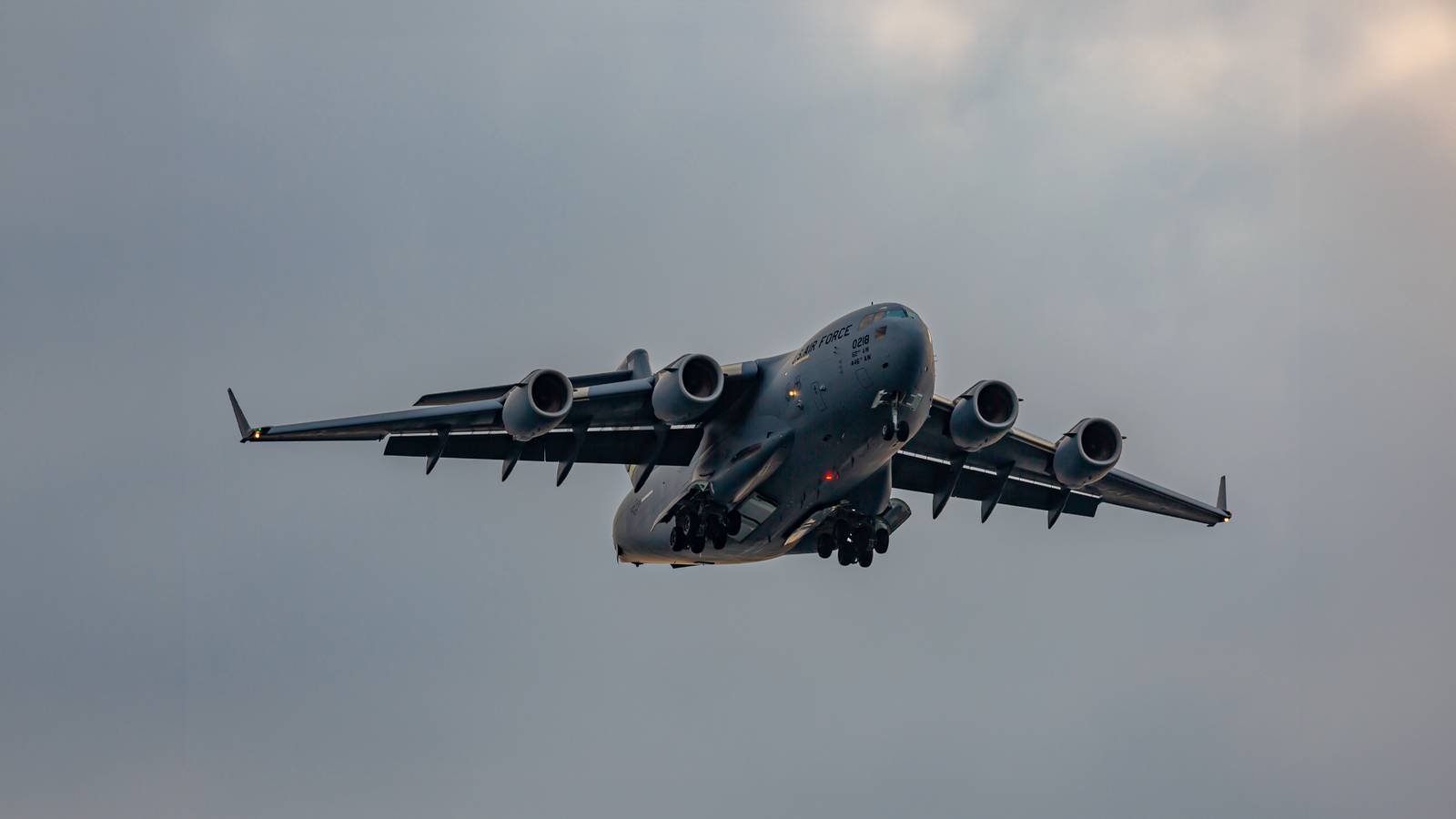
The Boeing C-17 Globemaster III remains one of the most capable military airlifters ever built, combining a 170,900-lb (77,519-kg) payload capacity with the ability to operate from runways as short as 3,500 feet (1,064 meters). Those same characteristics eventually sparked interest in a civilian derivative, the McDonnell Douglas MD-17, but turning a strategic military transport aircraft into a commercial freighter proved far more complicated than it initially appeared.
Taking into account US Air Mobility Command data, program history, and reporting from Simple Flying and Avgeekery, this analysis examines the design, economic, and operational factors that shaped the MD-17 concept. It also explores how the aircraft compares with established heavy-lift transports and why the project remains relevant as today’s cargo market shifts toward newer freighter platforms such as the Boeing 777-8F and Airbus A350F.
A Military Legend Built For A Different World
To understand why the MD-17 program collapsed, it helps to understand exactly what the C-17 was designed to do, and why those design priorities made it fundamentally incompatible with commercial operation. The Globemaster III was not engineered to minimize operating costs. It was engineered to project military power anywhere on Earth, including places that barely qualify as airfields. Every structural and aerodynamic decision in its 174-foot (53-meter) airframe flows directly from that mission.
As we have previously detailed in Simple Flying, the C-17’s extraordinary short-field performance stems from a specific combination of design choices: a high-lift wing, leading-edge slats, and externally blown flaps that together allow the aircraft to operate from just 3,500 feet (1,064 meters) of unpaved, austere runway — something no widebody freighter in commercial service would ever be asked to do. Those same features, however, carry a steep aerodynamic penalty at the cruise altitudes where commercial operators spend most of their time, burning fuel on every transatlantic or transpacific sector.
The C-17’s general characteristics are worth restating in full, because they illuminate both the aircraft’s remarkable capability and the commercial problem at its core. According to the AMC fact sheet, the Globemaster III features four Pratt & Whitney F117-PW-100 turbofan engines, each rated at 40,440 pounds of thrust and derived from the commercial PW2040 used on the Boeing 757, and a cargo compartment measuring 88 feet (26.82 meters) long by 18 feet (5.48 meters) wide. Its key operational features include:
- Maximum payload capacity of 170,900 lb (77,519 kg) across 18 pallet positions
- Takeoff and landing on runways as short as 3,500 feet (1,064 meters) and only 90 feet (27.4 meters) wide
- Drive-on/drive-off rear ramp capable of accommodating a 69-ton M1 Abrams main battle tank
- Thrust reversers powerful enough to taxi the aircraft backwards on the ground
- Three-point star-turn capability on a runway just 90 feet (27.4 meters) wide
- Airdrop capacity of 102 fully equipped paratroopers
- Maximum gross takeoff weight of 585,000 lb (265,352 kg)
The BC-17X: Boeing’s Commercial Gamble

According to Avgeekery.com, McDonnell Douglas was first to formally pitch a commercial Globemaster derivative in 1997, during the final months of the company’s independent existence. When Boeing completed its acquisition of McDonnell Douglas later that same year, it inherited both the aircraft program and the commercial concept, renaming the project the BC-17X. Boeing sent out several press releases during the late 1990s indicating it was close to launching the civilian variant, and the program accumulated at least two high-profile false starts.
Catch what other flight trackers miss
Emergency squawks, holds, NOTAMs — live signals, no signup.
Open tracker
Catch what other flight trackers miss
Emergency squawks, holds, NOTAMs — live signals, no signup.
Open tracker
The most inventive approach involved a structure modeled after the Civil Reserve Air Fleet (CRAF) — the US Department of Defense program through which commercial operators commit their aircraft to military service during national emergencies, in exchange for peacetime access to government cargo contracts. Under the BC-17 version of this concept, civilian operators would fly the aircraft commercially in peacetime, with the understanding that the military retained the right to recall the fleet in a crisis. It was a creative attempt to bridge the gap between the C-17’s military utility and the commercial world’s need for reliable returns on capital.
The CRAF-style arrangement never attracted a single committed customer. Operators looked at the terms, looked at the numbers, and walked away. As Avgeekery.com noted, the fundamental issue was never political or contractual, but rather economic. The BC-17’s military core, which made it so formidable on the flight line, made it deeply unattractive on the spreadsheet. Boeing eventually allowed the program to fade without fanfare, and the C-17 production line at Long Beach, California, closed in 2015 after delivering 279 aircraft.
Why The C-17 Globemaster Is Getting A Complete Digital Cockpit Overhaul To Fly Until 2075
The shift to a Modular Open Systems Architecture (MOSA) in the C-17’s cockpit will enable faster upgrades and ensure long-term sustainability.
The Numbers That Killed The Deal

No analysis of the BC-17X’s failure is complete without working through the raw operating economics. The C-17 was designed with a blunt nose and a high-lift wing optimized for short-field performance and heavy tactical loads, not for minimizing drag at 35,000 feet (10,668 meters) over the North Atlantic. At cruise altitude, the aerodynamic penalties of that military-optimized geometry translate directly into a fuel-burn figure that no cargo operator would willingly accept.
According to Avgeekery.com, a C-17 burns approximately three-quarters as much fuel per hour as a Boeing 747-400, yet it can only carry about half the number of cargo pallets. The 747-400F accommodates 30 pallet positions on the main deck alone, compared to the C-17’s 18. That arithmetic is brutal: an operator would be paying nearly 747-level fuel costs while generating roughly 767-level revenue. As written on Simple Flying, the Boeing 767-300F, which is a comparable-sized commercial freighter, commands its market position precisely because it offers a favorable balance of operating costs and revenue payload, a balance the BC-17 was structurally incapable of achieving.
The acquisition cost compounded the problem. According to the AMC fact sheet, the C-17’s unit cost stood at $202.3 million in fiscal year 1998 constant dollars, at a time when a used Boeing 747-400F could be acquired for a fraction of that figure and put to work immediately on established global freight routes. A brand-new aircraft requiring full FAA type certification would add years and hundreds of millions of dollars to an already difficult business case, for an airframe whose operating economics were already deeply problematic. In commercial aviation, there is no amount of tactical capability that compensates for a genuinely poor cost-per-ton-mile.
ITAR, Certification, And The Regulatory Wall

Even if the economics had been workable (but they were not!), the BC-17 program faced a second set of barriers that would have been nearly as difficult to overcome: the International Traffic in Arms Regulations (ITAR) and the requirements for FAA type certification. Understanding these two layers is essential to answering a question that regularly comes up in aviation discussions: why do Russian-built military transports like the Ilyushin Il-76 and the Ukrainian Antonov An-124 operate commercially on the international market, while an American military transport like the C-17 cannot?
ITAR governs the export of US defense-related hardware, technology, and technical data. The C-17 is packed with military-grade avionics, communications systems, and sensors that fall under ITAR control, meaning any foreign commercial operator would require extensive US government export licenses before receiving an aircraft. For an international cargo company looking to deploy aircraft across dozens of countries with different regulatory environments, that administrative burden borders on operational impossibility. The Il-76 and An-124, by contrast, were developed as Soviet military platforms under an entirely different regulatory framework. When Soviet-era operators like Volga-Dnepr began offering their services commercially after 1991, there were no equivalent export restrictions blocking international deployment — and no Western airworthiness authority whose approval was a prerequisite for revenue service. The two situations are simply not comparable.
The FAA certification challenge deserves separate consideration. Certifying a military transport aircraft for commercial operations requires demonstrating compliance with an entirely different regulatory regime from military airworthiness standards, and systems that satisfy military specifications may require significant redesign to meet civil requirements. As noted by Simple Flying, the C-17’s development was already shaped by enormous cost pressures and near-cancellation in the early 1990s; layering a full civilian certification program on top would have required an investment no prospective commercial operator was willing to underwrite for an aircraft with structurally problematic operating economics.
Why Did McDonnell Douglas Build The C-17 Globemaster With 4 Engines?
The C-17 Globemaster III’s four-engine design holds the key to its unrivaled capabilities, but was this a choice of power or necessity?
What The Soviet Comparison Actually Tells Us

The Il-76 and An-124 comparison resurfaces whenever the C-17’s commercial potential is discussed, but it deserves closer scrutiny because it reflects a misunderstanding of why those aircraft entered commercial service in the first place. The assumption that Boeing could likewise commercialize the C-17 simply because operators of ex-Soviet transports did so does not hold once the design and regulatory distinctions are taken into account.
The Il-76 is a conventional high-wing jet transport with a swept wing designed to achieve reasonable cruise efficiency at commercial altitudes. It was never optimized for 3,500-foot (1,064-meter) austere strips or powered-reverser taxiing, the way the C-17 was. The An-124 Ruslan is even more purpose-built for outsized heavy cargo, with a nose door that opens for drive-through loading — a feature commercial operators prize for industrial machinery and energy equipment. Both aircraft were designed under Soviet military budgets, but neither carries the ITAR entanglements of a US defense platform or equivalents, and both entered the commercial market through a certification and registration process that, while demanding, was not compounded by US export control law applying to every single customer and every single destination. They operate commercially because the path to doing so was legally and practically open to them. For the C-17, it never was.
There is also a capability argument that cuts against the C-17 in commercial terms. The Il-76 and An-124 are preferred in the civilian heavy-lift market precisely because their cargo systems and loading geometries are optimized for oversized commercial loads. The C-17’s rear ramp and cargo floor are brilliantly engineered for military vehicles, palletized military cargo, and airdrop operations, not for the turbines, yacht hulls, and oversized industrial loads that define the commercial niche those Russian types serve. The C-17 would be bringing the wrong set of specialist skills to a job that already has experienced candidates.
Could A Commercial C-17 Ever Come Back?

The BC-17X program faded away without ever securing a launch customer, and the Long Beach production line that built every Globemaster closed in 2015. The economic conditions that doomed the project in the late 1990s have not improved; if anything, the emergence of fuel-efficient widebody freighters such as the Boeing 777F, the Boeing 777-8F, now entering production, and the Airbus A350F has raised the commercial threshold even further. Any renewed effort to commercialize the C-17 would face a freight market that is both more cost-competitive and more heavily regulated on environmental grounds than the one Boeing confronted when it last considered the concept.
Interest in the aircraft certainly has not disappeared. In 2025, a Qatar Amiri Flight C-17 owned on behalf of Qatar Emiri Air Force drew widespread attention after appearing in full Qatar Airways cargo markings, prompting renewed speculation about whether a civilian Globemaster could ever exist. As noted by Simple Flying’s coverage of the aircraft, however, the aircraft remained a military-operated airlifter despite the branding, underscoring the distinction between a military strategic transport and a true commercial freighter. The visual overlap may have looked convincing, but the underlying economics and certification realities have not changed. The same barriers that killed the BC-17X in 1997, aerodynamic inefficiency at cruise, ITAR entanglements, the FAA certification gap, and a unit price north of $200 million, are still there.
The AMC fact sheet on the C-17 describes it as the most flexible cargo aircraft to enter the airlift force — a designation that inadvertently explains the commercial problem in a single sentence. In military logistics, flexibility is the mission. In commercial aviation, flexibility is a cost center. Every feature that allows the Globemaster to land on a gravel strip in a conflict zone, taxi backwards out of a parking spot, or airdrop a battalion’s worth of paratroopers over a drop zone is a feature that adds weight, adds drag, and costs money on every scheduled freight sector between proper airports with proper runways. The BC-17X was not a bad idea because Boeing executed it poorly. It was a commercially unworkable idea because the C-17’s greatest military virtues are precisely what make it a commercial liability — and that tension was never going to resolve itself, no matter how creative the financing structure.
