


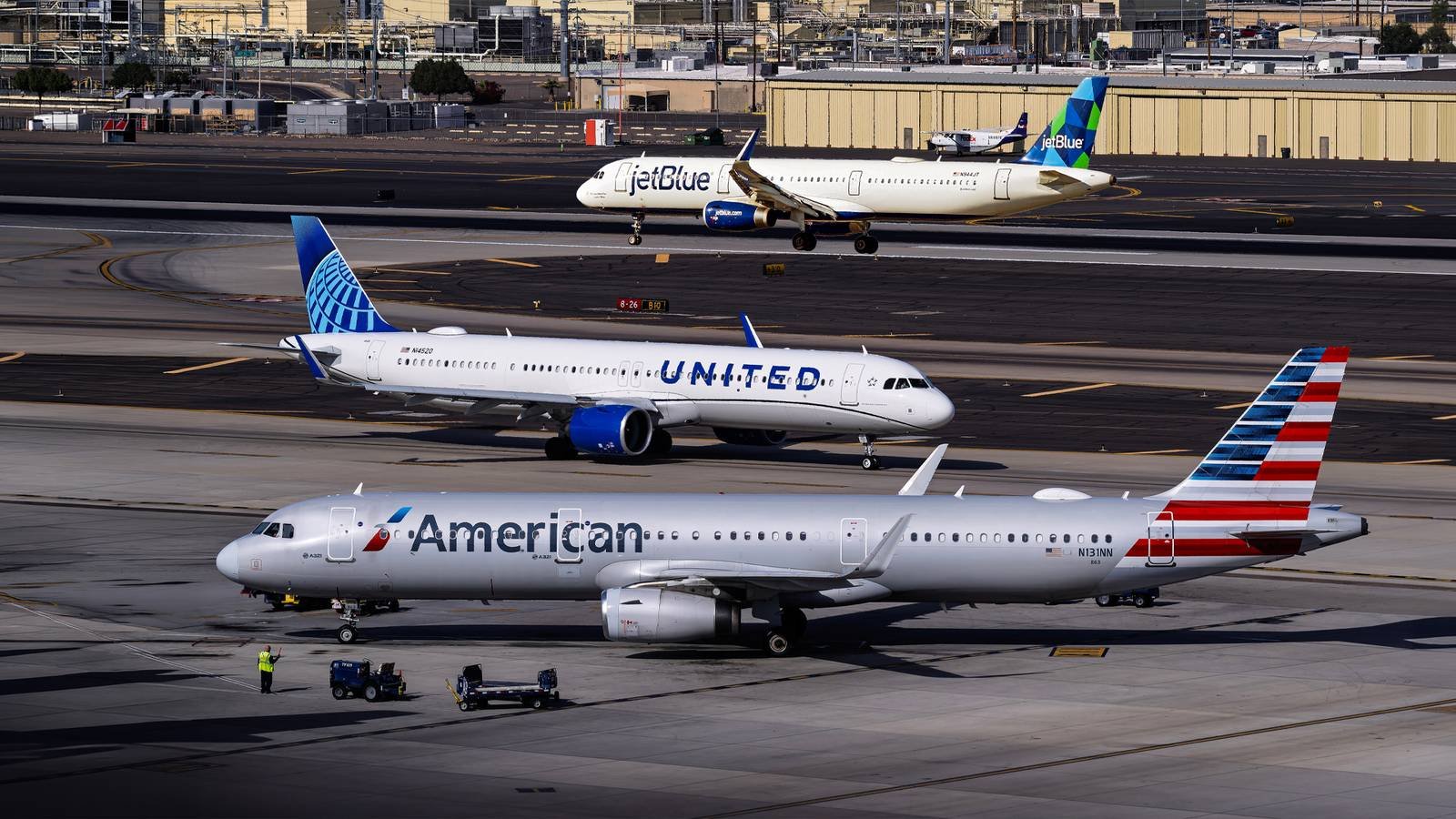
In the midst of an increasingly K-shaped airline industry in the US and rising fuel costs from the war in Iran, word is now spreading of perhaps the most insane proposal in the business. An anonymous source from the White House is alleging that United Airlines CEO Scott Kirby spoke with President Donald Trump about buying American Airlines. The combined airline would have large hubs in 16 airports, over 2,000 mainline planes, and a roughly 35% market share in the United States, dwarfing any other airline in the world.
This is a crazy idea, and this level of market consolidation would stand almost no chance at being approved, even with the current administration being considered merger-friendly. Instead, the common line of thinking is that Kirby has proposed this idea to make the concept of acquiring JetBlue more appealing. JetBlue has not made money since 2019, and the rising fuel prices seem like the death knell for the carrier. United Airlines has long appeared as the most likely candidate to acquire JetBlue, and compared to a merger with American, the concept isn’t so crazy.
The Circumstances Surrounding A United-JetBlue Merger
Scott Kirby himself has sent mixed signals on the idea of merging with JetBlue, at times stating that ‘the ball is going to be in JetBlue’s court’ while also correctly pointing out that mergers use up valuable time and resources. United has made leaps in product and technology in recent years, so if a merger with JetBlue has the potential to be distracting, an American Airlines merger would be significantly more so. United is extremely successful today, and acquiring American would require massive concessions if it were approved. In other words, it’s doubtful that United would really want to merge with American.
It’s generally considered by many US airline executives that now is the best time for consolidation, since the Trump administration is considered to be more merger-friendly than the Biden administration. However,  United Airlines is the world’s largest airline by some metrics, and it’s also the leading airline in New York, home to JetBlue’s largest operations. As such, a merger or acquisition between the two parties would be a difficult proposition, even with the current political climate.
But as with all things in life, success in the airline business sometimes comes from personal relationships. Scott Kirby has made extremely flattering comments regarding the Trump administration, and the comments regarding a merger with American are alleged to have been made during a conversation between Kirby and Trump. Therefore, if you’re Kirby looking to conduct an acquisition that will have difficulty getting approved, proposing a merger with American might be a smart way to make a JetBlue merger more reasonable.
Why Would United Airlines Want JetBlue?

United Airlines is the largest airline in the New York metropolitan area through its hub in Newark Liberty International Airport, but it lacks any presence at New York JFK Airport. Given that it only serves LaGuardia Airport as a spoke, this means that the carrier loses out on high-value corporate contracts that prefer JFK over Newark, and is essentially locked out from attracting wealthy individuals in Long Island. Kirby himself has stated that United’s withdrawal from JFK in 2015 was a mistake, and JFK is also slot-controlled, meaning that United can’t easily return.
JetBlue is the second-largest airline at JFK (after Delta Air Lines). The two airlines already partner together under the ‘Blue Sky’ agreement, and part of the deal also agrees that United will acquire a small number of JFK slots from the Long Island City-based carrier for transcontinental services. If it wants to build up a larger presence at what is largely considered the city’s premier gateway, then acquiring JetBlue will be perhaps the only way to do so, especially given the political climate.
JetBlue Hub Airports | United Airlines Hub Airports |
|---|---|
Boston Logan International Airport (BOS) | Chicago O’Hare International Airport (ORD) |
Fort Lauderdale Hollywood International Airport (FLL) | Denver International Airport (DEN) |
John F. Kennedy International Airport (JFK) | Guam Antonio B. Won Pat International Airport (GUM) |
Orlando International Airport (MCO) | Houston George Bush Intercontinental Airport (IAH) |
San Juan Luis Munoz Marin International Airport (SJU) | Los Angeles International Airport (LAX) |
Newark Liberty International Airport (EWR) | |
San Francisco International Airport (SFO) | |
Washington Dulles International Airport (IAD) |
In addition, JetBlue also has a large hub in  Boston Logan International Airport, located in one of the largest and wealthiest business centers in the country. While United already has a secondary Northeastern hub in Washington Dulles International Airport, a Boston hub would still be immensely lucrative because of its strong, high-yielding local demand. Meanwhile, JetBlue also has substantial operations in Orlando and Fort Lauderdale, whereas United lacks a hub in the Southeast US.

Third Time’s A Charm? The Past, Present, And Future Of United Airlines At New York-JFK
The last time United Airlines had flights out of New York-JFK was in 2022.
The Counterpoint For Merging With JetBlue

From a network perspective, JetBlue makes for an overall attractive merger partner, and the carrier’s Airbus fleet would fit in well with United’s growing fleet of A321neos (although its Airbus A220s would be foreign to United). However, JetBlue founder (and current CEO of Breeze Airways) David Neeleman’s take on the issue is that United isn’t fully sold on the idea of taking on JetBlue, as seen in a leaked recording reported on X by JonNYC.
Neeleman was asked by Breeze pilots about JetBlue’s future, and he quoted the common line of thinking that Scott Kirby proposed merging with American to make a JetBlue merger appear more appealing. However, he also stated that executives within United Airlines are concerned about JetBlue’s current debt, which, according to Neeleman, could rise to as high as $9 billion if fuel costs stay high. If Neeleman’s words are true, United executives don’t want to take on that debt.
Neeleman also stated that neither Southwest nor Alaska Airlines would be interested in acquiring JetBlue, and predicted bankruptcy for the failing airline that he originally started. Of course, Neeleman is the CEO of a competing airline, and his conclusions are somewhat speculative. This doesn’t mean that United isn’t concerned about taking on $9 billion of debt, especially considering that the company has roughly $31 billion of its own debt to worry about. What remains to be seen is if this really will stop the Chicago-based carrier from making a move for JetBlue anyway.
JetBlue Is Exploring The Idea Of Finding A Buyer

JetBlue management has hired analysts to explore the viability of selling itself to another airline, including planning scenarios on the regulatory approval of a deal with either United Airlines,  Alaska Airlines, or
  Southwest Airlines. United is already considered the front-runner for the aforementioned reasons, but would probably also face the highest amount of regulatory scrutiny. Alaska and Southwest, however, are the more interesting mentions.
Regarding the network, Alaska Airlines is perhaps the best option, as it’s a juggernaut in the Pacific Northwest while JetBlue’s network is concentrated on the US East Coast. Fleetwise, while Alaska primarily operates Boeing airliners, it has a small fleet of Airbus A321neos that it wants to grow, along with a fleet of A330s that it’s committed to retaining. However, Alaska has just finished acquiring Hawaiian Airlines (from which the A321neos and A330s came), and it’s unlikely that it will have the finances or will to enter into another transaction, especially since JetBlue would be its largest yet.
JetBlue Types | United Airlines Types | Alaska Airlines Types | Southwest Airlines Types |
|---|---|---|---|
Airbus A220 | Airbus A319/A320 (IAE) | Boeing 737 | Boeing 737 |
Airbus A320/A321 (IAE) | Airbus A321neo (PW1000G) | Boeing 787 | |
Airbus A321neo (PW1000G) | Boeing 737 | Hawaiian Airlines | |
Boeing 757 | Airbus A321neo (PW1000G) | ||
Boeing 767 | Airbus A330 | ||
Boeing 777 | Boeing 717 | ||
Boeing 787 |
Southwest Airlines has improved its finances, but it operates a 737-only fleet with over 800 examples, and has long resisted adding a second type, let alone two Airbus narrowbodies. Meanwhile, Southwest primarily operates point-to-point routes between cities of varying size, but has avoided the Northeast’s biggest airports. While Southwest would benefit from JetBlue’s Florida operations, the rest of the carrier’s network doesn’t fit with Southwest’s business model.

United Airlines’ Return To New York-JFK: How Many Daily Flights Will It Operate?
The carrier will be operating seven daily flights.
JetBlue’s Market Standing

JetBlue holds a strong market position in New York and Boston, but it’s largely irrelevant outside of the Northeast and Florida. Airspace in the Northeast is complex and congested, making it difficult to run a reliable operation, and the carrier’s lack of reliability has harmed its reputation. Meanwhile, although its economy product is generally well-liked, it lacks a mainstream domestic first-class product to upsell customers to in many markets, where the real money is made. Although it is planning exactly that, called ‘Mini-Mint’, it’s arguably several years too late.
JetBlue has been unable to command a fare premium for its current product, and it’s having difficulty competing against  Delta Air Lines in particular, which has a stronger brand with nationwide relevance and stronger operational reliability. With current fuel prices, David Neeleman predicts that JetBlue could lose close to $1.3 billion in 2026, and although current CEO Joanna Geraghty has denied that the carrier is considering bankruptcy, time is running out for New York’s hometown airline.
To top it all off, the current market conditions favor large carriers with extensive international networks and a premium brand image. Despite its strong Mint business class offering, the carrier as a whole lacks this premium brand to command higher fares, and not only is its long-haul network limited, but its domestic network is only relevant to low-yielding vacationers and Northeasterners.
