


MINNEAPOLIS — The proposed coast-to-coast merger of Union Pacific and Norfolk Southern is bad for the industry, a rival CEO warned, and would give the transcontinental behemoth a dominant 50% share of all U.S. rail freight.
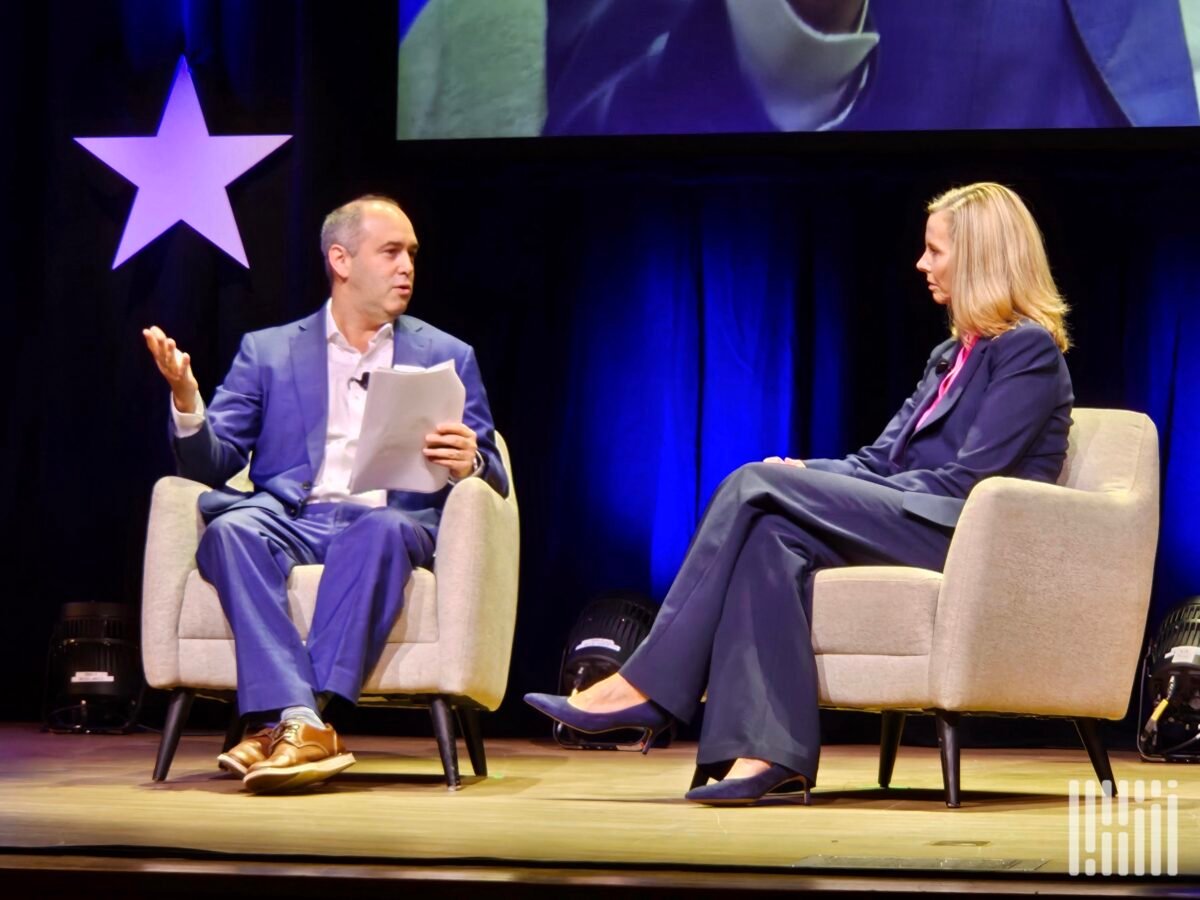
“We’ve had lots of opportunities to be very clear that we’re opposed to this merger, and we don’t think it’s good for the industry,” said Katie Farmer, chief executive of BNSF Railway. “Make no mistake, this is a consolidation of almost 50% of all the rail volume…to one road. When you consolidate 50% of all rail volume that moves under one carrier, you eliminate, or significantly reduce, flexibility for customers, optionality, and ultimately there’s going to be fewer interchange points. You have one railroad that is looking to optimize their network, and based on what’s happened in the past, that is not always good for customers.”
Farmer was the keynote interview Monday at the Association of American Short Line & Regional Railroad Association’s annual conference.
Warren Buffett, former chairman and CEO of BNSF parent Berkshire Hathaway (NYSE: BERK-B), and successor Greg Abel publicly dismissed speculation they would pursue their own merger with CSX (NASDAQ: CSX) or one of the Canadian carriers. BNSF’s vast network is a near-transcon itself, stretching from the West Coast to Alabama.
Farmer was also skeptical of the growth projections UP (NYSE: UNP) and NS (NYSE: NSC) included in their merger application, which it plans to resubmit by April 30 after the initial filing was rejected as incomplete by the Surface Transportation Board.
“They’re claiming that they’re going to grow volume with this new combined railroad by 12% in three years,” said Farmer, who has worked more than three decades in the business. “If you go back and look at the last large merger, the Union Pacific and Southern Pacific, UP’s volumes have actually declined by 13% in the last 10 years. At the same time, their average revenue per unit has increased 37% above all the other Class I networks. I’d be concerned about reduction of interchange options, reduction of flexibility, and optimization by that very large railroad of their own network And then think about the customers, which is where we all have to start, who have fewer options and higher rates.
“That’s what’s happened over time. For every merger that’s happened, it plays out the same way.”
When that growth fails to materialize, Farmer warned, UP would likely sell off underperforming portions of the network. She called for regulatory oversight to safeguard local service and the customer experience, and other factors that are important for growth.
Farmer claimed that the tougher rules formulated by the STB in 2001 after post-consolidation service meltdowns were meant to dissuade future mergers.
Under the new rules, Farmer said, a merger has to enhance competition for the customer, and it has to be in the public interest. She said UP-NS mistakenly conflates the two.
“Is it in the public interest to take trucks off the highway — of course it is,” Farmer said, referring to 2 million truckloads UP says the merger will shift from road to rail. “Is it enhancing competition? That’s not what the 2001 new merger rules were about, they were about existing rail customers. And so we have to only look at existing rail customers, and look very carefully at the conditions that are being proposed for enhancing competition.”
Farmer said that the industry should demand the STB impose concessions that would enhance competition, improve service and grow volumes.
“I’ve got a lot of folks working together, figuring out exactly what those suggestions are.”
Farmer also took issue with UP’s proposal for committed gateways, interchange points it says it will keep open on commercially reasonable terms so shippers can still hand off traffic to another railroad instead of being forced onto a single-line route.
She noted UP in filings opposing the Canadian Pacific (NYSE: CP)-Kansas City Southern merger in 2022 in fact did not believe open gateways would preserve competition.
“I’ll tell you, though, I agree with them. Case in point, our railroad. We used to do 10,000 units a month at the [U.S.-Mexico] Laredo [Texas] gateway. With the open gateway concept as part of the CP-KCS merger, today we move zero. Is the gateway open? Sure, operationally. Is it economically open? No. But it’s not about that we lost volume. It’s that our customers lost a competitive option.”
Farmer said that UP’s open gateway only applies to about four-tenths of a percent of all rail freight, and excludes shippers of hazardous materials, unit trains, and intermodal.
“And, if you’re lucky enough to be in that four-tenths of a percent, you get a reward of the top 30% of all the rates that UP publishes today. And you only get to use them during the STB oversight period.”
Subscribe to FreightWaves’ Rail e-newsletter and get the latest insights on rail freight right in your inbox.
Read more articles by Stuart Chirls here.
Related coverage:
New business: South Carolina rail route will see first trains since 2012
Norfolk Southern awarded control of disputed eastern port rail line
Best month in years marks broad US rail recovery
Maryland Senate expects to pass two-person train crew bill
The post Merged UP-NS would control half of all rail freight: BNSF CEO appeared first on FreightWaves.
