


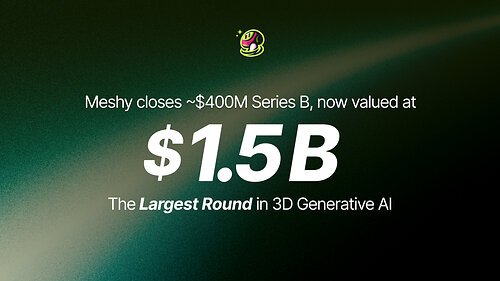
A generative AI platform focused on 3D content Meshy has closed a Series B of nearly $400 million at a $1.5 billion valuation, labeled as the largest round raised by a company built specifically for AI 3D generation and the company’s first publicly disclosed valuation. The round drew participation from every existing investor alongside new global backers, with proceeds earmarked primarily for R&D and international expansion.
The raise rests on unusual commercial traction for the category. Meshy reports annual recurring revenue growing roughly 12x year over year as of July 2026, with more than 12 million registered users and over 100 million models created.
Four product updates aimed at the print bed
Founded by MIT PhD Ethan Hu, the company generates a usable 3D model from a single line of text or one image in about a minute, work it frames as previously requiring specialist skills, expensive software and weeks of time.
Alongside the funding, Meshy announced four releases, three of them live now. The headline item is Meshy 3D Agent, which the company describes as the first AI agent for 3D creation. It turns a conversation, text line, photo or sketch into a print-ready model exported as FBX, OBJ, GLB or STL, brainstorming ideas and generating concepts in batches before converting a chosen concept into a model in one step. Meshy claims a slicer success rate of up to 97% for 3D printing, and Unity, Unreal and Blender compatibility for game work.
Auto Split targets what is arguably the hardest step between a generated model and a finished object: breaking it into printable, reassemblable parts. The tool performs the split in one click, repairing surfaces and arranging parts on the print bed, with each part a closed watertight solid and seams placed along concealed boundaries. Meshy says the output has been verified on physical printers, and draws a pointed contrast with rival tools whose part segmentation it characterises as colour-coded for on-screen display and prone to falling apart in the real world.
Smart Topology, an in-house model, generates native clean geometry in about ten seconds with polygon count controllable between 100 and 15,000, aimed at real-time rendering work. 8K Texture, offering higher-resolution texture generation, is rolling out soon.
Five of the ten largest tech companies
Meshy says teams at five of the world’s ten largest technology companies by market capitalisation or valuation are building with its tools. Named customers and partners span games, Nexon, NetEase Games and 37 Interactive Entertainment, and the consumer 3D printing sector, including Bambu Lab, Creality, Elegoo, FlashForge and xTool. Hugo Boss and Sweden’s museum of art and design also appear on the list.
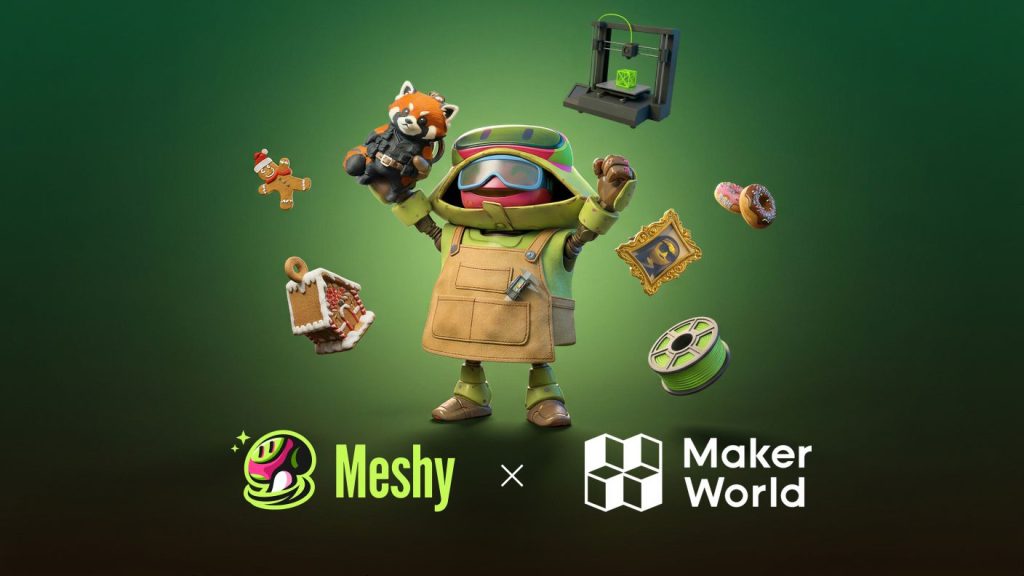
That printer-brand concentration is not incidental. In March 2026, Meshy’s generation engine was embedded into Bambu Lab’s MakerWorld via the MakerLab hub, letting users convert a photo into a print-ready file in-browser, alongside a Multi-Color Printing update that maps textures to filament zones automatically for Bambu’s AMS. A month later, the company connected its tools to Formlabs’ Form Now print-on-demand service, debuted at RAPID + TCT 2026 in Boston and described by both parties as the first AI generation pipeline linked end to end to professional-grade manufacturing.
Lowering the cost of making something real
Meshy frames its purpose as narrowing the distance between imagining an object and holding one. That gap has shrunk from specialist 3D modelling skills and software to a prompt and about a dollar. But the barrier was never only creative: a generated mesh still had to survive repair, splitting, slicing and printing before it became an object, and each step quietly excluded many of the people generation had just let in.
The same ambition has produced a crowded field. Womp launched a generative AI platform that lets users generate a model from a text prompt or image, refine it in a browser workspace with a dedicated print mode for hollowing and printability checks, then order the physical part through its own stereolithography service, no software, no printer.
Autodesk introduced Wonder 3D for editable 3D assets from text and images, bringing the same idea inside an incumbent design suite. On the research side, NVIDIA’s PartPacker generates part-based, editable models from a single 2D image with STL and 3MF export for multi-material printing, the same part-splitting problem Auto Split addresses, approached from a lab.
Generation is commoditising faster than the pipeline around it, which is why the money now follows workflow rather than model quality. Meshy is saying the pipeline ends at a print bed. Its own headline figure counts models generated, not objects made.
3D Printing Industry is inviting speakers for its 2026 Additive Manufacturing Applications (AMA) series, covering Energy, Healthcare, Automotive and Mobility, Aerospace, Space and Defense, and Software. Each online event focuses on real production deployments, qualification, and supply chain integration. Practitioners interested in contributing can complete the call for speakers form here.
To stay up to date with the latest 3D printing news, don’t forget to subscribe to the 3D Printing Industry newsletter or follow us on LinkedIn.
Explore the full Future of 3D Printing and Executive Survey series from 3D Printing Industry, featuring perspectives from CEOs, engineers, and industry leaders on the industrialization of additive manufacturing, 3D printing industry trends 2026, qualification, supply chains, and additive manufacturing industry analysis.
Featured image shows Meshy Raises Nearly $400 Million. Image via Meshy.
