


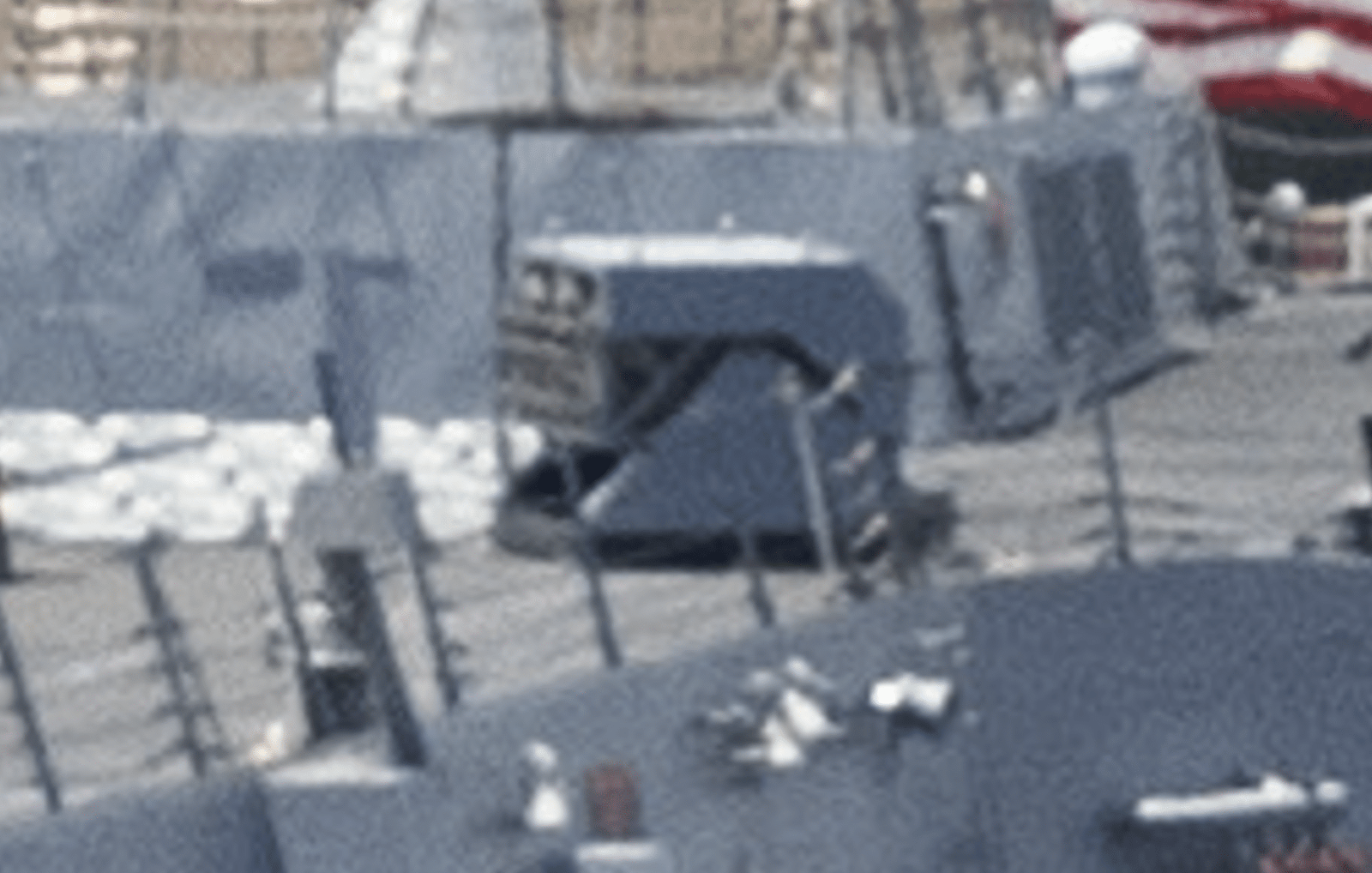
An upgraded Coyote Counter-UAS (C-UAS) launcher has been installed on the Pearl Harbor-based USS Carl M. Levin (DDG 120), marking the first known dedicated shipboard launcher for Raytheon’s combat-proven C-UAS on a U.S. Navy ship.
The service has been grappling with a series of shortcomings related to counter-UAS capabilities since it began combat operations in the Middle East in 2023, including one instance of a near-impact in June 2025 that left a U.S. Navy destroyer with just 100 yards to spare from being hit by a hostile drone. To supplement the current spectrum of anti-air weapons like ESSM and SM-6, the service has been experimenting with a wide range of new capabilities that were tested on ships in the USS Gerald R. Ford CSG.
Now, the U.S. Navy is hard pressing towards a dedicated suite of counter-UAS systems as part of its C-UAS Afloat program, Naval News has learned.
The launcher seen on the Carl M. Levin is the first in a series of upgrades being installed on four ships across the fleet as part of the next Carrier Strike Group (CSG) deployment. The launcher doubles the capacity of Coyote missiles from four to eight missiles and adapts the launcher for conditions at sea, according to a Navy spokesperson.
“By updating the Coyote launcher to double its capacity from four to eight cells and further adapting the system for conditions at sea, the Navy is fielding a more resilient and lethal system.”
U.S. Navy Spokesperson
The U.S. Navy will also continue to leverage existing assets for its various defensive and offensive enhancement programs, according to the spokesperson. The installation of this new Coyote launcher is the first “clear and repeatable model for accelerating the deployment of advanced capabilities throughout the Fleet”.
Anduril’s Roadrunner, RTX’s Coyote, and BAE Systems’ Hypervelocity Projectile were all tested during the Ford‘s east coast pre-deployment trials, with least two of those systems known to have been deployed on four ships in response to the operational experiences of ship crews in the Red Sea and Mediterranean, which Aviation Week was first to report on.
Previous variants of the Coyote C-UAS launcher were seen on USS Bainbridge (DDG 96) and featured very few differences compared to its mainstream land-based counterparts.

Current Coyote interceptors come in two variants, the Coyote Block 2 kinetic interceptor and Coyote Block 3NK non-kinetic interceptor. The Block 2 variant has seen use during the war in Iran, including instances where Coyote interceptors served as the last line of defense guarding critical infrastructure. The Block 3 non-kinetic variant has shown success in RTX-led testing.
Funding for C-UAS first came for urgent requirements in the Red Sea and wider Middle East. With a blockade now underway in the Gulf of Oman, It is unclear if the U.S. Navy plans to send a Pacific-based CSG to CENTCOM.
