


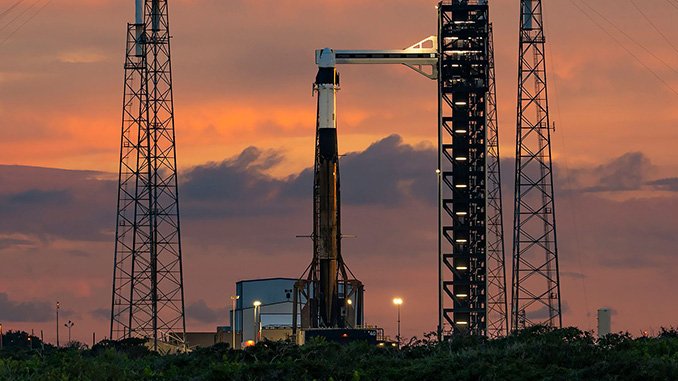
SpaceX and NASA are preparing to fly a resupply cargo flight to the International Space Station on Tuesday morning.
The pre-sunrise launch will be SpaceX’s 35th mission to the orbiting outpost as part of NASA’s Commercial Resupply Services (CRS) contract.
Liftoff of SpaceX’s Falcon 9 rocket from Space Launch Complex 40 at Cape Canaveral Space Force Station is scheduled for 6:33 a.m. EDT (1033 UTC). The rocket will fly on a northeasterly trajectory upon leaving the pad.
If all goes well, the Cargo Dragon spacecraft, tail number C211, will dock with the zenith port of the Harmony module on Oct. 15 around 11 a.m. EDT (1500 UTC). The space-facing docking port was recently vacated by the Crew Dragon Freedom, which safely delivered the four members of NASA’s SpaceX Crew-12 mission back to Earth with a splashdown on Oct. 8.
Spaceflight Now will have live coverage beginning about an hour prior to liftoff.
SpaceX will launch the mission using the Falcon 9 first stage booster B1096. This will be its eighth launch after previously flying NASA’s IMAP, CRS-34, NROL-77, NROL-95, GPS-III 9, Kuiper Falcon 01, and Starlink 6-87.
It is the fourth flight for Dragon C211. It’s previous cargo runs included CRS-26, -29, and -33. The spacecraft will remain docked to the ISS for about a month following docking.
Stowed in the unpressurized trunk of Dragon C211 is the final pair of ISS Roll-Out Solar Arrays (iROSAs), which will help to augment the power generation of the aging space station. The spacecraft also contains a clamshell apparatus that will house the failed Canadarm2 joint that was removed during the June 30 spacewalk.
“Additional equipment we’re launching includes a dose pump for our toilet, some pre-treat quality sensors, a robot microcontical tool used for space station maintenance and utilization tasks with external replacement units and impairments,” said Bill Spetch, the deputy manager of Commercial for NASA’s Low Earth Orbit Program.
“We also have a wealth of science experiments on board, including studies to manufacture artificial retinas, understand how microgravity affects the growth of 3D heart tissue models, study how glass forms when made with non-traditional elements, and better understand how inflammation is linked to neurodegenerative diseases.”
