


The U.S. Navy released new technical requirements Aug. 11 designed to rapidly scale metallic 3D printing across the submarine enterprise, stripping away administrative and engineering hurdles that have slowed the use of additive manufacturing (AM) in submarine construction, maintenance and repair.
A New Pathway to Replace Legacy Parts
The newly approved Project Peculiar Document (PPD) 802-8436658 establishes a streamlined, repeatable technical pathway for substituting traditional cast and wrought submarine components with 3D printed metallic equivalents. Previously, swapping in an AM part triggered a lengthy chain of part-by-part engineering assessments, manual drawing revisions and repeated first-article testing. The new framework eliminates that bottleneck, letting engineers bypass redundant approvals and field AM components faster.
The requirements are authorized for immediate use across submarine design, construction, overhaul and repair, and are indexed through the Defense Logistics Agency‘s Quick Search Portal and the Navy Digital Sea Resource Portal.
Vice Adm. Robert Gaucher, Director of Submarine Programs, said the change addresses a persistent supply chain problem. “This is exactly the type of barrier we must remove if we are going to unlock 21st century technology to get our submarine programs on plan and ahead of the threat,” he said. “Additive manufacturing gives us a tool to get after supply chain constraints and part obsolescence by reducing the time it takes to get critical capability to our warfighters.”
Safety Standards Remain in Place for High-Consequence Systems
Despite the faster pathway, the Navy said quality and safety requirements are not being relaxed. AM materials used in high-consequence applications, including Level I material control and SUBSAFE systems, remain subject to existing Navy quality standards, backed by additional tracking and non-destructive inspection.
“Moving faster does not mean accepting less,” Gaucher said. “As we scale our advanced manufacturing capabilities, we will relentlessly enforce the safety and quality standards our crews rely on.”
Additively manufactured metal components are already in service aboard the USS Washington and USS Nevada, both operating in deep-sea conditions. The new requirements build on that operational track record to expand AM use further into the platform. The effort was developed by the Submarine Industrial Base Program Office‘s Advanced Manufacturing team, working with Navy stakeholders, shipbuilders and suppliers.
Tied to the Navy’s “1+2” Production Target
The push is directly linked to the Navy’s broader production goal, known as “1+2”, building one Columbia-class and two Virginia-class submarines annually while sustaining the existing fleet. The Navy is treating additive manufacturing as a force multiplier toward that target, using it to provide alternative sourcing for long-lead-time parts, work around suppliers that have gone out of business, and reduce the risk of parts becoming obsolete before replacements are qualified.
The SIB Program Office’s new requirements sit alongside a parallel Navy effort, the Maritime Industrial Base (MIB) Program, which has already put money behind the same goal. In September 2025, the MIB Program funded General Dynamics Electric Boat to source components from a new large-scale metal 3D printing line at Lincoln Electric, citing material availability as a leading driver of submarine construction delays.
In its first annual report, the MIB Program said 169 supplier projects worth $648 million had addressed critical bottlenecks in 2025, with additively manufactured submarine parts procured through the Defense Logistics Agency’s standard supply system for the first time.
Fast-Tracking in the Navy: A Defense-Wide Pattern
The Navy’s PPD 802-8436658 addresses a problem shared across the entire defense establishment: getting a 3D printed part approved has historically been harder than printing it. By replacing part-by-part, machine-by-machine engineering reviews with a single streamlined pathway, the Navy is targeting the same certification bottleneck that has slowed AM adoption military-wide.
Other services are tackling the same gap in parallel. The Defense Logistics Agency’s FY2026 budget funds the Joint Additive Manufacturing Acceptability program, aimed at unified qualification standards across DoD branches, while America Makes has launched a funding call targeting the same bottlenecks: excessive testing, inconsistent machine standards, and rigid processing rules, that have slowed Navy and Air Force qualification alike.
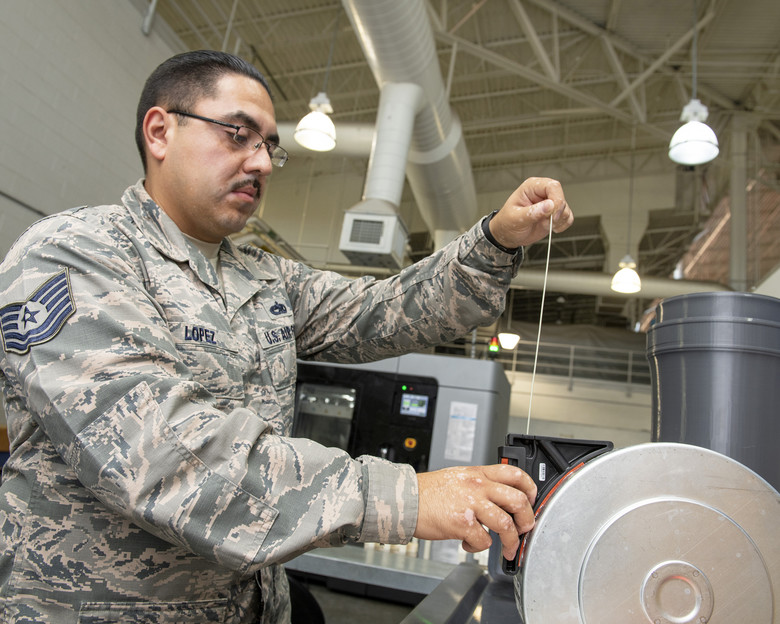
Taken together, the Navy’s directive isn’t an isolated fix, it’s one branch’s move in a broader defense-wide race to make AM certification fast enough to match production demand.
3D Printing Industry is inviting speakers for its 2026 Additive Manufacturing Applications (AMA) series, covering Energy, Healthcare, Automotive and Mobility, Aerospace, Space and Defense, and Software. Each online event focuses on real production deployments, qualification, and supply chain integration. Practitioners interested in contributing can complete the call for speakers form here.
To stay up to date with the latest 3D printing news, don’t forget to subscribe to the 3D Printing Industry newsletter or follow us on LinkedIn.
Explore the full Future of 3D Printing and Executive Survey series from 3D Printing Industry, featuring perspectives from CEOs, engineers, and industry leaders on the industrialization of additive manufacturing, 3D printing industry trends 2026, qualification, supply chains, and additive manufacturing industry analysis.
Featured image shows A wire-arc directed energy deposition system at the Advanced Manufacturing Center of Excellence in Danville, Virginia. Photo via US Navy.
