


The 2026 edition of our AMA: Energy online conference returns on April 30th. Register now!
Market intelligence firm CONTEXT has published its Q4 2025 analysis of global 3D printer hardware shipments, with growth concentrated at opposite ends of the price spectrum.
The numbers point to a market that has stopped growing uniformly and started reorganizing around two distinct poles, leaving the middle segments in a contraction that has now extended across multiple consecutive quarters.
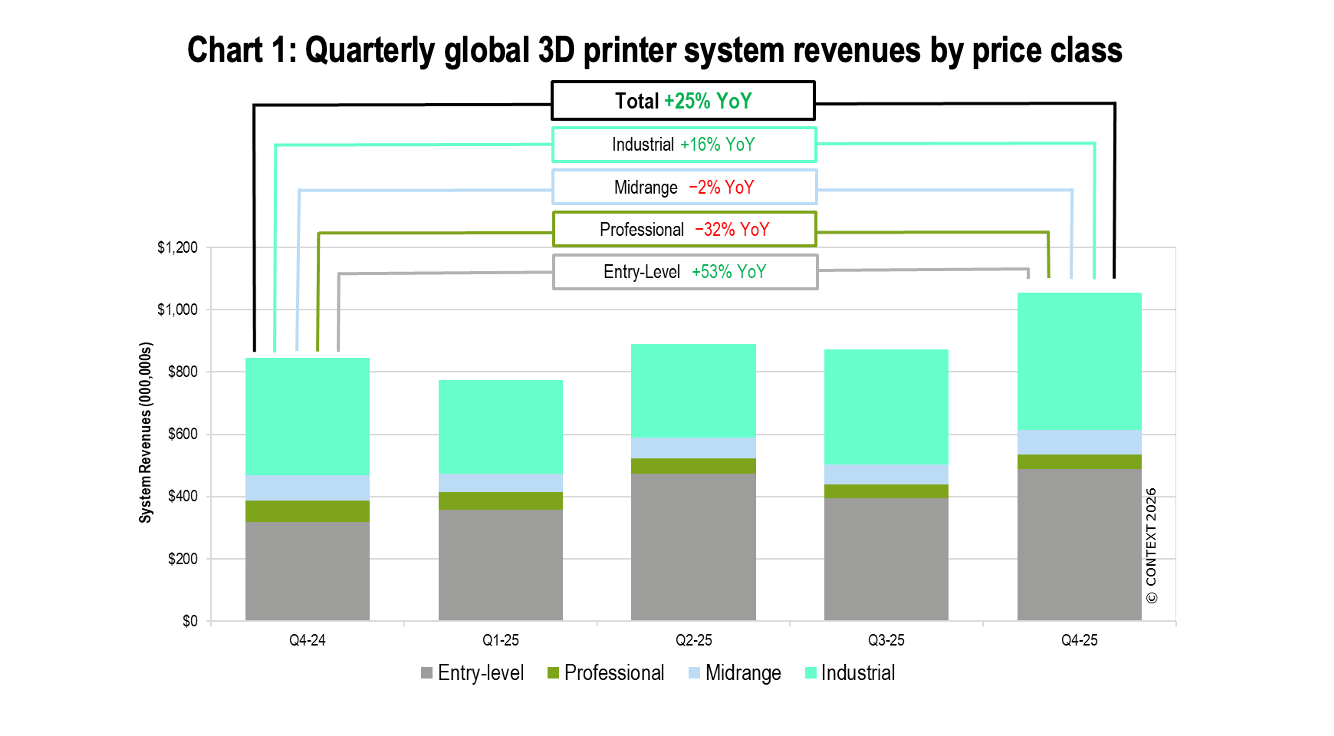
Aggregate system revenues rose 25% Y/Y for the quarter, and the bulk of that movement came from the bottom. Entry-level systems, priced below $2,500, saw shipments rise 47% year-on-year in Q4, producing a 53% revenue increase. For the full year, entry-level units grew 26%.
Almost all of that entry-level volume originated in China. Chinese vendors accounted for over 90% of global shipments in the segment, with Chinese vendors accounted for over 90% of global shipments in the segment, with Bambu Lab holding 37% market share and Creality, Elegoo, and Anycubic also among the top positions.
“Entry-level 3D printing has never been hotter,” said Chris Connery, VP of Global Analysis at CONTEXT. “Nowhere was this more evident than at the recent TCT Asia show in Shanghai, which again showcased ongoing technical innovation and frenetic consumer excitement.”
The financial momentum behind those names is building: Creality is reportedly approaching an IPO, and other segment leaders are said to be in discussions over multi-billion-dollar investments from Chinese financial institutions.
Industrial Resurgence, Midrange Contraction Continues
At the top of the market, industrial systems above $100,000 posted a 12% unit increase in Q4 and 16% revenue growth, reversing a slide that had produced four consecutive years of full-year unit declines. The forces behind that rebound are less legible than those driving entry-level, though CONTEXT points to aerospace and defense momentum as a contributing factor.
Within industrial, polymer systems led the quarter, rising 23% on a 39% surge in vat photopolymerization units, mostly from Carbon and UnionTech. Metal powder bed fusion grew 24% in Q4, with Chinese vendors Bright Laser Technologies, Eplus3D, ZRapid Tech, and Farsoon Technologies leading in unit share and EOS and Nikon SLM Solutions holding leading positions in revenue share.
Full-year metal shipments across all technologies still fell 4%, an overhang from merger and acquisition disruption among Western metal binder jetting and material extrusion vendors.
Although industrial 3D printing picked up through H2 2025, the VP added “the hype of years past has largely been replaced by a rigorous focus on key verticals and strategic areas of growth.”
Between those two recoveries, the middle continued to erode. CONTEXT attributes much of that pressure to what it calls the “Bambu effect,” demand for material extrusion shifting toward lower price points as Bambu Lab’s products set a new performance-per-dollar benchmark for the segment.
Midrange systems fell 6% in Q4 and 12% for the full year. Professional systems declined 12% in the quarter and 15% for the year, with material extrusion shipments in both categories falling as demand shifted toward lower price points. Vat photopolymerization now represents 71% of professional segment units shipped globally in the quarter, with Formlabs holding 38% full-year category share.
CONTEXT projects growth across all price segments in 2026, with entry-level expected to record the highest growth rate and industrial shipments approaching double-digit percentage gains Y/Y.

Confirming a Lasting Structural Shift
The Q4 data brings into sharper focus a pattern CONTEXT had already documented. CONTEXT’s Q3 2025 data showed the same fault lines forming earlier in the year.
Total hardware revenues rose just 5% Y/Y in Q3, with industrial systems returning to growth for the first time in nearly two years, up 3%, while midrange and professional segments were already recording double-digit declines of 13% and 14% respectively.
The Q4 acceleration, where industrial growth jumped from 3% to 12% and entry-level shipments surged from 18% to 47%, confirms that the divergence was not a quarterly anomaly but a structural shift gathering pace.
Connery had flagged the underlying dynamic as early as Q3. “The industry has moved past the expansion-at-any-cost phase and is now concentrating on sectors where additive manufacturing is already delivering clear economic value,” he said at the time. “Aerospace, defence and domestic Chinese manufacturing are doing most of the heavy lifting.”
That concentration of momentum is now visible at the industry revenue level as well. The Wohlers Report 2026, published by Wohlers Associates and ASTM International, recorded total AM revenues of $24.2 billion in 2025, up 10.9% for the year. Within that, printing services at $11.7 billion grew 15.5%, while printer sales and servicing reached $6.2 billion, growing just 3.6%.
The installed base is maturing, and the industry is generating more of its growth from using machines than from selling them. For vendors caught in the middle of the hardware price spectrum, that is not a temporary headwind.
Chinese manufacturing scale and rapid product iteration have effectively repriced the lower end of the industry, pulling demand away from the segment immediately above it. The middle, serving neither the scale economics of entry-level nor the application-specific demand of industrial, has yet to find a comparable anchor.
3D Printing Industry is inviting speakers for its 2026 Additive Manufacturing Applications (AMA) series, covering Energy, Healthcare, Automotive and Mobility, Aerospace, Space and Defense, and Software. Each online event focuses on real production deployments, qualification, and supply chain integration. Practitioners interested in contributing can complete the call for speakers form here.
To stay up to date with the latest 3D printing news, don’t forget to subscribe to the 3D Printing Industry newsletter or follow us on LinkedIn.
Explore the full Future of 3D Printing and Executive Survey series from 3D Printing Industry, featuring perspectives from CEOs, engineers, and industry leaders on the industrialization of additive manufacturing, 3D printing industry trends 2026, qualification, supply chains, and additive manufacturing industry analysis.
Featured image shows full-year global 3D printer shipment trends by price class, 2024 vs. 2025. Image via CONTEXT.
