


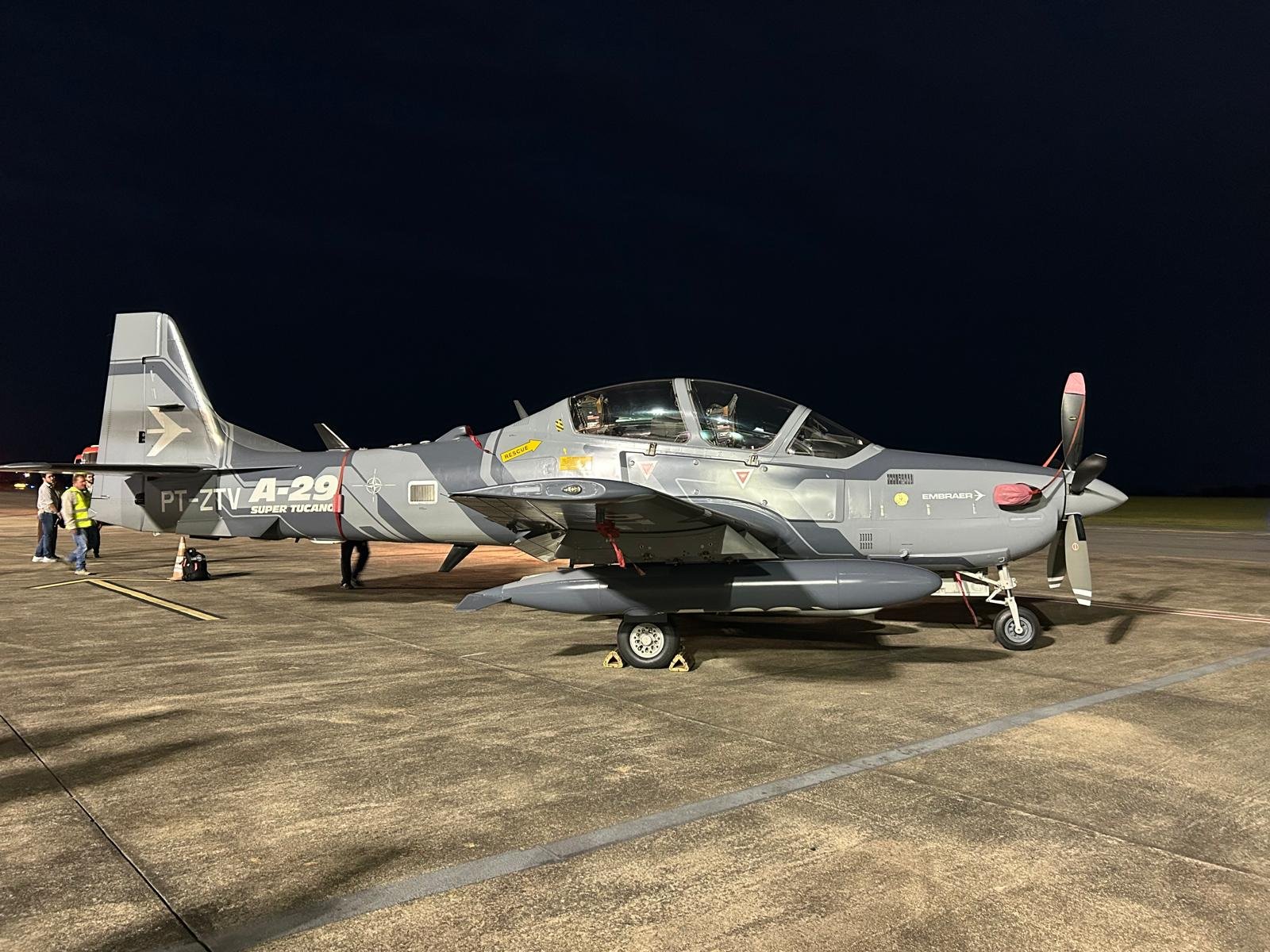
The Brazilian airframer says it is focusing engineering resources on expanding its own platforms like the KC-390 tanker/transport and A-29 light-attack aircraft.
Brazilian aircraft manufacturer Embraer currently has no plans to develop a new fighter to supplement the company’s existing defence portfolio, at least for now.
Despite recently unveiling the first locally produced Saab Gripen E fighter from an Embraer-operated production line in Sao Paulo state, senior Embraer officials do not see a scenario in which the company would take on the burden of developing its own clean-sheet tactical jet in the near future.
“We don’t have plans to develop a fighter,” says Francisco Gomes Neto, chief executive of Embraer. “We have other plans… we are studying other segments first.”
Those plans include adding combat capability to Embraer’s A-29 Super Tucano light-attack turboprop and continuing to expand production of the flourishing KC-390 multi-role tactical transport.
When it comes to fighters, Embraer will assemble 15 Gripens for the Brazilian air force (FAB) under an industrial offset provision of the 2014 contract between Brasilia and Gripen designer Saab. That deal covers a total fleet of 36 aircraft, although the possibility of an additional buy has been floated.
The FAB is already operating examples of the type under the local designation F-39, with 28 single-seat F-39Es and eight two-seat F-39Fs eventually to be in use.
Saab rolled out the FAB’s first F-39F earlier this month. That aircraft was assembled at the company’s Linkoping site in Sweden.
The FAB today has 11 F-39Es in service, including initial Swedish-assembled jets. The newness of that fleet is a big part of the reason for Embraer’s reluctance to take on any new fighter development effort.
“If we were to lead that, we would need funding from a launch customer,” says Marcio Monteiro, chief marketing officer of Embraer Defense & Security.
Typically, Monteiro says, such funding would come from a manufacturer’s home government, along with mission requirements to inform design work. With Brazil already in the process of recapitalising its fighter fleet, Embraer is unlikely to find the financial support it would require to take on such a costly and time-consuming endeavour as building a new fighter aircraft.
More likely than developing its own jet is the possibility that Embraer would use its Gripen assembly line in Gavio Peixoto, known colloquially as GPX, to support export orders for Saab.
“We have a very nice facility in GPX for the Gripens that can support new sales… in other countries in South America, and maybe in other countries, if they need additional capacity,” Gomes Neto says.
However, if the FAB or some other customer did come through with the necessary financial commitment, Monteiro says Embraer would be ready with the engineering and industrial capacity.
“Of course, we’ll do [that] just like we did with the A-29, just like we did with the 390,” he notes. “These were all funded and led and specified by the Brazilian air force.”
Both of those programmes have paid dividends for Embraer. The company has racked up nearly 90 firm orders and options for the KC-390 tactical transport in recent years, with a total addressable market estimated at roughly 450 aircraft over the next two decades.
Future initiates for the KC-390 include a maritime patrol variant, which Monteiro says Embraer is “seriously studying”. The company sees “great potential” for that market, which is currently dominated by the Boeing P-8A Poseidon as the only active-production option in the Western world.
Work also continues with Northrop Grumman to develop a fuel transfer boom that could be added to the KC-390. Embraer and Northrop revealed their partnership on that project in February, with an eye toward capturing new US business. The US Air Force, which operates the world’s largest tanker fleet, uses the boom method for aerial refuelling, rather than the probe-and-drogue configuration currently employed on the KC-390.
Although less eye-catching than a jet-powered fighter, Embraer’s two-seat Super Tucano turboprop has also delivered solid numbers. The company says it secured 51 A-29 export sales between 2019 and 2026. Nearly 40 of those orders came in the last two years, including from Paraguay, Uruguay, the Philippines, Panama and Portugal.
The Super Tucano is also in active production at the same Gavio Peixoto facility where C-390s are assembled, with over 300 aircraft ordered across 22 air forces, according to Embraer. That includes countries like Chile, which use the A-29 as a lead-in fighter trainer.
Embraer is particularly optimistic on prospects for the A-29, given the surging interest in low-cost options for defending against swarms of one-way attack drones like the Iranian Shahed family and Russian Geran series.
Ukraine pioneered the use of turboprops and rotary-wing aircraft in this role, using cheap and simple weapons like machine guns to shoot down attack drones in flight. American firms like L3Harris have adapted low-cost guided weapons like BAE Systems’ 70mm Advanced Precision Kill Weapon System rockets for counter-drone applications.
Those laser-guided rockets have emerged as a popular choice for shooting down Shahed drones, with the US Air Force and UK Royal Air Force adapting them to high-end jets like the Lockheed Martin F-16, Boeing F-15 and Eurofighter Typhoon.
In addition to two internally-carried machine guns, the Super Tucano can carry a variety of precision weapon systems, including rocket pods and guided bombs. The single-engined turboprop also comes with an ultra-low operating cost of roughly $1,500 per flight hour – a key consideration in the counter-drone mission.
In 2023, Embraer unveiled a NATO-standard Super Tucano variant dubbed the A-29N, with deliveries to launch customer Portugal underway.
With those attributes and a hot production line, Embraer hopes to entice potential customers by expanding A-29 capacity to include specific counter-UAS features. Demonstrations are planned by the end of this year, Monteiro says, noting that Embraer has already been approached by potential buyers interested in counter-drone applications for the Super Tucano.
“It looks very promising,” he says. “I think we will see some movements or some cases materialising very soon.”
Embraer does face competition in the space, particularly from L3Harris, which is delivering the OA-1K SkyRaider II to US Special Operations Command. That platform uses a militarised Air Tractor AT-802 crop duster, equipped with weapons, sensors and a reinforced cockpit to offer low-cost air-to-ground and counter-drone support.
Other options include the American Textron AT-6, Turkish Aerospace-made Hurkus and the Paramount Mwari from South Africa.
“We feel the heat,” Monteiro says when asked about the urgency of getting a counter-UAS offering to market.
“Many countries are suffering right now with this problem,” he adds. “So time to market is crucial in this case.”
As an indicator of the priority Embraer is placing on the A-29 counter-UAS effort, Monteiro says his work calendar now includes three meetings per week to receive updates on the project’s progress.
The company hopes to have an offering ready shortly after the demonstrations expected for later this year.
Embraer is also in discussions around establishing a Super Tucano production line in Portugal, with an eye toward advancing sales opportunities in Europe. This could complement the GPX line and a separate facility in Jacksonville, Florida, which Embraer operates for customers interested in purchasing the A-29 through the US government’s Foreign Military Sales (FMS) system.
That site had been providing aircraft to the now-defunct Afghan air force previously backed by Washington.
While Embraer continues to maintain the Jacksonville A-29 assembly site, Monteiro says that facility cannot be operated indefinitely without any new FMS orders coming in.
“Soon there will be a time when we will have to sit down and discuss with our American partners, and the US government itself, what to do,” he says. “That time has not come yet,”
So, are there any future defence projects that Embraer has its eye on?
If there are, the company is not saying. While every aerospace manufacturer around the world is rushing to unveil new autonomous jet fighters and uncrewed systems, Embraer seems in no hurry to follow the crowd.
“We continue to monitor different types of opportunities,” Monteiro says. “I think we are right now very happy with the platforms and the success we are having.”
Subscribe to gain access to all news
Already have a subscription? Log in.
Choose your subscription
Considering a corporate subscription? Contact us to find out more.
