


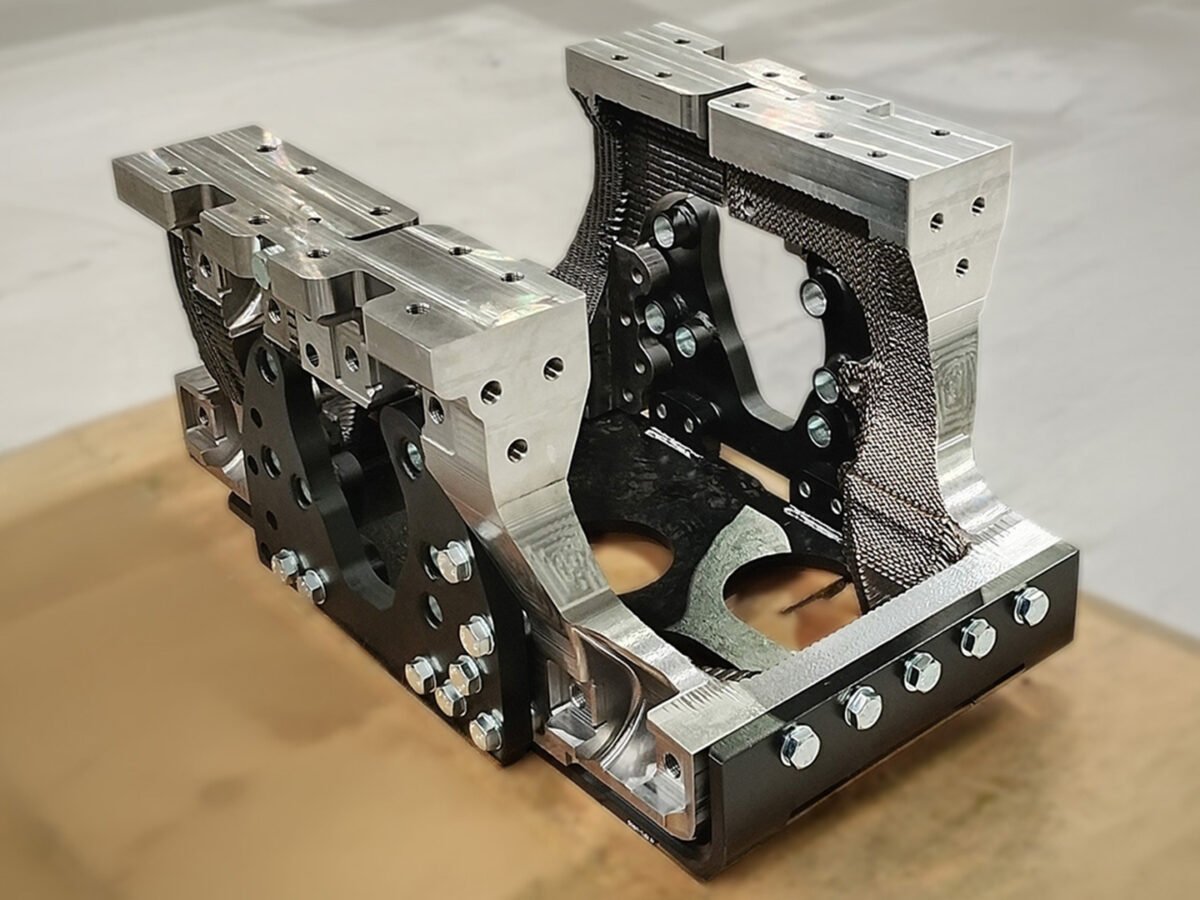
NP Aerospace, working with the Digital Manufacturing Centre (DMC), has used Caracol‘s Vipra AM platform to produce the Mastiff suspension and differential carrier, a structurally critical, load-bearing component for protected and dual-use vehicles, through wire arc additive manufacturing (WAAM). Printed as a single piece without tooling in 60 hours, the component marks a direct challenge to the casting and forging routes that have historically defined this class of manufacturing.
Those conventional methods work, but on low-volume, fast-iteration defense programs, their constraints compound quickly. Long lead times tied to tooling qualification, high upfront costs difficult to justify at small quantities, and geometric rigidity that limits topology-driven design all slow down programs where speed and adaptability are operational requirements. WAAM eliminates all three at once.
110 Kilograms, 60 Hours, No Tooling
The component was produced on Caracol’s VIPRA XP system using ER100 wire feedstock, printing a 540 × 500 × 500 mm structure weighing 110 kg. Post-processing included heat treatment and machining to meet the part’s functional and compliance requirements.
What made the process notable was not just the scale, but the geometry. The Mastiff carrier features extreme overhangs and highly complex organic surfaces, forms that would be extremely challenging or impossible on conventional fixed-axis systems. Caracol’s multi-axis robot-and-part positioning allowed the component to be built in a single process without redesigning the functional specification or compromising on performance targets.
The outcome was a measurable lead time reduction of up to 50% against the conventionally manufactured equivalent, with tooling costs eliminated entirely, a combination that makes low-volume production and rapid design iteration economically viable for the first time on a component of this structural class.

Defense Manufacturing’s Agility Problem
Defense procurement is caught between two competing pressures: the need for faster spiral development cycles and the structural impossibility of tooling-dependent supply chains on low-volume platforms. Protected vehicle programs rarely operate at the volumes that justify conventional tooling investment, yet the performance and compliance bar on their components is as demanding as anywhere in industry. That gap is where WAAM is finding its footing.
Nurol Makina and MetalWorm demonstrated this in a direct defense application, producing an armored vehicle component via WAAM with steel wire feedstock, machining it to final geometry, and subjecting it to both destructive and non-destructive testing. The part was then installed on an armored vehicle for eight months of operational field trials, with post-test inspections recording no failures or damage.
DEEP Manufacturing has taken a parallel path, earning DNV Approval of Manufacture for WAAM production of pressure vessels and hull structures, and expanding into a Houston facility to bring large-format metal additive capability closer to customers across energy, defense, and maritime sectors.
The NP Aerospace Mastiff carrier is the kind of result that makes the business case for WAAM in defense self-evident. When the bottleneck is the tooling cycle, removing it entirely changes the pace of the program.
3D Printing Industry is inviting speakers for its 2026 Additive Manufacturing Applications (AMA) series, covering Energy, Healthcare, Automotive and Mobility, Aerospace, Space and Defense, and Software. Each online event focuses on real production deployments, qualification, and supply chain integration. Practitioners interested in contributing can complete the call for speakers form here.
To stay up to date with the latest 3D printing news, don’t forget to subscribe to the 3D Printing Industry newsletter or follow us on LinkedIn.
Explore the full Future of 3D Printing and Executive Survey series from 3D Printing Industry, featuring perspectives from CEOs, engineers, and industry leaders on the industrialization of additive manufacturing, 3D printing industry trends 2026, qualification, supply chains, and additive manufacturing industry analysis.
Featured image shows Caracol’s Vipra AM platform produced the Mastiff’s suspension and differential mount. Photo via Caracol.
