


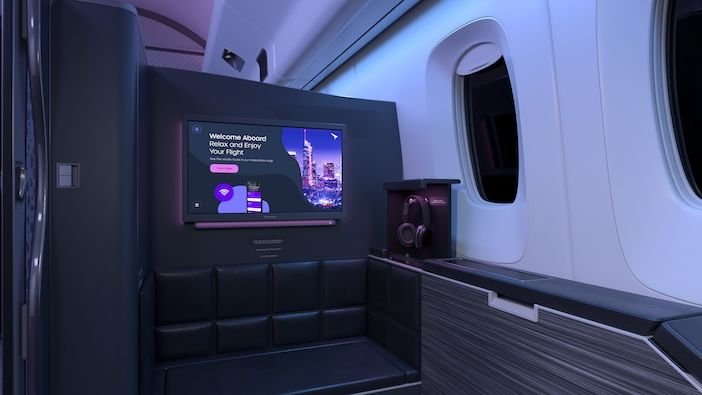
Digital eye strain is a consideration for developers of display technology, particularly in environments such as aircraft cabins where passengers can spend long periods viewing screens at close range.
According to Eyesafe, a technology and standards company working to manage and reduce high-energy blue-light emissions from digital screens, blue light has been the subject of ongoing research relating to eye comfort, visual experience, and circadian impacts. Exposure to digital devices is a key factor, and may be influenced by factors including the viewer’s proximity to the screen, the duration of use, and the cumulative viewing time.
Panasonic Avionics has been working on this issue, and has announced that its Astrova 4K OLED in-flight entertainment (IFE) displays, which range from 13-inch to 42-inch, have achieved Eyesafe’s Display Requirements 3.0 certification. Panasonic says that Astrova is the first IFE system to receive this voluntary, third-party verified certification of blue-light management and display performance criteria.
The Eyesafe accreditation certifies that Astrova enables airline customers to standardise eye comfort across all classes and screen sizes and support a more comfortable viewing experience during extended viewing sessions such as long-haul flights.
The Eyesafe Display Requirements 3.0 certification framework establishes the criteria used to evaluate and guide blue-light emissions for digital displays. The Astrova IFE system meets these requirements as it intelligently manages blue light by using precise spectral tuning at the pixel level for a more comfortable viewing experience, while preserving the standards of colour, contrast and clarity expected from 4K OLED technology.
