


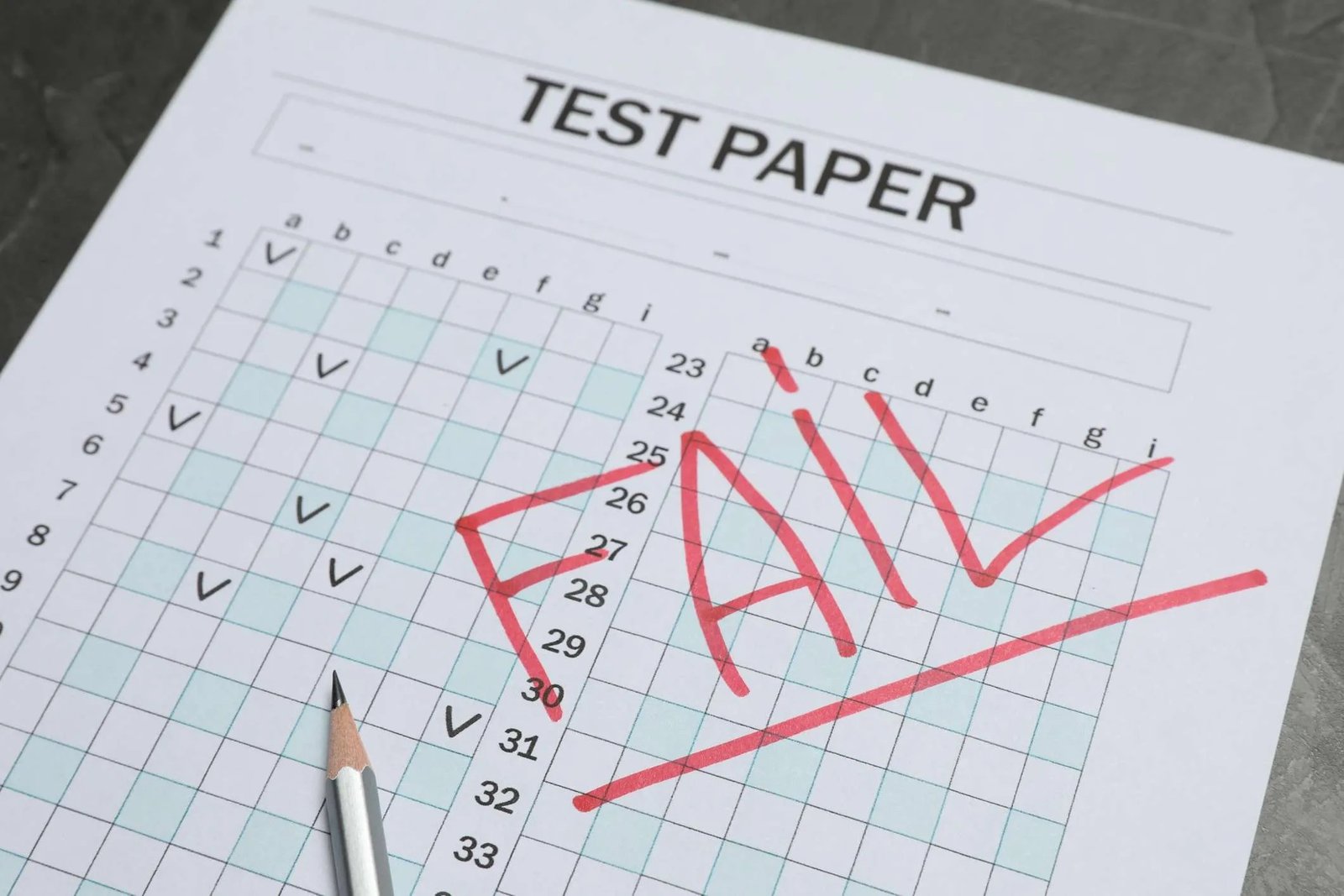
The FAA has released its 2025 Airman Knowledge Test data, and if you’re looking for a feel-good story about the state of drone pilot preparedness in America, you won’t find it here. Not only are scores on the Small Unmanned Aircraft General (UAG) Knowledge Test — the exam required to fly commercially under Part 107 — still lagging behind every other major FAA test, they actually got worse last year.

In fact, average Part 107 scores in 2025 saw all-time lows. Not coincidentally, 2025 also gave us the lowest overall Part 107 test pass rate. In 2025, just 82.96% of Part 107 test-takers passed, clocking an average score of just 79.31%.
2025 also gave us an all-time high of people attempting to take the Part 107 test — 73,914 aspiring pilots total (up from about 67,500 in 2024, and nearly double the roughly 40,000 who tried in 2020).
In other words, more people than ever are pursuing their drone license — and yet both the average score and the pass rate ticked down year over year.
A history of Part 107 test scores
2025 was the bleakest year yet for Part 107 test scores, but they’ve actually been falling for years. In 2024, just a smidge more people passed, with the average score at 79.95% (vs 2025’s 79.31%) and the average pass rate at 84.20% versus 2025’s (82.96%).
To be clear, 79.31% is technically a passing grade (the minimum is 70%). But it’s not a good one. It’s a C+. And scores have been largely trending downward every year. Here’s how they look, based on FAA data:
| Year | Test-Takers | Avg Score | Pass Rate |
|---|---|---|---|
| 2016 | 16,263 | 81.09% | 90.07% |
| 2017 | 41,074 | 82.65% | 93.02% |
| 2018 | 40,985 | 83.05% | 93.03% |
| 2019 | 45,892 | 82.99% | 92.23% |
| 2020 | 39,455 | 83.56% | 93.36% |
| 2021 | 53,681 | 81.20% | 87.63% |
| 2022 | 57,049 | 80.31% | 85.68% |
| 2023 | 63,935 | 81.22% | 87.07% |
| 2024 | 67,576 | 79.95% | 84.20% |
| 2025 | 73,914 | 79.31% | 82.96% |
The Part 107 test went live in mid-2016, which explains why the test-taking rate was so much lower them. For the record, I took the test in October 2016. I passed the Part 107 test with a score of 90%, and I studied almost entirely by using the Drone Pilot Ground School online course.
The Part 107 exam is the most popular FAA test — and the worst-performing
Of the 293,516 people who took an FAA Airman Knowledge Test of any kind in 2025 (that includes commercial airline pilot, maintenance or transport pilot tests, among others), the overall pass rate was 89.56%. The Part 107 exam’s 82.96% pass rate falls well short of that benchmark. And the average score of 79.31% is lower than virtually every comparable test on the list.
Take the Airplane Private Pilot test: 44,657 people took it in 2025, with an average score of 81.64% and a pass rate of 89.56%. The Airplane Instrument Rating test saw 27,143 takers post an average of 86.15% with a 94.38% pass rate. Even the Aviation Maintenance Technician tests (notoriously tough exams covering aircraft systems) have comparable or better pass rates despite requiring deep technical knowledge.
The gold standard? The Military Competence Instructor test, where 1,028 test-takers averaged a 96.02% with a 99.22% pass rate. (Granted, that population is… a little self-selected.)
So what’s going on?
The growth in test volume is almost certainly part of the story. As drones become more mainstream — whether for real estate photography, construction site mapping, content creation, or delivery — more people with varying (or no) aviation backgrounds are pursuing their Part 107. That means the test-taking pool includes everyone from seasoned pilots adding a credential to total newcomers who’ve never thought about airspace classification in their lives.
More test-takers from a wider range of backgrounds means more variability in preparation. That variability tends to pull averages down. It’s not necessarily that drone pilots are getting dumber (though with terms like AI-driven brain rot being thrown around, who knows?).
Either way, the drop in scores should be semi-concerning. The Part 107 test exists for a reason: it ensures that commercial drone operators understand airspace rules, weather patterns, and safety procedures. A lower average score means more pilots are flying commercially with shakier foundational knowledge. That’s not great for anyone sharing the sky.
What you can do about it (for your own Part 107 test score, at least)
You can’t control what 73,000 other people score. But you can make sure you’re not the one dragging down the average. Here are the basics:
Related
Discover more from The Drone Girl
Subscribe to get the latest posts sent to your email.
