


Nearly half of all adults in the United States live with hypertension, and for roughly one in ten of them, conventional drug treatments simply don’t work. A research team at Pennsylvania State University (PSU) has developed a potential answer: a soft, 3D printed bioelectronic device that attaches directly to one of the body’s most critical arteries and uses gentle electrical signals to bring blood pressure under control.
The device, called CaroFlex, was developed by a team led by Tao Zhou, Wormley Family Early Career Assistant Professor of Engineering Science and Mechanics, and tested in rodent models. Results were detailed in a paper published in the journal Device. For patients whose blood pressure remains elevated despite taking three to five medications simultaneously, the research points toward a new treatment pathway built not on chemistry, but on bioelectronics.
A Body-Friendly Device That Works With Tissue, Not Against It
CaroFlex targets the carotid sinus, a small junction where the carotid artery, the main vessel supplying oxygen-rich blood to the head, face, and neck, branches into several smaller pathways. Clustered in this area are baroreceptors, specialized nerve endings that detect changes in arterial stretch and trigger the body’s natural blood pressure regulation response, known as the baroreflex. Existing bioelectronic devices already exist to stimulate this system, but they are typically constructed from rigid metals and plastics.
“These devices are usually held in place with stitches,” Zhou said. “These stitches can cause damage to the devices, and more importantly, the tissues they’re integrated with over time, as arteries stretch and shrink to help move blood around the body.”
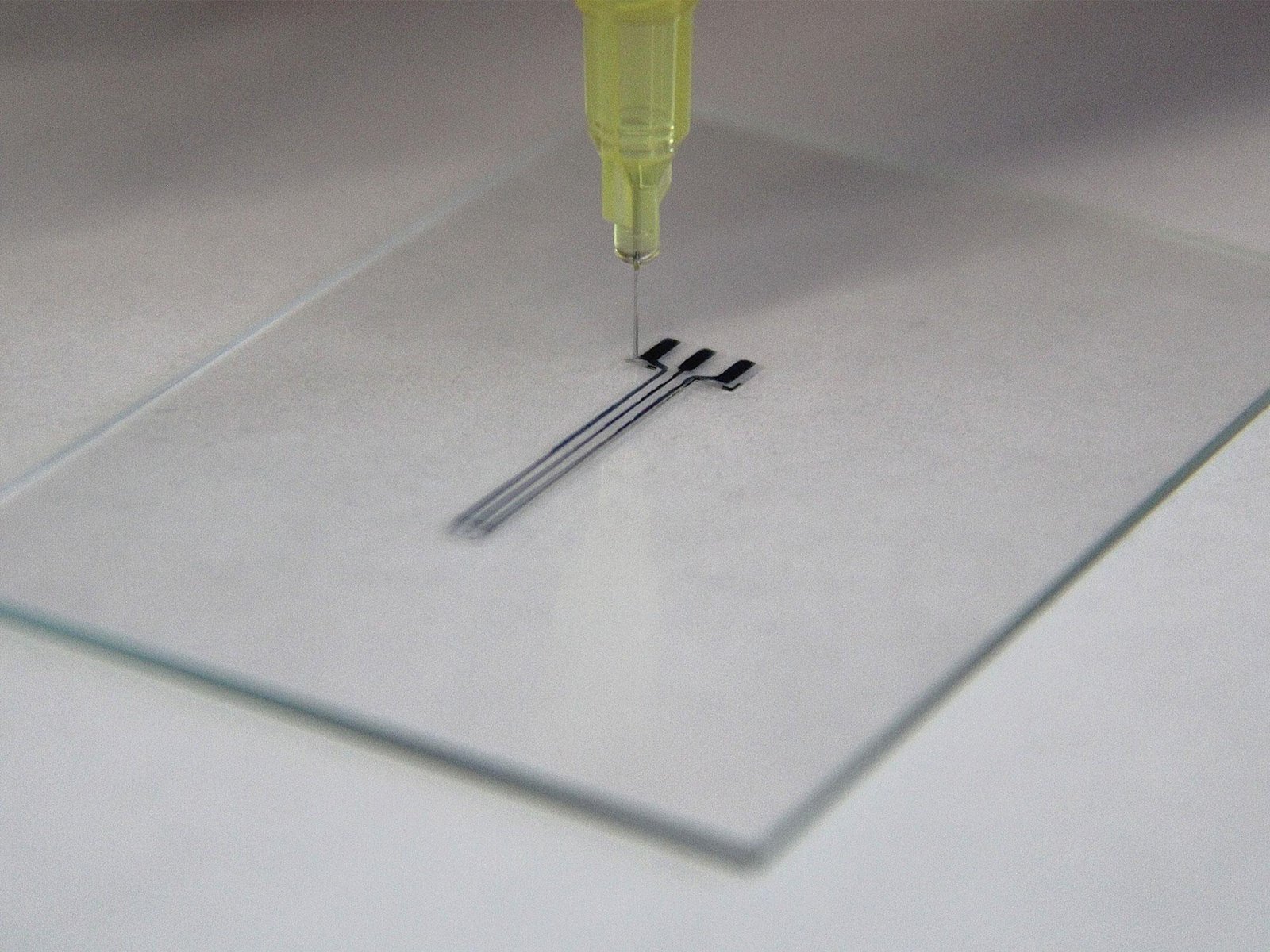
CaroFlex takes a different approach. The device is printed primarily from hydrogel, a soft, jelly-like material, with conductive hydrogel electrodes that transmit electrical signals and an adhesive hydrogel layer that bonds to biological tissue without stitches, toxic chemicals, or mechanical anchoring. The result is a device that moves with the artery rather than resisting it.
Lab testing confirmed that CaroFlex can stretch to more than twice its original length before breaking. The adhesive layer maintained strong, consistent bonding even after six months of storage, and the device outperformed traditional platinum electrodes in both tissue contact quality and electrical reliability.
What the Results Showed
The team implanted CaroFlex into the carotid sinus of rat models and monitored blood pressure continuously over a ten-minute window. Of five electrical frequencies tested, four produced measurable reductions in blood pressure, lowering average readings by more than 15%. Two weeks after implantation, tissue surrounding the device showed no signs of damage or immune response, a result that distinguishes CaroFlex from rigid predecessors that tend to cause chronic inflammation over time.

“For many patients, even taking a combination of three to five medicines doesn’t alleviate their high blood pressure,” Zhou said. “In these cases, bioelectronic devices that use electrical signals to modulate the body’s natural response systems offer a promising form of alternative treatment.”
The next phase of the research will focus on refining CaroFlex’s effectiveness and scaling the approach toward eventual clinical trials in humans. Zhou noted that additive manufacturing is central to that roadmap.
“Our lab is actively leading several developments in 3D printed bioelectronics for use across the body, which is exciting,” Zhou said. “This fabrication approach allows us to design, fabricate and adapt bioelectronics for potential clinical trials and commercial distribution much more efficiently than traditional methods of manufacturing.”
The research was conducted with contributions from a diverse team of scholars and faculty members. Engineering science and mechanics doctoral candidates Marzia Momin, Salahuddin Ahmed, Jia Sun, and Jiashu Ren served as co-authors, alongside Arafat Hossain, a doctoral candidate in electrical engineering, and Xinyi Wang, a doctoral candidate in mechanical engineering.
The team was further supported by Li-Pang Huang, a research assistant, and Umar Farooq, associate professor of nephrology at the Penn State College of Medicine. Also contributing was Basma AlMahood, who is currently pursuing a physics doctorate at Michigan State University, as well as John Bisognano, clinical professor of cardiovascular medicine at the University of Michigan. The study received funding from the National Institutes of Health and the U.S. National Science Foundation.
3D Printed Bioelectronics Enters the Body
CaroFlex arrives at a moment when additive manufacturing is establishing itself as the fabrication method of choice for bioelectronic devices that need to live inside living tissue. MIT engineers used conducting polymers to 3D print soft, flexible brain implants, demonstrating that printed PEDOT:PSS electrodes could detect electrical signals from a single neuron in a freely moving mouse, with researchers noting the potential to ease symptoms of epilepsy, Parkinson’s disease, and severe depression through printed neural stimulation devices.
The approach is spreading across institutions and target conditions. Engineers from the University of Sheffield, St Petersburg State University, and Technische Universität Dresden developed a 3D printed soft bioelectronic neural implant with potential to treat nervous system injuries such as paralysis.
Elsewhere, researchers from KTH Royal Institute of Technology and Stockholm University introduced a method that streamlines the production of electrochemical transistors using a standard Nanoscribe 3D microprinter, eliminating the need for specialized cleanroom environments and accelerating the prototyping of essential components for medical implants, wearable electronics, and biosensors.
The through-line across all of these efforts and CaroFlex is the same fundamental problem: the body’s tissues are soft, dynamic, and intolerant of rigid foreign materials over time. Additive manufacturing is the only fabrication method flexible enough to meet that constraint while producing devices precise enough to be therapeutically useful.
3D Printing Industry is inviting speakers for its 2026 Additive Manufacturing Applications (AMA) series, covering Energy, Healthcare, Automotive and Mobility, Aerospace, Space and Defense, and Software. Each online event focuses on real production deployments, qualification, and supply chain integration. Practitioners interested in contributing can complete the call for speakers form here.
To stay up to date with the latest 3D printing news, don’t forget to subscribe to the 3D Printing Industry newsletter or follow us on LinkedIn.
Explore the full Future of 3D Printing and Executive Survey series from 3D Printing Industry, featuring perspectives from CEOs, engineers, and industry leaders on the industrialization of additive manufacturing, 3D printing industry trends 2026, qualification, supply chains, and additive manufacturing industry analysis.
Featured image shows 3D printing allows the team to produce bioelectronics. Photo via Tao Zhou.
