


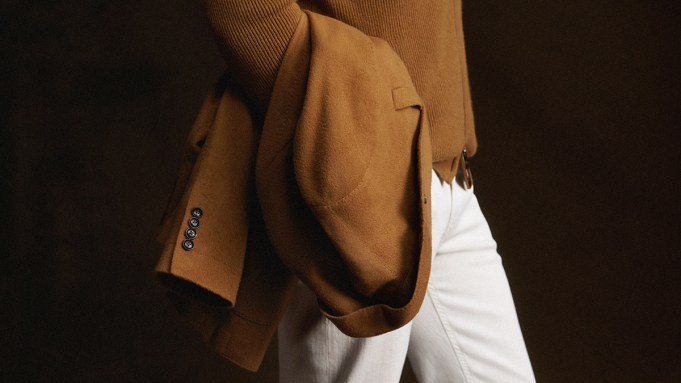
It’s a challenge for even the most established clothiers to work with vicuña, the ultra-rare fiber sourced from the South American camelid of the same name. The animals are about as well protected as patents and personal health information: Unlike llamas, alpacas, and the sheep and goats that produce wool and cashmere, vicuñas can’t legally be farmed.
Instead, the government of Peru tightly restricts how fabric mills can acquire precious strands from the nation’s wild herds. As during the reign of the Inca empire, today’s vicuñas are corralled using a communal technique called the chaccu—a human chain of hundreds of people slowly guiding groups of the creatures into mobile paddocks. Once inside, they’re restrained, sometimes blindfolded to preserve their sanity, and carefully sheared before being released. And this is not a seasonal occurrence. “If they’re sheared too often, they can freeze to death,” says Jason Cater, chief creative officer of menswear brand Peter Millar. The result is that each adult animal’s hair can only be harvested once every two to three years.
To celebrate its 25th anniversary, Peter Millar painstakingly sourced rare Peruvian vicuña to craft these
limited-edition sweaters and jackets.
Peter Millar
Despite these restraints, Cater and his colleagues have produced a limited-edition offering of 25 vicuña jackets ($6,995) and zip-up cardigans ($4,995) to celebrate Peter Millar’s 25th anniversary. And while cashmere might be soft, these garments are far, far softer. “If you compare it to cashmere, which is about 15.5 microns in terms of the measurement of the fiber, this is 12.5 microns,” he explains. “That three microns doesn’t sound like a lot, but it’s a significant difference in the world of natural fibers.”
It might seem like a big swing from an operation best known for its $125 golf polos, but dig a little into its history, and the move feels right on target. Peter Millar was founded in 2001 just outside Raleigh, N.C., with only one item: a cashmere sweater rendered in a wide array of colors. The brand quickly established such expertise at producing ultrasoft performance fabrics—in fits appreciated by non-fashion guys—that it was bought and sold by a succession of increasingly larger companies. In 2011, it opened its first stores in the Hamptons and Palm Beach, and by the following year, Richemont had acquired it. That made Peter Millar a corporate cousin to European fashion houses including Dunhill and Chloé, as well as watchmakers IWC, Jaeger-LeCoultre, and Vacheron Constantin.

An inner label on the jacket certifies the limited-edition piece.
Peter Millar
The rest of the fall 2026 collection reflects the same emphasis on exceptional sourcing. Cater points to a double-face-cashmere peacoat, knits made from a fine Italian baby cashmere he’s calling First Fleece, and a vest made from New Zealand deerskin.
They’re serious materials, certainly, but Cater’s designs prioritize comfort as much as elegance and sophistication.
“One of the markers of Peter Millar is softness—not just comfort, but softness,” he says. “I think we’re always looking for: ‘How can we make it softer, more comfortable, more casual?’ ” And if the answer is herding wild animals in the Andes, so be it.

