


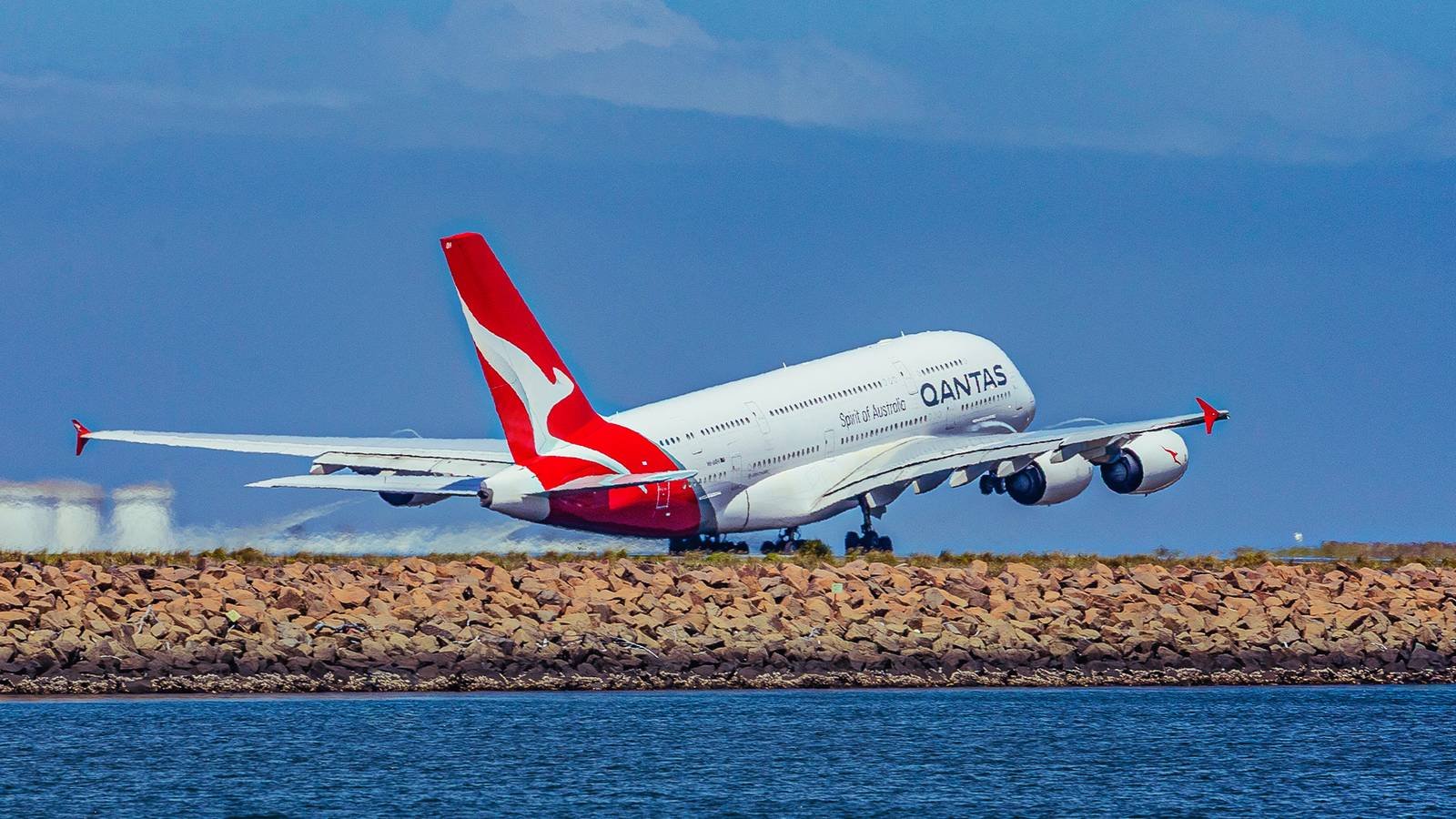
For years, the Airbus A380 has represented the pinnacle of the Qantas international travel experience. On long-haul routes, carrying holidaymakers to Los Angeles, business travelers to Singapore, or premium passengers to London via Singapore, the airline’s superjumbo has remained an unmistakable flagship. Now, however, Qantas has quietly put a countdown on its iconic aircraft by confirming that the fleet’s retirement will begin in 2032. While that may sound distant, the announcement effectively opens a finite window for travelers hoping to experience one of the world’s most recognizable first class products before it disappears from much of the airline’s network.
The retirement, however, forms part of the largest fleet renewal program in Qantas history, one that will reshape virtually every long-haul operation over the next decade. More than 200 aircraft are either on firm order or scheduled for delivery, older Airbus A330s are already being prepared for replacement, and Airbus A350s will gradually assume the airline’s flagship role. But unlike the A380s, most of these aircraft will not include first class, making today’s retirement announcement as much about the future of premium travel as it is about the end of the world’s largest passenger jet.
Qantas Has Put A Date For The Airbus A380’s Farewell
For years, Qantas avoided committing to an exact retirement timeline for its Airbus A380 fleet. The airline invested heavily in refurbishing the aircraft after the pandemic, leading many observers to believe the superjumbos would remain in service well into the 2030s. That uncertainty has now ended. Qantas has formally confirmed that the 2032 financial year will mark the beginning of the retirement process for its remaining fleet of 10 Airbus A380s, giving the aircraft a clearly defined final chapter in Australian aviation history. According to Australian Aviation, the airline intends to replace the type with the more modern Airbus A350s as part of its broader fleet modernization strategy.
For many passengers and aviation fans, however, this retirement announcement is a very sad event. Unlike airlines that retired the A380 abruptly during the COVID-19 pandemic, Qantas is still providing something rare in modern aviation: certainty. Travelers now know there is effectively a six-year countdown before the airline’s flagship aircraft gradually leaves the network. Rather than disappearing unexpectedly, the superjumbo will likely be withdrawn in phases as replacement aircraft arrive, allowing aviation enthusiasts and premium travelers time to plan what could become a final first class experience aboard one of Australia’s most iconic airliners.
The timing also reflects how dramatically aviation has evolved since the A380 entered service. When Qantas introduced the aircraft in 2008, global airlines were still pursuing ever-larger aircraft capable of carrying more than 500 passengers between major hubs. Since then, efficient twin-engine widebodies such as the Boeing 787 Dreamliner and Airbus A350 have transformed long-haul economics, allowing airlines to operate thinner routes more profitably while consuming significantly less fuel. Even so, the A380 remains uniquely suited to Qantas’ busiest international markets, explaining why the airline chose to refurbish the fleet rather than retire it immediately after the pandemic. The decision now appears to have been less about extending the aircraft indefinitely and more about extracting maximum value before an orderly transition begins.
A Fleet Renewal Program Unlike Anything In Qantas’ History

The retirement of the A380 is only one element of a fleet transformation that is unprecedented in the airline’s history. Qantas is currently undertaking a renewal program involving more than 200 firm aircraft orders across the Qantas Group, covering everything from regional turboprops to ultra-long-haul widebodies. Instead of replacing one aircraft at a time, the airline is effectively rebuilding much of its fleet over a single decade, creating one of the largest modernization efforts underway in commercial aviation.
That pace is difficult to comprehend until viewed through the airline’s own projections. Rob Marcolina, Qantas Group’s Chief Financial Officer, recently noted in his LinkedIn post that the carrier expects to receive approximately one new aircraft every three weeks over the next two years as deliveries accelerate. Such a sustained delivery schedule requires careful coordination between manufacturers, engineering teams, maintenance organizations, pilot training departments, and airport infrastructure. It also illustrates how seriously Qantas is approaching long-term fleet efficiency rather than relying on incremental upgrades.
The airline’s official fleet strategy highlights just how broad that renewal has become. Alongside Project Sunrise Airbus A350-1000s, Qantas is introducing additional Boeing 787 Dreamliners, Airbus A321XLRs, Airbus A220s, and numerous aircraft destined for Jetstar. Collectively, these aircraft promise lower fuel burn, improved reliability, quieter cabins, and significantly reduced maintenance costs compared with the types they replace. The A380 retirement, therefore, represents only one visible milestone within a much larger corporate strategy focused on operating one of the youngest and most efficient fleets in the Asia-Pacific region over the coming decades.
Airbus A330 Is Also Being Replaced

Although many naturally focus on the Airbus A380, the first major widebody fleet transition is actually happening elsewhere. Qantas has already begun the long-term retirement of its Airbus A330 fleet, with replacement aircraft scheduled to begin arriving from 2027. In total, the airline has ordered 24 widebody aircraft specifically intended to assume many of the A330’s duties: 12 Airbus A350-1000s, four additional Boeing 787-9 Dreamliners, and eight Boeing 787-10s. This carefully balanced mix reflects the airline’s desire to match aircraft size and capability with different international markets rather than relying on a single aircraft family, as per Economy Class And Beyond.
The Airbus A330 has quietly become one of the airline’s most versatile aircraft over the past two decades, operating everything from domestic trunk routes between Sydney, Melbourne, and Perth to medium-haul international services across Asia and the Pacific. But many examples are now approaching more than 20 years of age, as per planespotters.net, at which point replacement becomes economically attractive. New-generation aircraft deliver double-digit improvements in fuel efficiency while offering longer maintenance intervals, lower emissions, and cabin designs better aligned with evolving passenger expectations.
For Qantas, replacing the A330 before the A380 also makes strategic sense. The A330 operates far more flights across the network, meaning efficiency gains can be realized much sooner through higher daily utilization. Meanwhile, the relatively small fleet of 10 refurbished A380s continues serving routes where exceptionally high passenger demand still justifies the aircraft’s enormous capacity. This staggered approach minimizes operational disruption while allowing the airline to spread aircraft deliveries over several years instead of attempting multiple large-scale retirements simultaneously. It also means the A380 remains the airline’s flagship for a little longer, even as its eventual successor has already been chosen.
Could The Airbus A380 Be Replaced Even Sooner?

While Qantas has officially nominated the 2032 financial year as the point when its Airbus A380 retirement will begin, that timeline may not necessarily represent the final word. Fleet plans in commercial aviation are rarely fixed for an entire decade, particularly when manufacturers, delivery schedules, fuel prices, and passenger demand continue to evolve. In June 2026, reports emerged that Qantas was evaluating a further order for approximately 20 additional widebody aircraft from either Airbus or Boeing, potentially accelerating the modernization of its long-haul fleet.
According to AirGuide, the airline has been studying another round of widebody acquisitions beyond its existing commitments, with both the additional Airbus A350 family and Boeing’s 787 (and even 777X, though highly unlikely) programs considered potential candidates. Such an order would not only provide additional capacity for future growth but could also allow Qantas to retire older aircraft earlier than originally anticipated if sufficient replacement capacity becomes available.
Qantas’ Long-Haul Fleet Transition
Fleet element | Current / Future status |
Airbus A380 fleet | 10 aircraft remaining, all refurbished |
Official A380 retirement | FY2032 |
A330 replacement aircraft | 24 total |
Airbus A350-1000 orders | 12 |
Boeing 787 deliveries | 4 Boeing 787-9 + 8 Boeing 787-10 |
Replacement deliveries begin | 2027 |
Additional widebody evaluation | Up to 20 aircraft under consideration |
Total Qantas Group firm aircraft orders | More than 200 |
That possibility has already fueled speculation among aviation analysts. Australian aviation blog 2PAXfly suggested that an accelerated delivery stream could bring forward the retirement of the A380 fleet rather than waiting until FY2032. Although Qantas has made no public indication that its official timeline has changed, the economics are difficult to ignore. Modern twin-engine aircraft require substantially less fuel, incur lower maintenance costs, and require fewer crew members than the four-engine superjumbo. If additional A350s or Boeing widebodies arrive sooner than expected, retiring the A380 earlier would become an increasingly logical business decision.
That uncertainty creates an unusual situation for travelers. Instead of assuming there will always be another opportunity to fly aboard the aircraft, passengers hoping to experience the refurbished cabins may decide to book sooner rather than postponing until the last moment. Even if 2032 remains unchanged, the fleet is likely to shrink gradually rather than disappear overnight, reducing the number of routes on which the aircraft can be found during its final years.
The Countdown Is Really About First Class

For aviation enthusiasts, the Airbus A380 itself is naturally an attraction. And for many premium travelers, the more significant change concerns what disappears alongside it. Today, every Qantas A380 features the airline’s flagship four-class cabin, including one of the world’s most exclusive international first class products, as shown in AeroLOPA. The extensive refurbishment program completed in recent years introduced refreshed interiors, upgraded seating, new lounges, and redesigned premium cabins, ensuring the aircraft remains highly competitive despite its age.
Ironically, those investments now make aircraft more desirable than ever. All 10 surviving A380s have emerged from refurbishment looking substantially different from the cabins passengers encountered before the pandemic. The upgrades included new premium economy seating, refreshed business class, improved in-flight entertainment, redesigned social spaces, and numerous interior enhancements intended to keep the fleet attractive until retirement.
The challenge is that their successors will not fully replicate that experience. Except for the specially configured Airbus A350-1000s being built for Project Sunrise, Qantas’ future long-haul fleet is expected to adopt a lower-density three-class configuration consisting of business, premium economy, and economy. That means first class may gradually disappear from most of the airline’s international network once the A380s leave service.
For frequent flyers, that represents a much larger shift than simply replacing one aircraft with another. Over the past two decades, First Class has served as both a revenue product and a branding exercise, projecting Qantas as a premium global carrier alongside competitors in Asia, Europe, and the Middle East. Many airlines now prioritize larger business class cabins and high-yield premium economy seating; therefore, the business case for maintaining traditional international first class has steadily weakened. Qantas appears to be following the same trend, albeit while preserving first class on its most ambitious ultra-long-haul Project Sunrise services.
What Qantas’ Strategy Says About The Future Of The World’s Last Superjumbos

The retirement timetable adopted by Qantas may ultimately become a blueprint for other few flag carriers still operating the Airbus A380. Unlike airlines that permanently grounded their fleets during the pandemic, Qantas, just like  Emirates, chose a different path: to invest heavily in refurbishment, maximize the aircraft’s remaining economic value, and then replace them with new-generation widebodies through a carefully staged transition rather than an abrupt withdrawal.
That approach reflects the reality facing many global airlines. The Airbus A380 continues to perform exceptionally well on dense routes linking major international hubs, particularly at airports with constrained airport slots, such as  Dubai International Airport (DXB). At the same time, economics increasingly favor smaller twin-engine aircraft that operate more flexibly and consume significantly less fuel. Rather than viewing the A380 as obsolete, airlines are treating it as a highly specialized aircraft with a finite but still valuable role.
For passengers, however, the announcement transforms every remaining A380 flight into something with an expiration date. The aircraft itself will undoubtedly be remembered as one of aviation’s greatest engineering achievements, but the experience surrounding it, particularly the spacious premium cabins, in-flight bars, showers, and international first class offering, may prove even harder to replace. Travelers who have long postponed flying aboard the Qantas superjumbo now know that the opportunity is no longer indefinite. The timer has officially started.
