


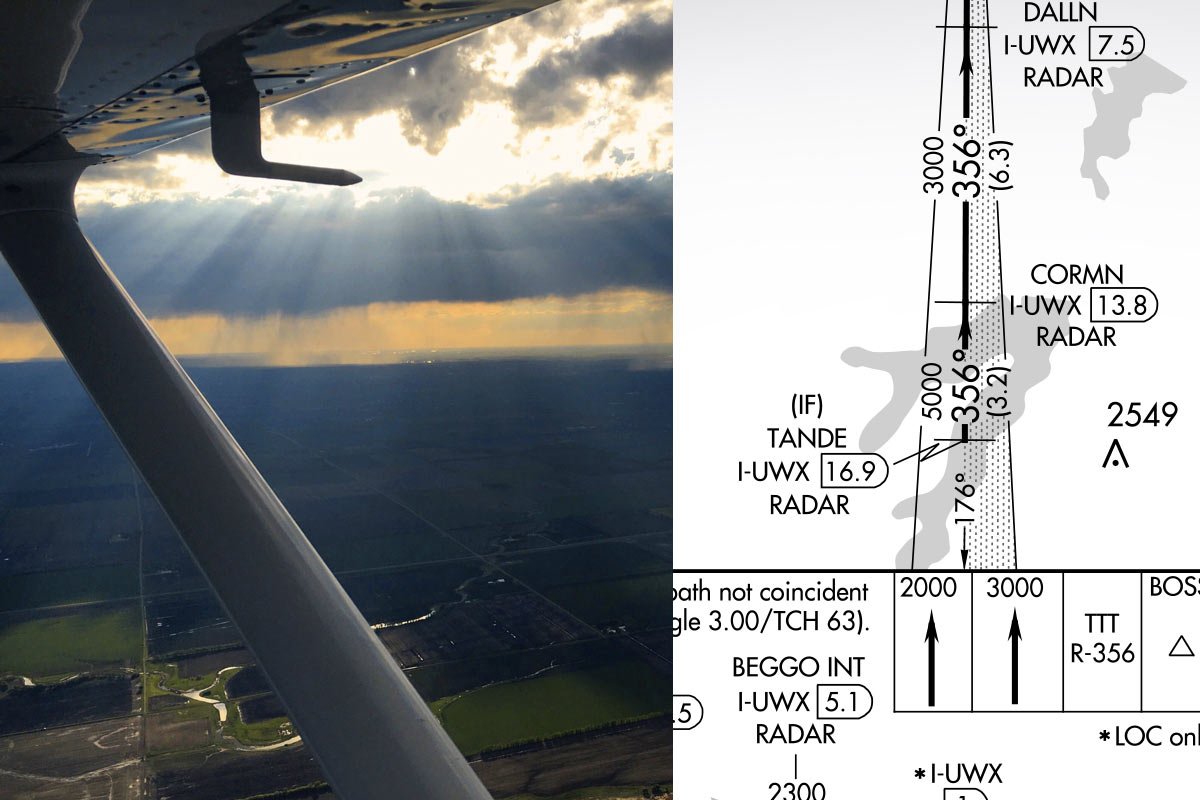
How many do you know?
1) What does the circle surrounding this waypoint indicate?
When a waypoint has a circle around it, it indicates that the waypoint is a fly-over point and must be flown over, as opposed to a fly-by point which can use turn anticipation.
When a waypoint has a circle around it, it indicates that the waypoint is a fly-over point and must be flown over, as opposed to a fly-by point which can use turn anticipation.
2) What is the bold “V”?
The visual descent point is the point on the non-precision approach which allows for a normal 3 degree descent path to the runway. Any point past the visual decent point may require a missed approach to be executed due to an excessive descent rate needed to reach the runway.
The visual descent point is the point on the non-precision approach which allows for a normal 3 degree descent path to the runway. Any point past the visual decent point may require a missed approach to be executed due to an excessive descent rate needed to reach the runway.
3) What is the lightning bolt symbol?
This indicates glideslope intercept altitude on the precision approach.
This indicates glideslope intercept altitude on the precision approach.
4) What do the 3 white ovals indicate on the airport diagram?
These white ovals indicate the location of the displaced threshold.
These white ovals indicate the location of the displaced threshold.
5) What does this symbol (A4) denote?
This represents the type of approach lighting configuration for the runway. In this example, “A4” means the lighting is a medium intensity or simplified short approach light system, which can be a MALS, MALSF, SSALS, or SSALF. In this case, it’s a MALSF, which is labeled at the top of the box.
This represents the type of approach lighting configuration for the runway. In this example, “A4” means the lighting is a medium intensity or simplified short approach light system, which can be a MALS, MALSF, SSALS, or SSALF. In this case, it’s a MALSF, which is labeled at the top of the box.
6) What does “TCH 63” mean?
This indicates the threshold crossing height, which is 63 feet.
This indicates the threshold crossing height, which is 63 feet.
Earn your instrument rating and master IFR with Boldmethod’s new Instrument Procedures course.
Whether you’re starting your instrument training or brushing up for your next flight, this course gives you the knowledge, confidence, and flexibility to be a great instrument pilot.
