


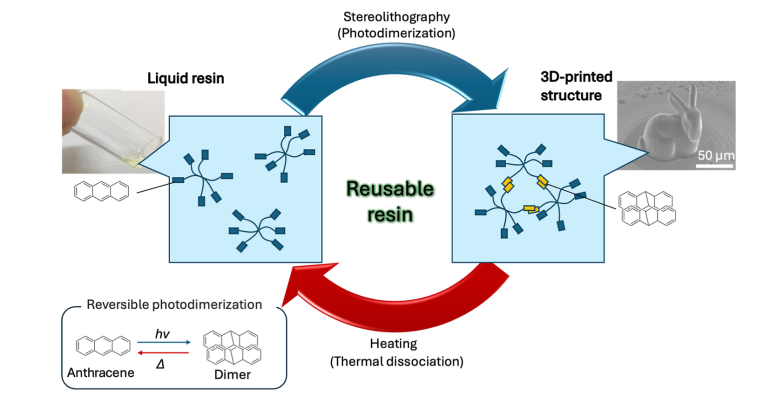
Researchers Masaru Mukai, Shoji Maruo, and colleagues at Yokohama National University have introduced a photocurable resin that can be printed, melted down, and printed again, more than ten times over, without adding a single chemical along the way.
The material, built around the reversible photodimerization of anthracene, could mark a turning point for sustainable high-resolution additive manufacturing. The research was published in ACS Omega.
How It Works: Light In, Heat Out
The resin operates on a deceptively simple principle. When exposed to blue light, anthracene molecules within the material bond together, forming a rigid cross-linked network. When that solid is then heated, typically to around 150–180°C, those bonds come apart and the material flows again as a liquid, ready for reuse. No photoinitiators, no additives, no purification steps between cycles. The transition between states is driven entirely by physical stimuli: light and heat.
The team demonstrated compatibility with both two-photon lithography, capable of sub-micron precision, and single-photon microstereolithography, making it applicable across a wide range of printing scales. Using a custom-built two-photon lithography system with a femtosecond laser at 780 nm, researchers printed intricate 3D microstructures including microneedle arrays and a miniature bunny model. The minimum curing line width achieved was just 0.61 micrometers, on par with conventional chain-growth resins that are far harder to recycle.
To make the recycling process tangible, the researchers ran a memorable demonstration: using two-photon lithography, they printed the letter “Y” into the resin, erased it with an infrared heater, printed “N,” erased it again, then printed “U,” spelling out “YNU” across eleven consecutive print-and-erase cycles. The exercise confirmed that the resin could withstand repeated localized printing and full thermal dissolution without losing its ability to cure accurately.
The Challenges the Study Had to Overcome
Applying a step-growth polymerization mechanism to stereolithography came with real technical uncertainty. Step-growth reactions are generally difficult to localize, and it was not clear from the outset whether anthracene photodimerization could be spatially confined enough to support the precise, layer-by-layer curing that stereolithography demands. The researchers found that localized activation by light, combined with the six anthracene units per molecule, which lower the percolation threshold, made controlled, high-resolution patterning achievable.
A second challenge was adapting the resin to single-photon microstereolithography, where the material’s high adhesiveness complicated the layer lift-up process. The team tested multiple substrate options before finding that a perfluoroalkoxy (PFA) film at the bottom of the resin chamber performed best, enabling reliable layer separation without bonding the print to the chamber floor.
There was also the question of viscosity drift. After each heating cycle, the resin does not fully return to its original viscosity, it becomes slightly thicker with each pass. The team ruled out detectable chemical side reactions via NMR, pointing instead to low-level thermal effects below detection thresholds.
Nevertheless, mechanical testing showed that stiffness increases predictably with each cycle, the reduced elastic modulus measured 2.43 GPa on the first print, rising to 2.66 GPa after one recycle and reaching 5.39 GPa after ten. The material remains structurally coherent throughout, and the team is now working toward DLP-based systems capable of handling larger objects, with the longer-term goal of integrating this material into scalable, industrial-grade sustainable manufacturing pipelines.

Closing the Loop on 3D Printing Waste
Yokohama National University’s anthracene-based resin sits within a broader strategic push in materials science to solve one of additive manufacturing’s most persistent structural problems: the near-total non-recyclability of photocurable resins.
The effort is gaining momentum across research institutions. A team from Zhejiang University, led by PhD student Yang Bo and Professors Xie Tao and Zheng Ning, developed an infinitely recyclable resin based on a thermally reversible photo-click reaction, published in Science in April 2025. Rather than relying on conventional carbon-carbon bonds, the system uses dithioacetal linkages, molecular clips that assemble under light and release with gentle heat, allowing the material to revert to its base components and be reprinted without performance loss.
Researchers at the University of Birmingham introduced a bio-based recyclable resin that addresses the reliance on petroleum-derived photopolymers by enabling the material to be broken back down into its constituent parts for reuse.
Yokohama’s anthracene approach adds a distinct dimension to this field: rather than changing the source material or the end-of-life chemistry, it makes the resin itself reversible by design, requiring nothing external to reset it.
Titled, “Initiator-Free Recyclable Anthracene-Based Photocurable Resin Enabling Sustainable 3D Printing via Single- and Two-Photon Stereolithography,” the study was conducted by Masaru Mukai, Wakana Miyadai, Seina Matsubara, Tomomi Aoki, and Shoji Maruo.
3D Printing Industry is inviting speakers for its 2026 Additive Manufacturing Applications (AMA) series, covering Energy, Healthcare, Automotive and Mobility, Aerospace, Space and Defense, and Software. Each online event focuses on real production deployments, qualification, and supply chain integration. Practitioners interested in contributing can complete the call for speakers form here.
To stay up to date with the latest 3D printing news, don’t forget to subscribe to the 3D Printing Industry newsletter or follow us on LinkedIn.
Explore the full Future of 3D Printing and Executive Survey series from 3D Printing Industry, featuring perspectives from CEOs, engineers, and industry leaders on the industrialization of additive manufacturing, 3D printing industry trends 2026, qualification, supply chains, and additive manufacturing industry analysis.
Featured image shows recyclable resin using reversible photodimerization of anthracene, its use in stereolithography to create 3D objects, and regeneration of resin by heating. Image via Yokohama National University.
