


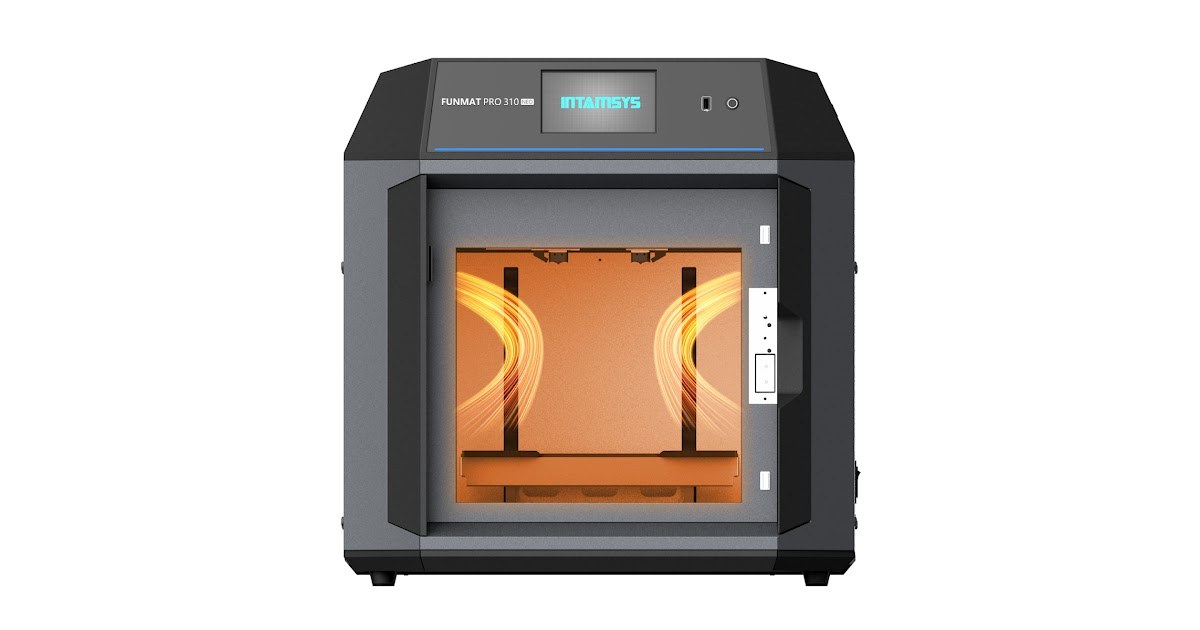
For years, INTAMSYS has been known for its Funmat Pro HT line of industrial Fused Filament Fabrication (FFF) printers.
With the Funmat Pro 310 NEO, the company extends that line with an Independent Dual Extruder (IDEX) motion system and a fully enclosed, actively heated chamber that reaches 100°C, targeting small and medium-sized enterprises (SMEs) and professional engineers who need dimensional stability and multi-material versatility when printing engineering-grade polymers such as polycarbonate, nylon, and reinforced composites.
INTAMSYS, founded in Shanghai in 2016, positions the machine for prosumer and industrial applications, with a specific focus on small-batch manufacturing.
For this review, the 3DPI engineering team tested the Funmat Pro 310 NEO using dimensional and statistical benchmarking, covering repeatability across multiple geometries, a 150-piece process capability run, perimeter and height accuracy, bridging, and overhangs, alongside seven functional application prints spanning automotive, motorsport, and general engineering use cases.
Why industrial dual-extrusion FFF matters
Industrial dual-extrusion FFF machines occupy a specific niche: they let manufacturers produce functional prototypes, jigs, fixtures, and short-run end-use parts in high-performance polymers. The main advantage over powder-based processes like selective laser sintering (SLS) or Multi Jet Fusion (MJF) is material selection: those processes are largely limited to nylon and a handful of TPUs, while FFF opens up materials like ABS, PC, nylon, and PPS on a comparatively large build plate, giving it a different use case altogether.
What typically separates this class of machine from a desktop FFF printer is security, safety features, consistency, and robustness, backed by the kind of thermal control and independent multi-nozzle motion built into the Funmat Pro 310 NEO.
What makes the Funmat Pro 310 NEO stand out?
The machine’s defining feature is its actively heated, fully enclosed chamber, which sustains 100°C internal temperatures rather than relying on the ambient-temperature enclosures found on most desktop dual-extrusion machines.That sustained heat keeps materials like PC, PPS, and carbon-fiber composite materials from warping or delaminating as a part cools unevenly, extending the machine’s practical reach into engineering polymers that ambient-chamber printers can’t process reliably.
The second defining feature is the IDEX system itself: two independent nozzles that move separately on the same gantry, rather than a single toolhead switching materials. That independence is what enables the machine’s duplicate mode (printing two identical parts at once), mirror mode (printing a part and its mirrored counterpart simultaneously), and dual-material mode (combining two materials or colors in one build), each of which is only possible because the two nozzles can move and park independently instead of sharing a single carriage.


Design and features
The Funmat Pro 310 NEO is built as an industrial workhorse, not a prosumer desktop machine. Its rigid stainless steel frame and metal-lined chamber house the IDEX motion system, driven by LDO NEMA 17 stepper motors and dual Z ball screws, giving the gantry the stability needed to hold tight tolerances across the machine’s full build height.
The print head reaches a maximum nozzle temperature of 350°C, using a direct-drive dual-gear extrusion system. Nozzles ship in a standard 0.4 mm diameter, with 0.25, 0.6, and 0.8 mm options also supported, feeding standard 1.75 mm filament.
That dual-nozzle layout comes with a tradeoff: build volume is 305 x 260 x 260 mm in single-extruder mode, but drops to 260 x 260 x 260 mm once the machine is running in a dual-material configuration, since both extruders then need to share the printable envelope.
Material support is broad, running on an open system rather than a closed, single-brand filament library.
Software and workflow
Software runs through INTAMSYS’ proprietary IntamSuite, which uses a CAD-style interface organized into ribbon-style header tabs: Home, Model, Profile, Manage, Tools, View, and Help.
Automated support generation comes with material-pairing recommendations built in, while a visual overhang detection tool flags problem areas in red before a print starts, and section-view clipping planes and measurement utilities let users inspect wall thickness and tolerances without leaving the slicer


Parameters can also be overridden on a per-model basis for jobs that need finer control than the presets allow. Preset profiles are organized by quality and speed tier, including Balance 0.2mm, Performance 0.15mm, Quality 0.1mm, and Speed 0.25mm.
Hardware and usability
Day-to-day operation runs through a 7-inch full-color touchscreen, with WiFi, Ethernet, and USB connectivity options for sending jobs.
Bed leveling is automated, using mesh leveling with Z-height compensation rather than requiring manual calibration before each print, though edge adhesion can still be inconsistent, sometimes calling for rafts or manual glue on the perimeter. The toolless quick-release print head is a genuine time-saver for maintenance or nozzle swaps, since it avoids the usual process of unscrewing and rewiring a hotend assembly.
One feature worth calling out separately is the IntamBox, an independent, thermostatically controlled dry box that uses molecular sieves and an integrated hygrometer to keep hygroscopic filaments dry before and during printing.


For materials like PA12 CF or PPA CF that readily absorb moisture, this kind of dedicated storage matters more than it might for a simpler desktop machine, though it’s a preventive measure rather than a cure: the IntamBox maintains dryness rather than reversing moisture already absorbed, so filament that’s picked up humidity still needs a proper drying cycle before it goes near the hotend.
Safety features include a door lock interlock, over-temperature protection, overload protection, and a combined HEPA and activated carbon filtration system, which is relevant given the enclosed, heated chamber and the range of engineering polymers the machine is designed to run.
The build plate itself is magnetic and flexible, with a textured aluminum surface designed to improve part adhesion and simplify print removal.


Machine capabilities and use cases
The Funmat Pro 310 NEO’s IDEX system supports four distinct operating modes. Duplicate mode runs both extruders simultaneously to print two identical parts at once, effectively doubling throughput. Mirror mode prints a model and its mirrored counterpart at the same time across a symmetry plane, useful for left-right part pairs. Dual-material mode combines two distinct materials or colors within a single build. Support-material mode dedicates the second extruder entirely to printing soluble or breakaway support structures for the part coming off the first.
That support-material ecosystem is one of the machine’s clearer strengths. Beyond standard breakaway HIPS and SP5010, the printer runs a water-soluble support material called SP3030, which our test results showed as having ‘exceptional behavior as a water soluble support for PA6, PA6 CF, TPU 95 A, and ABS plus,’ dissolving faster in heated water and printing far more easily than PVA.
Performance testing
Our engineering team has developed inhouse benchmarking to test dimensional accuracy, statistical process capability, and a set of geometry-specific stress tests designed to evaluate consistency across common failure modes such as bridging and overhangs.
Repeatability test
For the repeatability benchmarks, our engineering team isolated the machine’s mechanical precision from material-specific thermal behavior by using generic PLA as the reference material, printed with IntamSuite’s default Standard profile at a 0.20 mm layer height. Nozzle and bed temperatures were held at 210°C and 55°C respectively, the chamber’s active heating stayed off, and no support structures were used.
The test ran 42 parts in total: 12 squares, 12 hexagons, 12 tubes, and 6 circular trajectories, printed in batches of three and measured with calibrated instruments. The target threshold, the reference 3DPI uses to call a repeatability test successful, was a mean deviation under 0.1 mm and a standard deviation under 0.05 mm. The Funmat Pro 310 NEO comfortably met that threshold across all four geometries tested.


The squares test (12 mm hole, 10 mm height, 15 mm length) produced an overall mean deviation of 0.0167 mm (s = 0.0169 mm). The internal hole diameter averaged 11.9758 mm against a 12 mm target, a deviation of 0.0242 mm (s = 0.0169 mm) attributed to the physical tension filament naturally experiences tracing internal curves in FFF. Z-height deviation came in at 0.0167 mm (s = 0.0233 mm); the first six samples printed on the left toolhead showed slight compression, or elephant’s foot, at the base layers, though still within tolerance. Length was the tightest dimension, at just 0.0092 mm (s = 0.0130 mm)

The hexagons test (30 mm length, 10 mm height, 5 mm groove depth, 10 mm groove width) delivered the highest precision of the entire battery, with an overall mean deviation of 0.0162 mm (s = 0.026 mm). Length deviation was nearly negligible at 0.0025 mm (s = 0.0070 mm), groove depth came in at 0.0058 mm (s = 0.0137 mm), and groove width at 0.0142 mm (s = 0.0349 mm). The one notable variation was Z-height, at 0.0425 mm (s = 0.0552 mm), again linked to slight first-layer compression on the earliest replicates.

The tubes test (20 mm outer diameter, 20 mm height) showed outstanding Z-axis control, with height deviation of just 0.0308 mm (s = 0.0396 mm), but posted the widest error margin of the four geometries overall, at 0.072 mm (s = 0.032 mm). The outer diameter measured 0.1150 mm below the CAD target on average (s = 0.0290 mm), a gap driven by thermal shrinkage in the material and a lack of toolpath compensation.

Normal distribution results for the tube models. Images by 3D Printing Industry.
The circular trajectory test used concentric circles at 20 mm, 65 mm, and 100 mm. The 20 mm circle showed mean deviations of 0.033 mm in X and 0.035 mm in Y; the 65 mm circle came in at 0.012 mm in X and 0.022 mm in Y; and the 100 mm circle measured 0.013 mm in X and 0.025 mm in Y. Behavior was largely symmetric across both axes, with only a slightly elliptical trajectory showing up on the 65 mm and 100 mm circles.

The normal distribution of the circular trajectory tests. Images by 3D Printing Industry.
Combined across all 42 samples and four geometry types, the overall standard deviation came out to 0.024 mm, a tight figure for an FFF machine working at this build size.
Process capability
To assess long-run consistency rather than single-print accuracy, 3DPI ran a 150-piece continuous production run of 20.00 mm tubes against a tolerance window of ±0.10 mm.
The process capability index (Cp) came in at 4.49, reflecting a highly capable process with consistent output. The minimum process capability index (Cpk), which accounts for how well the process centers within its tolerance limits rather than just how tightly it clusters, came in at 2.01. For context, a Cpk above 1.33 is generally treated as capable in manufacturing quality control, so a reading of 2.01 indicates the process holds tight tolerances even after accounting for any systematic offset.
The Taguchi capability index (Cpm), which measures how well centered the process mean is on the target rather than just within the tolerance band, was comparatively low at 0.59, reflecting a systematic 0.055 mm undersizing across the run rather than random scatter.
In practical terms, that undersizing on a 20.00 mm tube works out to roughly +0.28% of nominal diameter, meaning operators chasing tight outer-diameter tolerances may need to scale models up by that amount to compensate, rather than relying on the slicer to correct for it automatically.


3DPI benchmark score
The 3DPI benchmarking suite scores FFF printers across nine categories, from dimensional accuracy to retraction, for a weighted total out of 100. A score above 60 is considered strong, and above 70 places a machine in the top tier. The Funmat Pro 310 NEO scored 85.15, comfortably in that top tier, acing nearly every category that matters for engineering parts: dimensional accuracy, bridging, wall thickness, clearances, and repeatability.
Retraction was the clear weak point, held back by visible stringing during testing, so parts with a lot of travel moves will likely need manual tuning to come out clean. That strong score also came with a tradeoff in speed: the benchmark run took roughly two and a half times longer than comparable machines, since IntamSuite’s default settings favor caution over speed.


Perimeter test
A perimeter test targeted the machine’s 260 x 260 mm dual-nozzle build envelope. The measured printed boundary came out to 259.95 x 259.93 mm, with a clean result free of stringing, elephant’s foot, or layer inconsistencies.


Tower test
To validate accuracy across the machine’s full build height, we printed dual towers with a 35 x 35 mm base up to the maximum Z-height of 260 mm. The first tower’s base measured 34.99 x 35.00 mm and the second measured 34.99 x 34.98 mm, while both towers hit the target height of exactly 260.00 mm with zero recorded layer shifts or Z-wobble. Together, the perimeter and tower tests cover the machine’s maximum XY area and maximum Z-height; this evaluation did not include a separate full-volume 3D print test.


Bridge test
Bridging was evaluated across unsupported horizontal spans from 5 mm to 60 mm. The hardware itself completed the bridges without issue. On repeatability, bridge uniformity was noticeably worse when printed along the X-axis orientation compared to the Y-axis, a difference traced to directional cooling airflow inside the chamber rather than to the hardware itself.


Overhang test
Overhang performance held up well at moderate angles but began to degrade at steeper geometry. Visible layer deformation and sagging started appearing at 65-degree overhangs, a limitation attributed to localized cooling capacity rather than to motion system accuracy. That same falloff is what cost the machine a fraction of a point in the 3DPI benchmark score.


Application and print tests
All functional application models were evaluated at a standard 0.20 mm layer height to balance surface resolution with build speed.
Engineering and industrial parts
The standout application test was a helical gear printed in pure Polyphenylene Sulfide (PPS) with single-material PPS supports enabled and an 80% Gyroid infill with four wall loops for torque and impact resistance, finishing in 2 hours at a 275°C nozzle and 100°C chamber. Because PPS bonds strongly between layers, the supports fused tightly to the gear body and needed manual tools to remove, leaving minor cosmetic marks at the contact points, though the teeth still printed with high dimensional fidelity and meshed smoothly with a mating gear under torque.


Following this, a topology-optimized generative design bracket, printed in glass-fiber reinforced PPA (PPA-GF) with SP5010 breakaway support at 290°C nozzle and 100°C chamber temperatures, demonstrated the machine’s ability to print complex, AI-driven geometries that can’t be produced by subtractive CNC machining. Because the generative geometry already distributes load efficiently, infill dropped to a 40% Gyroid pattern, and the support, applied only to the lower interface regions to cut material waste, held to a 0.0 mm Z-gap at the interface thanks to the IDEX system, detaching effortlessly and leaving smooth, unmarred contact surfaces. Being highly hygroscopic, the PPA-GF filament was pre-dried at 80°C for 12 hours before printing to prevent moisture porosity at that nozzle temperature, and the part came out exceptionally stiff and free of visible defects.


An engine timing cover, printed in PC-ABS with HIPS support at 280°C nozzle and 100°C chamber temperatures, finished in 3 hours 45 minutes with a 0.0 mm Z-gap at the support interface thanks to the IDEX system. The chamber heat prevented internal stresses and delamination, and HIPS detached smoothly from internal cavities and bolt-hole bores.


A dowelling drill jig came next, printed in pure polycarbonate with HIPS support at a 275°C nozzle, 100°C bed, and 100°C chamber, using an 80% Gyroid infill and four wall loops for added structural resistance, finishing in 3 hours 50 minutes in an upright orientation. Pure PC is notoriously prone to warping, so the part went down on a microtextured PEI magnetic build sheet with a PVP glue stick applied for extra adhesion; combined with the active chamber sustaining stable thermal conditions throughout, the jig came out with accurate hole alignments and high impact resistance, ready for shop deployment.


A wheel bracket automotive prototype, printed in ABS-HT with HIPS support at 260°C nozzle, 100°C bed, and 80°C chamber temperatures, with a 0 mm Z-gap between support and model, opens the automotive batch. Since ABS-HT is prone to warping, the part went down on a microtextured PEI magnetic build sheet with a PVP glue stick applied for extra bed adhesion. It finished in 7 hours 5 minutes, with the HIPS scaffolding detaching cleanly and no surface scarring, while the chamber held thermal equilibrium throughout, suppressing the warping and delamination ABS-HT is prone to.


A MotoGP aerodynamic winglet, printed in carbon-fiber reinforced ASA (ASA-CF) with HIPS support on a 3-layer raft using pre-dried filament, took 9 hours 30 minutes at a 260°C nozzle and 90°C chamber temperature; the raft and support detached cleanly, and the heated chamber prevented warping along the winglet’s thin trailing edges.


At the other end of the application set, the heated chamber proved its worth again on a Formula 1 2026 front wing prototype at 20 percent scale, printed in PA6-CF with SP3030 water-soluble support at 270°C nozzle and 70°C chamber temperatures. Because PA6-CF is highly hygroscopic, the filament was pre-dried at 80°C for 12 hours before printing to prevent moisture porosity at that extrusion temperature. The part used the machine’s full 260 mm Z-height, and post-print, it was submerged in a circulating hot water bath at 50°C for 2 hours, which dissolved the SP3030 support completely from the wing’s internal cavities without ultrasonic agitation or leaving residue, preserving the ultra-thin aerodynamic flaps with zero scarring and holding layer consistency across the entire vertical height with no shifting or warping.


Material compatibility
As an open material system running standard 1.75 mm filament, the Funmat Pro 310 NEO supports a wide spread of engineering and general-purpose polymers, including PLA, ABS, ASA, PETG, PC, PA12 CF, PPA CF, PPS-GF, TPU 95A, HIPS, PVA, BVOH, and the SP3030 and SP5010 support materials.
PPS deserves a specific note. While the material printed successfully for the helical gear test, it’s a demanding engineering polymer that requires careful single-material support tuning because of its strong interlayer bonding, which is also what makes it attractive for parts that need chemical and thermal resistance.
PLA served as the baseline material for repeatability and process capability benchmarking, a standard way to isolate machine accuracy from material behavior. It’s worth noting, though, that PLA isn’t the primary focus of this machine’s positioning, which centers on PC, PA, and ABS-class engineering materials for functional and industrial applications
An industrial dual-extrusion platform for engineers and small manufacturers
The Funmat Pro 310 NEO delivers industrial-grade dual-extrusion printing for $8,495 to $9,495, a price that puts high-temperature engineering-polymer capability within reach of SMEs that might otherwise outsource these parts.
In benchmarking, the machine achieved a 3DPI benchmark score of 85.15 out of 100, with process capability figures (Cp of 4.49, Cpk of 2.01) confirming tight, repeatable dimensional control across every geometry tested; the only meaningful points lost were in retraction and, to a lesser degree, steep overhangs. The heated chamber and IDEX system carried that precision into every application test, from PA6-CF to PPS, and the water-soluble SP3030 support system produced consistently clean, zero-gap interfaces on complex geometry.
The main areas that still warrant refinement are slow default print speeds, inconsistent edge adhesion, and occasional IntamSuite instability.
For engineering teams and small manufacturers who need functional prototypes and short-run, end-use parts in high-temperature and reinforced polymers, the Funmat Pro 310 NEO stands out as one of the more capable industrial dual-extrusion platforms in its price bracket, particularly where multi-material or soluble-support geometry would otherwise be impractical to produce.
Featured image shows Funmat Pro 310 NEO. Photo via 3D Printing Industry.
