


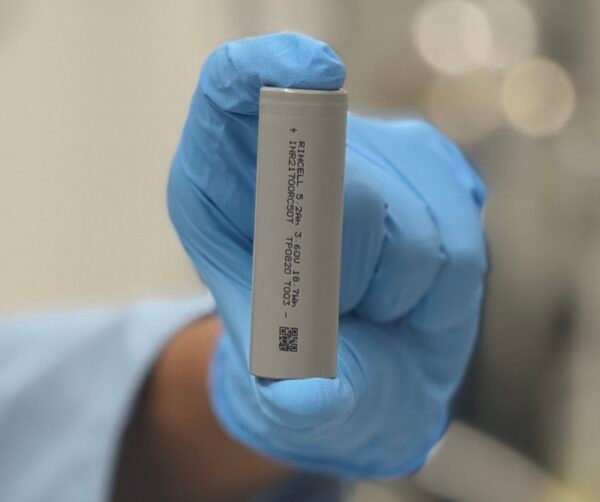
The Fremont cell maker makes its European debut in London with an NDAA-compliant tabless 21700 cell rated for 100A continuous discharge and already shipping to drone manufacturers.
Rincell, a U.S. battery cell manufacturer headquartered in Fremont, California, will unveil the RC50T at DroneX, held September 29-30, 2026 at ExCeL London. The show marks the company’s first public appearance in Europe. The RC50T is a tabless 21700 lithium-ion cell built for drones, and it is NDAA compliant. According to Rincell, production is ramping up and the cell is already shipping to customers.
The company designed the RC50T for the high-load phases of a mission: take-off, climb, payload lift and rapid maneuvering. From a standard 21700 cylindrical format, it delivers 100A continuous and 150A pulse discharge, with energy density above 265 Wh/kg (about 120 Wh/lb). Its tabless construction also cuts internal resistance to 3 to 4 milliohms, so more stored energy reaches the motors as usable power rather than heat. In addition, the cell accepts charge at up to 15A for quick turnaround between flights.
“In an industry often driven by future promises, we chose to focus on proven results. For three years we have kept our heads down, taken our cells from the lab into volume production and shipped them to customers. DroneX is the first time we have told that story. Everything visitors will see on our stand is a product they can order and fly today. That includes the RC50T, our highest power 21700 cell, and it is already in the air,” said Jignesh Parikh, co-founder and chief executive of Rincell.
“The RC50T gives us power headroom, without any loss in energy, that we have not had from a 21700 cell before. With internal resistance this low we can build lighter, cooler packs and let the aircraft use more of the energy it is carrying,” said Shashank Sripad, co-founder and chief technology officer of PROPEL AERO.
Rincell RC50T and RC50 specifications
The RC50T joins the RC50, a 5Ah 21700 cell already shipping in volume to drone manufacturers across defense, agricultural and surveillance applications. Both cells use silicon-graphite lithium-ion chemistry at a nominal 3.6V, and both operate from -20 to 60 degrees Celsius (-4 to 140 degrees Fahrenheit). By comparison, the RC50 offers roughly 276 Wh/kg, 5C continuous and 10C pulse discharge and a cycle life above 1,000 cycles. The RC50T trades cycle life for power, with a projected life above 500 cycles and a 5.2Ah nominal capacity.
Pricing between the two is comparable. As a result, the choice comes down to the mission: the RC50 where endurance and cycle life lead, and the RC50T where peak power matters most.
“Drone builders in the UK and Europe are looking for cells that combine real performance with a supply chain they can trust, and they want them now rather than at some point in the future. We are bringing both to London. Our approach is simple: we do not show anything that is not in production, so when we say a cell is available, it is,” Parikh said.
Manufacturing footprint and supply chain
Parikh and Dr. Jagjit Nanda, director of the SLAC-Stanford Battery Center, founded Rincell in January 2023. The company handles research and development in the United States, where it runs a 6,500-square-foot (604-square-meter) pilot line in Fremont. Volume production takes place primarily in India, while a U.S. production facility is scheduled to come online in late 2027. That timeline comes as drone builders face growing pressure on battery supply chains. Rincell is venture-backed and has support from In-Q-Tel, the U.S. Department of War and the California Energy Commission.
Rincell will exhibit on stand U534, showing the RC50T and RC50 alongside sample pack designs.
More information is available at Rincell.
Read More

Ian McNabb is a journalist focusing on drone technology and lifestyle content at Dronelife. He is based between Boston and NH and, when not writing, enjoys hiking and Boston area sports.
