


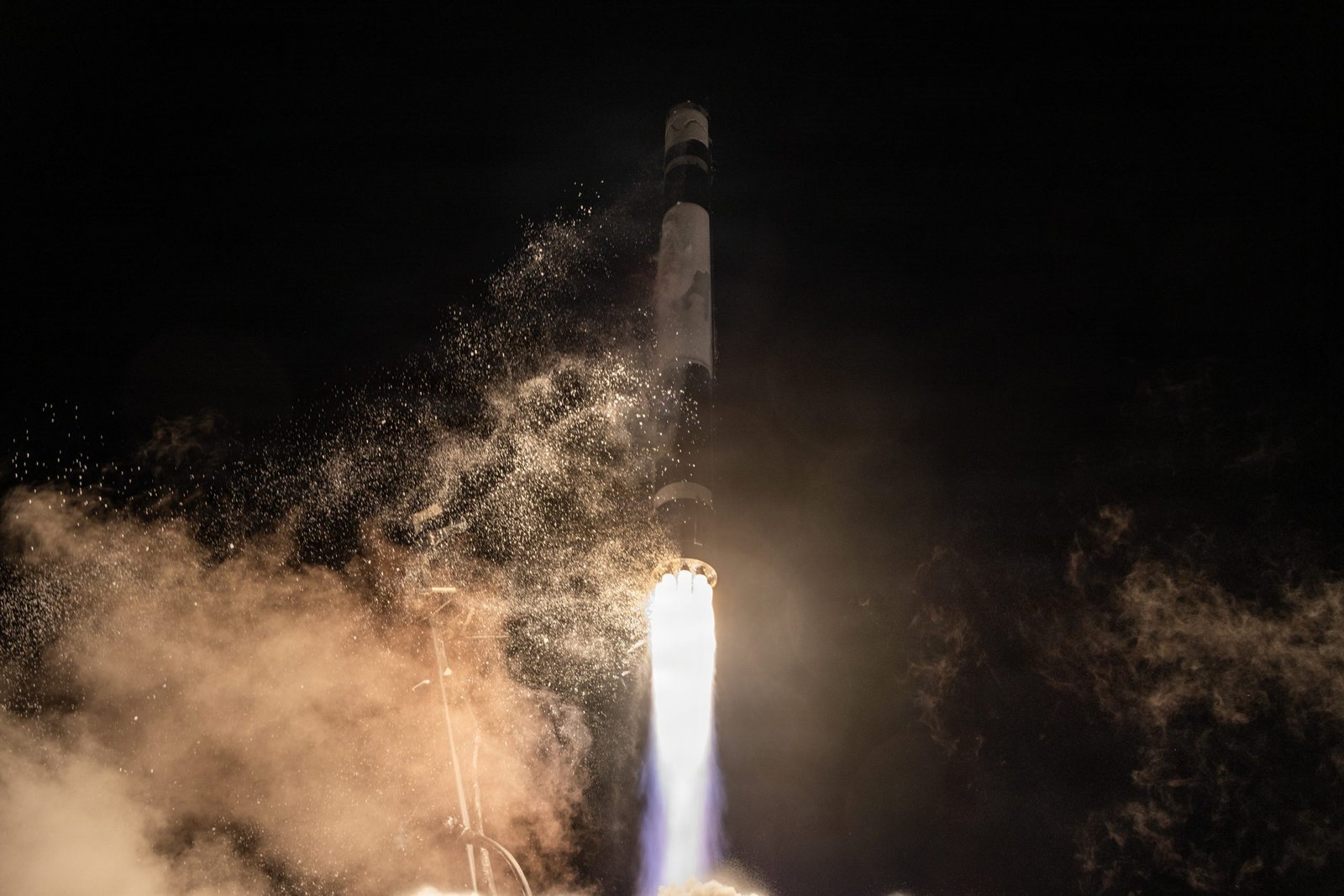
WASHINGTON — Rocket Lab launched a spacecraft for the U.S. Space Force to begin a military exercise focused on rapidly identifying and characterizing potential threats in space.
The company on June 19 launched the Victus Haze spacecraft, known as “Victus Haze Puma,” aboard an Electron rocket from the company’s launch site in Mahia, New Zealand. The satellite was developed under a $32 million contract awarded by the Space Force in 2024 and is one of two spacecraft participating in the Victus Haze mission.
The spacecraft was placed into a sun-synchronous orbit and will now undergo commissioning before beginning rendezvous and proximity operations, or RPO, with a spacecraft operated by Colorado-based startup True Anomaly.
“With launch complete, the team will now complete on-orbit checkout and vehicle commissioning, after which RPO operations begin,” Space Systems Command said in a June 22 statement. “During these operations, the teams operating both the Rocket Lab and the True Anomaly space vehicles will conduct a variety of scenarios, demonstrating space domain Awareness and characterization capabilities, each in dynamic engagements with the other.”
Victus Haze is the fourth demonstration under the Space Force’s Tactically Responsive Space, or TacRS, program, which seeks to prove that commercial providers can rapidly launch spacecraft on military timelines while also performing increasingly sophisticated missions once in orbit.
The exercise builds on lessons from the 2023 Victus Nox demonstration, when the Space Force and launch provider Firefly Aerospace launched a satellite within 27 hours of receiving a launch order. While Victus Nox focused primarily on rapid launch, Victus Haze expands the concept to include the ability to quickly deploy spacecraft capable of maneuvering, inspecting and characterizing objects in orbit.
The broader goal is to transform responsive launch from a demonstration effort into an operational military capability. Space Force officials have argued that future conflicts may require the rapid replacement of damaged satellites, deployment of new sensors or launch of spacecraft to investigate suspicious activity in orbit on timelines measured in days rather than months or years.
Under the Victus Haze architecture, the Space Force selected Rocket Lab and True Anomaly to provide separate maneuvering spacecraft that would conduct rendezvous and proximity operations after launch.
The Rocket Lab spacecraft is expected to conduct operations with Jackal-004, a True Anomaly spacecraft already in orbit, rather than waiting for a dedicated Victus Haze vehicle that had been expected to launch separately on a Firefly Aerospace rocket.
Jackal launched May 3 aboard a SpaceX Falcon 9 rideshare mission carrying South Korea’s CAS500-2 Earth observation satellite. The spacecraft will maneuver and interact with Rocket Lab’s vehicle with during the demonstration.
True Anomaly received a $30 million contract for Victus Haze.
Prior to the Rocket Lab launch, the Space Force’s Space Safari program office directed the company to a “heightened readiness posture” before activating the team into alert status. The activation process took less than 48 hours, according to the Space Systems Command. After an unspecified waiting period, the company received a notice-to-launch order requiring it to prepare for launch to a previously unknown orbit within its performance capabilities with only 24 hours’ notice.
“Victus Haze set out to demonstrate our ability to respond to irresponsible behavior on orbit under operationally realistic conditions, and we are doing just that, leveraging commercial partnerships to maximize flexibility and minimize cost,” said Col. Bryon McClain, acting Space Force portfolio acquisition executive for Space Combat Power.
True Anomaly said in a statement that Jackal is “fully operational and ready to execute rendezvous and proximity operations.”
