


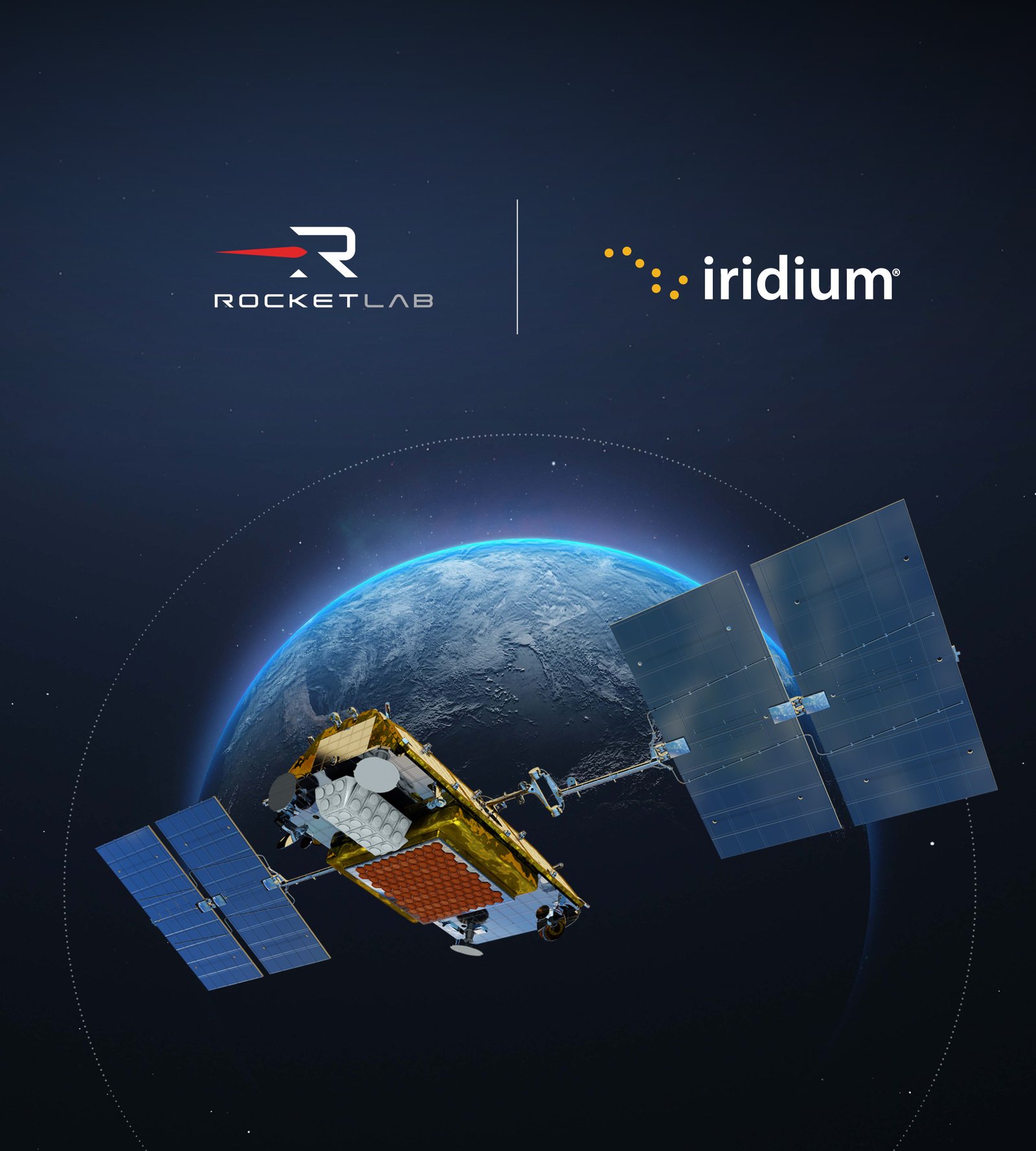
Nasdaq-listed launch and space systems company Rocket Lab Corporation and global satellite network operator Iridium Communications have signed a definitive agreement for Rocket Lab to acquire Iridium, valuing Iridium shares at $54 a piece through a combination of cash and stock and putting its enterprise value at roughly $8 billion. The combination creates a single, vertically integrated space business spanning launches, spacecraft manufacturing, spectrum rights, and orbital communications, cutting out third-party launch costs, keeping that revenue in-house, and securing reliable orbital access as launch capacity tightens.
“This is a defining moment for the space industry and the start of a new era of strategic, accelerated growth for Rocket Lab and Iridium,” said Sir Peter Beck, founder and CEO of Rocket Lab. “Iridium has built the gold standard in secure, safety critical global satellite connectivity. It is relied upon by maritime fleets, the aviation industry, governments, and heavy industrial organizations who operate in the most remote off-the-grid locations. By marrying Iridium’s deep heritage, trusted infrastructure, and highly sought-after spectrum with Rocket Lab’s extensive and proven launch and manufacturing capabilities, we have the capability to unlock entirely new markets. We will go far beyond maintaining a legacy; we are going to build upon it to pioneer next-generation space applications and deliver sought-after capabilities to existing and new customers.”
The Deal Specifications
Iridium stockholders will receive $27.00 in cash per share plus a number of Rocket Lab shares calculated through an exchange ratio tied to a price collar of $67.50 to $112.50. Rocket Lab has arranged a $3.6 billion, 364-day secured bridge loan through Deutsche Bank and Wells Fargo to help cover the cash portion, and expects to draw on its balance sheet along with additional debt and equity financing for the remainder.
Both companies’ boards approved the transaction unanimously, and every Iridium director holding company stock has committed to vote in favor. The companies expect the deal to close in mid-2027, subject to shareholder and regulatory approval.
On Rocket Lab’s side, the advisory team includes Deutsche Bank Securities as top financial adviser alongside Wells Fargo and PJT Partners, with Wilson Sonsini Goodrich & Rosati handling legal work, Goodwin Procter managing financing matters, and DLA Piper covering regulatory issues. Iridium, meanwhile, has retained Evercore as its sole financial adviser, Davis Polk & Wardwell for legal counsel, Wilkinson Barker Knauer on the regulatory side, and Joele Frank, Wilkinson Brimmer Katcher for communications strategy.
What Each Company Brings to the Combination
Iridium adds a network built over several decades: a constellation of low Earth orbit (LEO) satellites, globally coordinated L-band spectrum, and a partner base the company says exceeds 500 organizations, serving more than 2.55 million active subscribers, many in locations where GPS or other satellite navigation signals are degraded or absent.
With the deal, Rocket Lab gains immediate scale in satellite-based Internet of Things connectivity, direct-to-device messaging, positioning and timing services, and life-safety communications, all in one move. The plan isn’t to keep Iridium’s network running as-is, but to expand it, pushing into new markets and launching space-based services that weren’t previously part of either company’s offering.
“As the worlds of space and terrestrial communications continue to converge, more critical services will depend on space-based capabilities,” said Matt Desch, CEO, Iridium. “Success will come from those who can bring new innovations to space quickly and sustain them over time as efficiently as possible. We’re excited about being able to accelerate the next generation of IoT, aviation, maritime, PNT, and national security capabilities, and pursue new innovative applications as part of Rocket Lab – a fully integrated, end-to-end space company. That’s an incredible opportunity for our customers, partners, employees, and stockholders.”
Following the close, the companies plan to invest in Iridium’s next-generation constellation, with full terms for the exchange ratio calculation to appear in the transaction agreement once filed with the SEC.

An End-to-End Space Company
The deal creates a single space business spanning launches, spacecraft, spectrum, and orbital communications. That logic runs through Rocket Lab’s broader approach to growth: additive manufacturing has already lowered the cost of producing spacecraft hardware at scale, making it more commercially attractive to own and operate a satellite network than it would have been under traditional manufacturing economics. That said, running a network involves operating costs, spectrum licensing, and subscriber economics that go beyond hardware costs alone.
This isn’t Rocket Lab’s first move toward vertical integration, either. Rocket Lab’s acquisition of Mynaric, a German laser-communications terminal maker, was framed around the same logic, bringing satellite optical communications in-house to support what Rocket Lab called pursuing every part of the space value chain, from launching its own rockets to eventually operating its own constellations. Iridium is simply the largest step yet in a strategy the company has been building for years.
Other launch companies are chasing similar control over their supply chains. South Korean launch company INNOSPACE built an in-house 3D printing division specifically to internalize production of core rocket engine components, a move described as a direct parallel to the vertical integration strategy Rocket Lab pioneered at its Long Beach facility.
Whether the goal is laser terminals, engine components, or an entire satellite network, the pattern across the industry is the same: companies are betting that owning more of the stack, rather than depending on outside suppliers, is now cheaper and more defensible than staying specialized.
3D Printing Industry is inviting speakers for its 2026 Additive Manufacturing Applications (AMA) series, covering Energy, Healthcare, Automotive and Mobility, Aerospace, Space and Defense, and Software. Each online event focuses on real production deployments, qualification, and supply chain integration. Practitioners interested in contributing can complete the call for speakers form here.
To stay up to date with the latest 3D printing news, don’t forget to subscribe to the 3D Printing Industry newsletter or follow us on LinkedIn.
Explore the full Future of 3D Printing and Executive Survey series from 3D Printing Industry, featuring perspectives from CEOs, engineers, and industry leaders on the industrialization of additive manufacturing, 3D printing industry trends 2026, qualification, supply chains, and additive manufacturing industry analysis.
Featured image shows Rocket Lab has signed a definitive agreement to acquire Iridium. Image via Rocket Lab.
