


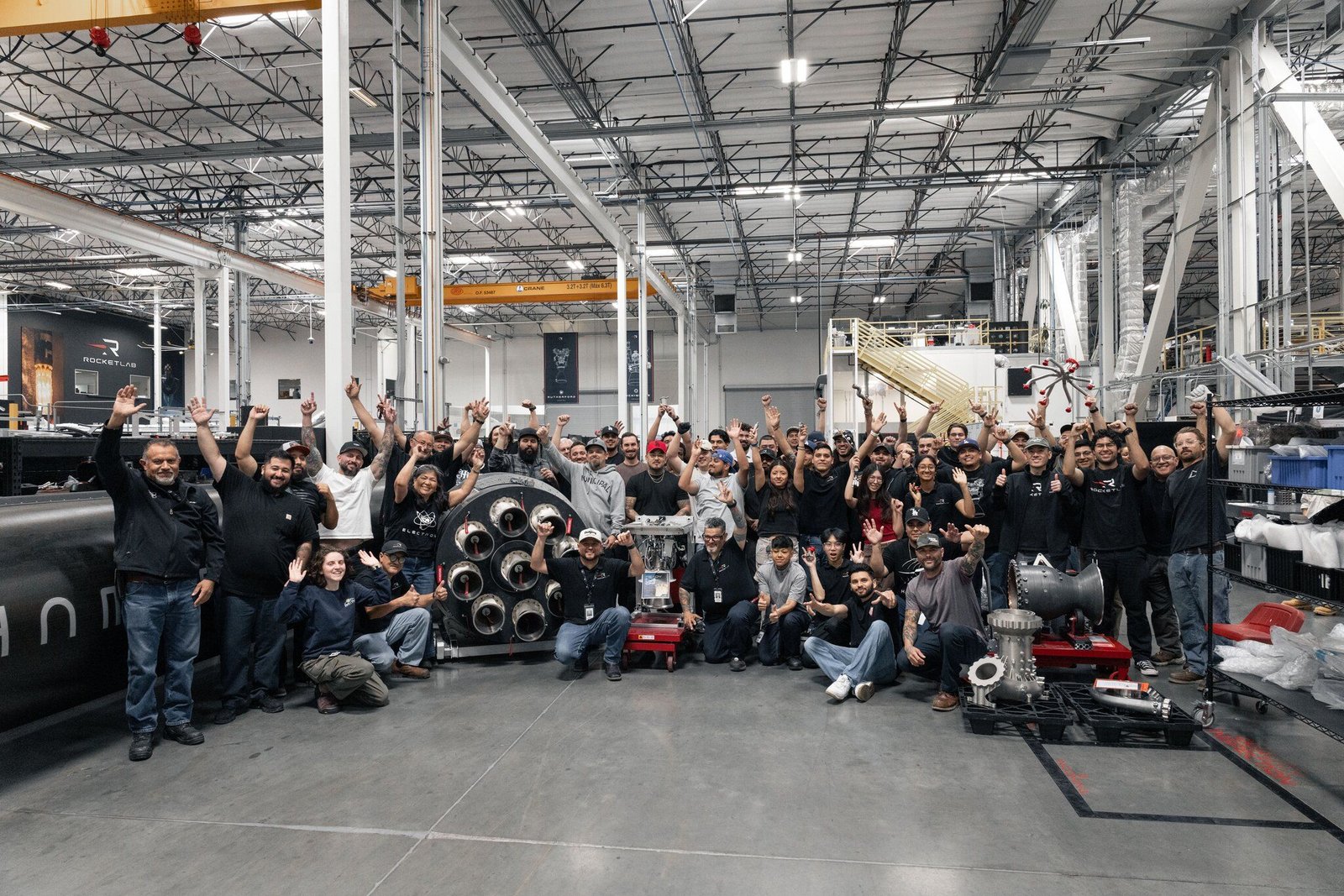
US-based space systems company Rocket Lab has completed production of its 1,000th Rutherford engine at its Long Beach, California facility, a milestone that reflects the maturation of additive manufacturing as a viable industrial process in orbital spaceflight. The Rutherford is the world’s first 3D printed, electric pump-fed orbital rocket engine, and its production volume now places it among the most manufactured rocket engines on Earth.
“The 1,000th Rutherford engine has rolled off the production line, The world’s first 3D printed, battery-powered rocket engine is now one of the most manufactured rocket engines on Earth,“ stated the company on LinkedIn.
One Engine, Built Differently From the Start
Rutherford’s development traces back to 2013, with the engine first reaching orbit in January 2018 as the propulsion system behind the Electron small launch vehicle. The design departed from industry convention in several key ways. Electron’s first stage runs on nine sea-level variants, each generating 24 kN of thrust, with a second stage powered by a single vacuum-optimized version. At just 35 kg, the engine swaps the gas turbine assemblies found in traditional rocket propulsion for lithium-polymer battery-driven electric motors, an architecture that additive manufacturing made structurally and economically feasible.
Every major component, from the combustion chamber and injectors to the pumps and propellant valves, is additively produced. The full set can be printed within a single day, a stark contrast to the timelines associated with conventional casting and machining. Production takes place at Rocket Lab’s Long Beach facility, where metal printing systems from EOS, Nikon SLM Solutions, and Renishaw handle fabrication, with Carpenter Technology supplying the metal powders.
Output has grown considerably since the program’s earliest phase, when the team was producing roughly one engine per month. The current annual target sits at around 200 units. By late 2025, the engine had accumulated a flight record spanning more than 70 Electron missions, with upward of 800 units having reached space ahead of the 1,000th rolling off the line.

A Global Race to Print Propulsion
Rocket Lab’s milestone arrives as additive manufacturing in aerospace propulsion moves from proof-of-concept to a global production race. LEAP 71 and HBD recently produced a 200 kN 3D printed aerospike rocket engine, designated XRA-2E5, manufactured as a monolithic Inconel 718 part in a continuous 289-hour build and exhibited at TCT Asia 2026 in Shanghai, demonstrating large-format metal additive manufacturing for aerospace propulsion at a scale previously considered impractical.
Newer entrants are scaling the same logic into dedicated facilities. South Korean launch company INNOSPACE launched an in-house 3D printing division in 2025 specifically to internalize production of core rocket engine components, becoming the first company in the country to earn ISO/ASTM 52941-20 certification for aerospace-grade metal AM systems, a direct parallel to the vertical integration strategy Rocket Lab pioneered with its Long Beach facility years earlier.
What separates Rocket Lab from the field is not the technology but the track record. One thousand engines, more than 70 orbital missions, and a production rate that has compounded steadily for nearly a decade.
3D Printing Industry is inviting speakers for its 2026 Additive Manufacturing Applications (AMA) series, covering Energy, Healthcare, Automotive and Mobility, Aerospace, Space and Defense, and Software. Each online event focuses on real production deployments, qualification, and supply chain integration. Practitioners interested in contributing can complete the call for speakers form here.
To stay up to date with the latest 3D printing news, don’t forget to subscribe to the 3D Printing Industry newsletter or follow us on LinkedIn.
Explore the full Future of 3D Printing and Executive Survey series from 3D Printing Industry, featuring perspectives from CEOs, engineers, and industry leaders on the industrialization of additive manufacturing, 3D printing industry trends 2026, qualification, supply chains, and additive manufacturing industry analysis.
Featured image shows Rocket Lab’s team. Photo via Rocket Lab.
