


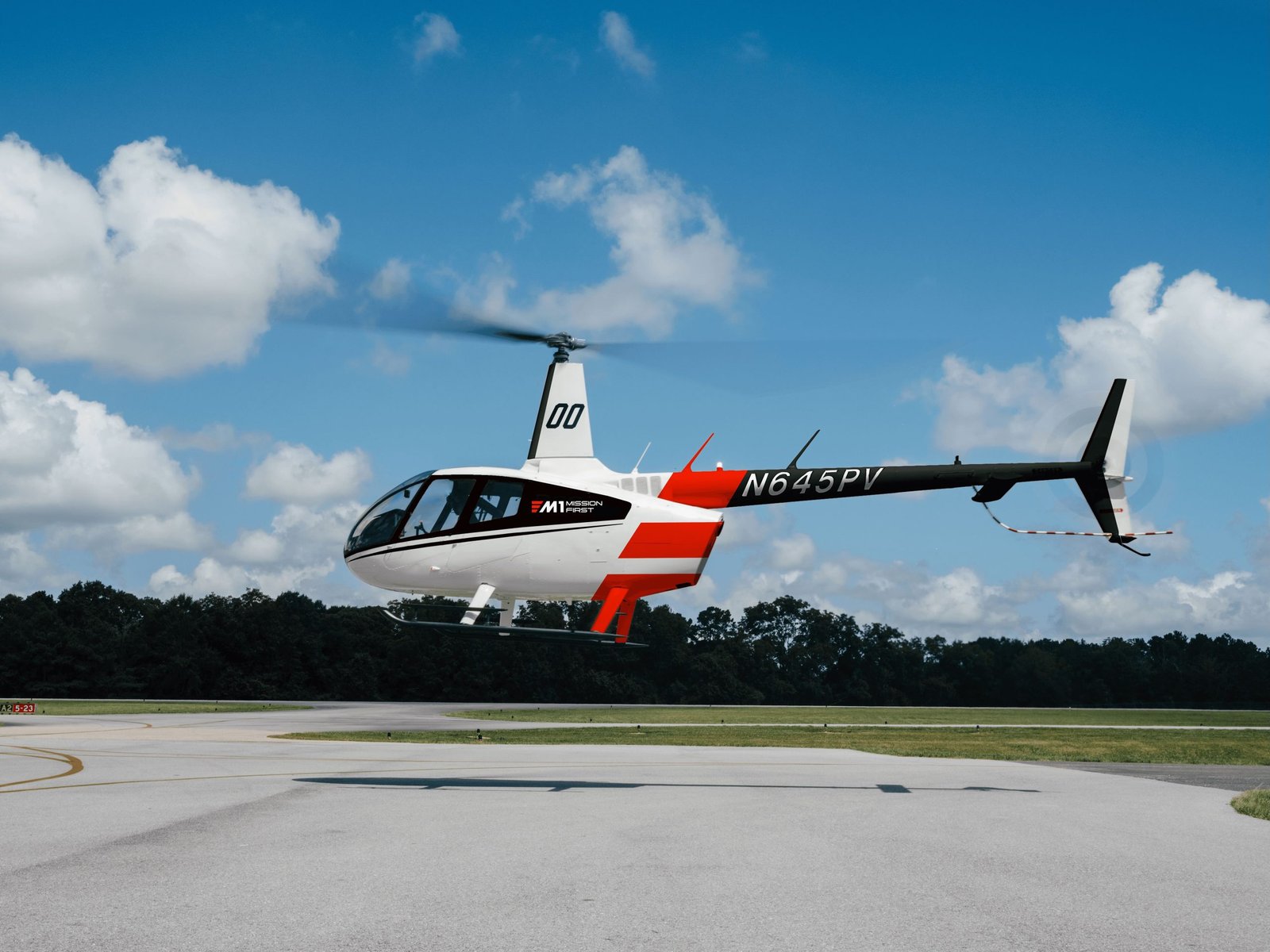
California helicopter manufacturer plans first deliveries to M1 Support Services next spring.
Robinson Helicopter will deliver at least 150 R66 light-singles to M1 Support Services as part of its forthcoming training contract with the US Army, although that figure could rise to as many as 200 units, the airframer says.
M1 was selected by the army on 13 August as the winner of its Flight School Next (FSN) initiative to revamp the service’s training system. The associated contract is worth $10 billion and could run for up to 26 years.
Under FSN, the service will move away from the provision of primary pilot training by multiple vendors using a fleet of army-owned Airbus Helicopters UH-72A Lakotas in favour of a contractor-owned/contractor-operated model based on the R66, with instruction and sustainment integrated into the contract.
The army argues the Lakota’s high levels of automation do not properly teach basic flying techniques, leading to safety problems further down the line.
Speaking to FlightGlobal, David Smith, chief executive of Robinson, says a minimum of 150 R66s will be needed to service the output requirements of FSN, potentially rising to 200 helicopters “depending on utilisation and how the curriculum evolves”, he adds.
The new training structure will provide basic flight instruction for 800-1,500 new pilots annually, compared to 1,250 under the current system.
However, the fleet will be recapitalised as aircraft time out, he notes: “Ultimately it will be many more aircraft than that just to keep the fleet fresh.”
Such an arrangement will also provide a ready supply of used inventory for the second-hand market; even with “8,000 hours of hard army time, there’s a customer out there for that aircraft”, he says.
Deliveries of the first training-roled R66s to M1 will begin in the spring of next year, allowing for the induction of the first phase of students in late 2027 and early 2028.
“Our goal is to start on day one of this and make sure it never gets moved to another OEM,” Smith says. “The commitment is for a 26-year period, but nothing stops us holding it for 50 years.”
Robinson will then progressively ramp up to a delivery cadence of six helicopters per month as the programme gathers pace.
Although the Lakota will continue “doing the lion’s share [of training] for a while”, this will fall as “we roll more of our product in” and the army “decommissions more of the Lakota fleet over time”, says Smith.
That process could also be accelerated if the army demands it, although meeting that goal would depend on a steady supply of Rolls-Royce M300 engines.
Robinson has in recent years struggled to match demand for the R66 thanks to issues with its engine provider’s supply chain.
Smith says its concerns are being taken seriously by Rolls-Royce, which assembles the powerplant at its US facility in Indianapolis, Indiana, although the changes “have been a long time coming”.
If the engine-supply bottleneck is resolved, then Robinson can accelerate beyond the current rate of six aircraft per month.
As recently as 2008, the company delivered almost 900 helicopters from its Torrance, California final assembly line – including the smaller R22 and R44 – “so we absolutely can build a lot more if that’s necessary”, he points out.
Robinson will adapt the baseline R66 to the US Army’s requirements, notably adding an instrument flight rules capability.
While other manufacturers have or are working towards fielding this capability on their light-singles, the R66 will be the first to have this upgrade fully certificated rather than approved via a supplemental type certificate.
“Ultimately this will be a very big industry milestone,” Smith argues. “We are pretty advanced on this project with the FAA [Federal Aviation Administration] already.
“Once it certifies, it will have commercial customers as well – we are excited to field the most cost-effective way to fly helicopter IFR anywhere.”
Other changes for the contract include the integration of specific communications equipment and how night-vision goggles are combined with Robinson’s Garmin-based NXG glass cockpit.
Besides the immediate impact on Robinson’s deliveries – and revenue – the selection by the US Army presents a significant export opportunity, notably that the R66 will be eligible for Washington’s Foreign Military Sales mechanism.
“We have already been approached by foreign militaries anxious to upgrade their fleets and asking for the aircraft the US Army is ordering,” he says.
“So there are already active pursuits to add other countries to our fleet and roster, and I think that’s going to continue.”
Smith says it has seen strong interest in the type from operators in Asia and the Middle East, particularly those looking to replace fleets of elderly helicopters such as the Bell 206 JetRanger.
But one thing yet to be resolved is the name and designation for the R66 in its new role; although operated for the army, it will not be owned by the service, potentially ruling out a Native American tribal name.
The R66 is already in limited use as a military trainer via the US Navy’s Contractor Operated Pilot Training – Rotary programme, with the designation TH-66 Sage.
The post Route 66: Robinson readies for long-term boost after US Army’s Fight School Next selection first appeared on FlightGlobal.
