


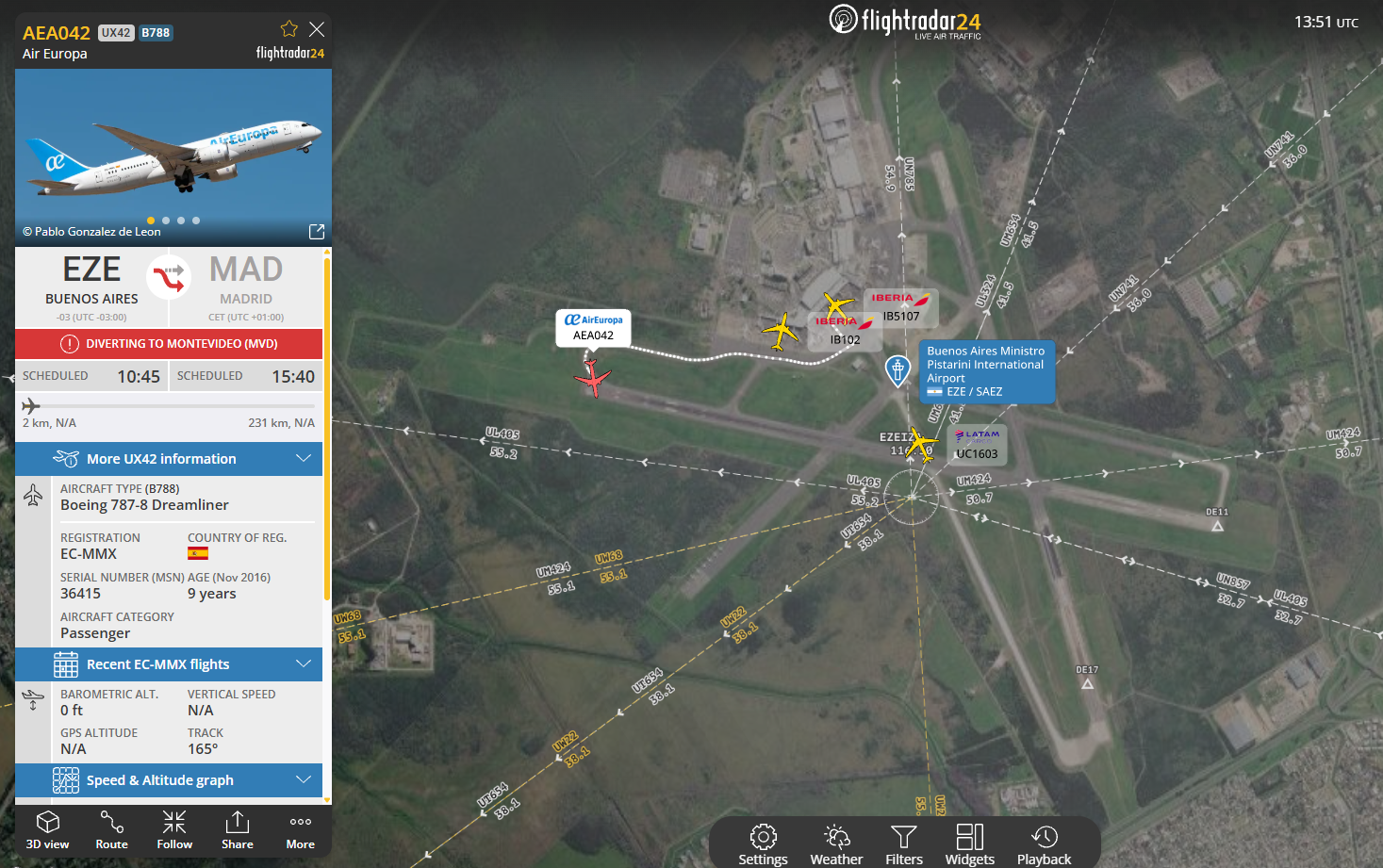
Ministro Pistarini International Airport (EZE/SAEZ), commonly known as Ezeiza Airport, is the main international airfield in Buenos Aires, the capital of Argentina. It is situated about 35 kilometers from downtown Buenos Aires, in the Ezeiza neighborhood, located in the province of Buenos Aires. Founded on April 30, 1949, it was the world’s largest airport until the completion and subsequent expansions of New York’s Idlewild Airport—now John F. Kennedy International Airport—surpassed it in total capacity and scale by the early 1950s.
Buenos Aires
The city’s commercial aviation is divided between two main hubs: Aeroparque and Ezeiza. Aeroparque is located in downtown Buenos Aires and handles only narrow-body aircraft. Established a year after Ezeiza, it originally served exclusively domestic routes and flights to neighboring Uruguay—a status that remained unchanged until the early 2010s. Since then, its international reach has steadily broadened, first capturing markets in Brazil, Chile, and Paraguay, and later expanding to Bolivia, Colombia, and Peru in the post-pandemic era. In 2023, Aerolíneas Argentinas announced the launch of the Aeroparque–Miami and Aeroparque–New York routes, but they were ultimately called off due to infrastructure and operational constraints.

The main airport
When it first opened, Ezeiza Airport had three runways: 11-29, 17-35, and 05-23. The least used runway was 05-23, which is currently utilized for aircraft parking. Today, the 3,300-meter-long and 60-meter-wide runway 11-29 serves as the primary airstrip, complemented by the secondary 17-35, which measures 3,105 meters long and 45 meters wide. Currently, this secondary runway is closed for a complete overhaul until mid-December. Because the two airstrips intersect, these ongoing works significantly restrict capacity on the main runway.
Aeropuertos Argentina, the concessionaire for Ezeiza Airport and 34 other airports in the country, began construction and maintenance work at the terminal earlier this year, targeting the secondary runway, taxiways, and new aircraft parking positions. Under the original timeline, the main runway (11-29) was slated to close on November 12, immediately following the reopening of runway 17-35. However, at the time of writing, unexpected delays have pushed back progress, leaving the secondary airstrip closed for at least another month.

Runway 11-29 crosses runway 17-35 at the 2,300-meter mark, meaning that operational restrictions were an unavoidable consequence of the secondary runway’s overhaul. This phase of the construction is currently underway, specifically from October 25 through November 11, and is heavily felt by foreign carriers, which rely mainly on wide-body aircraft for their long-haul operations into Buenos Aires.
Even though Aeroparque is adding an increasing number of international flights—which leaves Ezeiza with fewer operations—all wide-body flights in the metropolitan area operate exclusively from Ezeiza. Buenos Aires is the only Latin American city connected to every continent, including both nonstop and flights with a stopover. Twenty-six foreign airlines operate at the airport, though only 11 are doing so during the restrictions.

Current operations
The airlines suspending operations are Aeromexico, Air Canada, Air France, American, British Airways, China Eastern, Delta, Emirates, Ethiopian, ITA, KLM, Lufthansa, Swiss, Turkish, and United. This means that Buenos Aires will have no nonstop flights to the United States and Europe (from foreign carriers) for nearly three weeks, as well as no flights to Africa, Asia, and Oceania. However, flights to Africa and Asia normally involve a stopover, either in Brazil or Auckland, both of which are also suspended.
Excluding airlines from the Americas, Air Europa, Iberia, Level, and Plus Ultra—all of them from Europe— are the only foreign carriers operating flights to Ezeiza Airport during these 18 days. Flights to Buenos Aires will be nonstop, while most departures from the Argentine capital will have to make a technical stop in Montevideo—or at least that was the plan.
For its part, Aerolíneas Argentinas, the only Argentine airline to operate intercontinental flights, will continue offering services to Madrid and Rome from Buenos Aires. All of these operations were originally scheduled to include a technical stopover in Rio de Janeiro, but some of them—specifically those bound for Madrid—did not require the stop and operated nonstop despite the airfield’s limitations.

Nonstop flights to Europe?
As of this writing, the 1,850-meter runway restriction at Ezeiza Airport has not hindered some flights between Buenos Aires and Madrid, which operated nonstop. Aerolíneas Argentinas performed at least two nonstop flights, and Air Europa operated more than four services without a technical stop in Montevideo. It is likely that the aircraft departed with a low passenger load factor, close to 50%, which allowed them to carry less weight.
Regarding flights within the Americas, Aerolíneas Argentinas and Avianca are operating with wide-body aircraft, including services to Colombia, Mexico, the Dominican Republic, and the United States. The Argentine carrier uses Airbus A330-200 aircraft, just as it does on its flights to Europe, while the Colombian airline employs Boeing 787-8 Dreamliners.

Which international routes are currently in operation?
According to our database, international routes out of Ezeiza Airport through November 11 will be strictly limited to a specific network of destinations, including Barcelona, Belo Horizonte, Bogotá, Cancún, Florianópolis, Lima, Madrid, Medellín, Miami, Oranjestad, Panama City, Porto Seguro, Punta Cana, Recife, Rio de Janeiro, Rome, Salvador de Bahía, Santo Domingo, Santiago de Chile, and São Paulo.

| Route | Technical stop | Airline | Flights | Aircraft |
|---|---|---|---|---|
| EZE-Barcelona | Montevideo | Level | 6 weekly | Airbus A330 |
| EZE-Belo Horizonte | – | GOL | 1 weekly | Boeing 737 |
| EZE-Bogotá | – | Avianca | 14 weekly | Airbus A320 |
| EZE-Bogotá | – | Avianca | 7 weekly | Boeing 787 |
| EZE-Cancún | – | Aerolíneas Argentinas | 1 weekly | Airbus A330 |
| EZE-Florianópolis | – | GOL | 2 weekly | Boeing 737 |
| EZE-Lima | – | LATAM | 14 weekly | A319/A320 |
| EZE-Madrid | Río de Janeiro* | Aerolíneas Argentinas | 11 weekly | Airbus A330 |
| EZE-Madrid | Montevideo* | Air Europa | 7 weekly | Boeing 787 |
| EZE-Madrid | Montevideo | Iberia | 14 weekly | Airbus A330 |
| EZE-Madrid | Montevideo | Plus Ultra | 2 weekly | Airbus A330 |
| EZE-Medellín | – | Avianca | 6 weekly | Airbus A320 |
| EZE-Miami | – | Aerolíneas Argentinas | 14 weekly | Airbus A330 |
| EZE-Oranjestad | Córdoba | Aerolíneas Argentinas | 3 weekly | Boeing 737 |
| EZE-Panama City | Córdoba | Copa | 21 weekly | Boeing 737 |
| EZE-Panama City | Rosario | Copa | 21 weekly | Boeing 737 |
| EZE-Porto Seguro | – | GOL | 1 weekly | Boeing 737 |
| EZE-Punta Cana | – | Aerolíneas Argentinas | 3 weekly | Airbus A330 |
| EZE-Punta Cana | Rosario | Arajet | 17 weekly | Boeing 737 |
| EZE-Recife | – | LATAM | 1 weekly | Airbus A320 |
| EZE-Rio de Janeiro | – | GOL | 14 weekly | Boeing 737 |
| EZE-Rio de Janeiro | – | JetSMART | 7 weekly | A320/A321 |
| EZE-Rio de Janeiro | – | LATAM | 5 weekly | Airbus A320 |
| EZE-Roma | Río de Janeiro | Aerolíneas Argentinas | 5 weekly | Airbus A330 |
| EZE-Salvador | – | SKY | 2 weekly | Airbus A320 |
| EZE-Santiago | – | LATAM | 14 weekly | A320/A321 |
| EZE-Santiago | – | SKY | 2 weekly | Airbus A320 |
| EZE-Santo Domingo | Rosario | Arajet | 1 weekly | Boeing 737 |
| EZE-São Paulo | – | GOL | 14 weekly | Boeing 737 |
| EZE-São Paulo | – | LATAM | 14 weekly | A320/A321 |

Suspended routes
Through November 11, Ezeiza Airport will have more than 25 suspended routes to destinations including Brazil, Canada, Chile, China, Ethiopia, France, Germany, Italy, Mexico, the Netherlands, New Zealand, Spain, Switzerland, Türkiye, the United Arab Emirates, the United Kingdom, and the United States. Many of the routes from Buenos Aires to other South American countries, such as Brazil, Chile, Colombia, Paraguay, Peru, and Uruguay, as well as the majority of domestic operations, are served from Aeroparque.

| Route | Airline | Aircraft |
|---|---|---|
| Buenos Aires – Addis Ababa (via GRU) | Ethiopian | Boeing 777-200(LR) |
| Buenos Aires – Amsterdam | KLM | Boeing 777-200(ER) |
| Buenos Aires – Atlanta | Delta | Airbus A330 |
| Buenos Aires – Auckland | China Eastern | Boeing 777-300(ER) |
| Buenos Aires – Dallas | American | Boeing 787-9 |
| Buenos Aires – Dubai (via GIG) | Emirates | Boeing 777-300(ER) |
| Buenos Aires – Frankfurt | Lufthansa | Boeing 747-8 |
| Buenos Aires – Houston | United | Boeing 777-200(ER) |
| Buenos Aires – Istanbul (via GRU) | Turkish Airlines | Airbus A350-900 |
| Buenos Aires – London (via GIG) | British Airways | Boeing 777-200(ER) |
| Buenos Aires – Miami | American | Boeing 777 / 787 |
| Buenos Aires – Miami | LATAM | Boeing 787 |
| Buenos Aires – Mexico City | Aeromexico | Boeing 787 |
| Buenos Aires – New York | American | Boeing 777-300(ER) |
| Buenos Aires – New York | Delta | Airbus A330-900 |
| Buenos Aires – Paris | Air France | Boeing 787-9 |
| Buenos Aires – Rio de Janeiro | British Airways | Boeing 777-200(ER) |
| Buenos Aires – Rio de Janeiro | Emirates | Boeing 777-300(ER) |
| Buenos Aires – Rome | ITA | Airbus A350-900 |
| Buenos Aires – Santiago de Chile | KLM | Boeing 777-200(ER) |
| Buenos Aires – Santiago de Chile | LATAM | Boeing 787-9 |
| Buenos Aires – São Paulo | Air Canada | Boeing 787-9 |
| Buenos Aires – São Paulo | Ethiopian | Boeing 777-200(LR) |
| Buenos Aires – São Paulo | Swiss | Boeing 777-300(ER) |
| Buenos Aires – São Paulo | Turkish Airlines | Airbus A350-900 |
| Buenos Aires – Shanghai (via AKL) | China Eastern | Boeing 777-300(ER) |
| Buenos Aires – Toronto (via GRU) | Air Canada | Boeing 787-9 |
| Buenos Aires – Zurich (via GRU) | Swiss | Boeing 777-300(ER) |
All of these routes will be resumed as of November 12.
The infrastructure constraints have also sent shockwaves through the logistics sector, forcing major operators like Atlas Air, Emirates SkyCargo, and Lufthansa Cargo to temporarily suspend their flights to Buenos Aires. Aerolíneas Argentinas Cargo, Aeromas, Air Class, Avianca Cargo, DHL Aero Expreso, FedEx, and LATAM Cargo will continue to operate, with Avianca, DHL, FedEx, and LATAM utilizing wide-body aircraft despite the runway limitations.

Cover photo: © Alberto U. – JetPhotos (Buenos Aires Ezeiza)
The post Runway construction wreaks havoc on Buenos Aires’ international network appeared first on Flightradar24 Blog.
