



Since the incident PHI Australia has made procedural improvements, and adjusted its risk assessments for pilots with less than 500 hours on type, and night flights where both pilots have less than 500 hours at night on type.
The Australian Transport Safety Bureau (ATSB) has published its report into an incident in February of 2025 when an S-92 operated by PHI Australia inadvertently descended below 200ft over water at night. In its findings the ATSB pointed to low time on type and workload as central to the crew selecting an incorrect autopilot mode.
The aircraft was on a training sortie from the PHI base at Exmouth in Western Australia to the drilling rig Transocean Endurance the purpose of the sortie was to allow the three pilots on-board to carry out three take-off and landings each to meet recency requirements. While night operations are not typical for the offshore energy support operation. A night capability was required to be maintained in case an emergency evacuation of the rig is required during the hours of darkness.
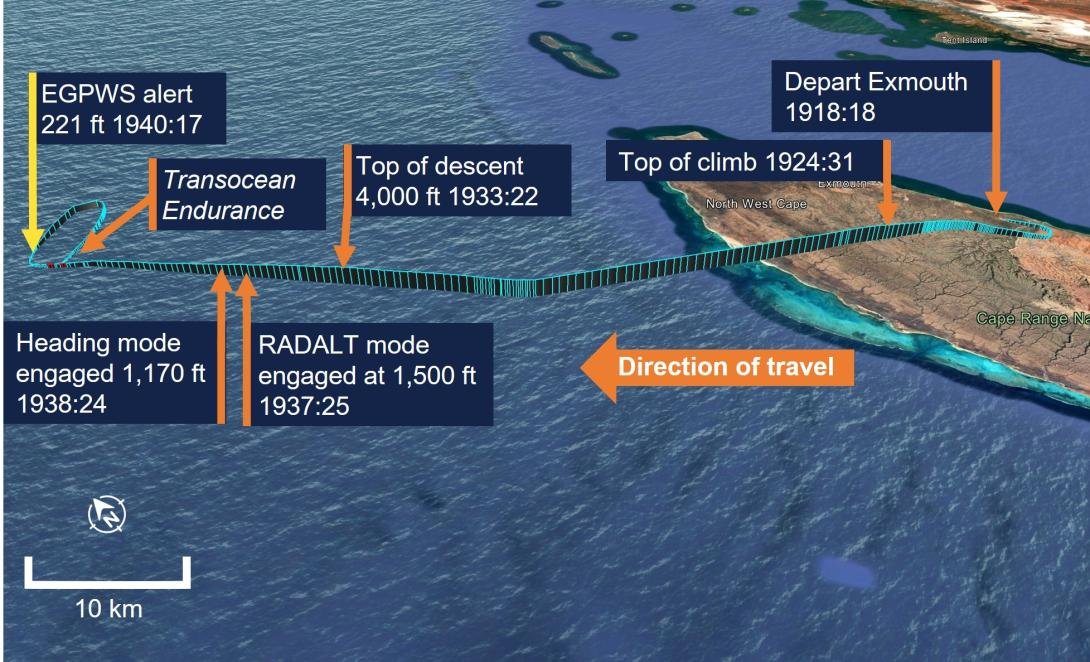
On the outbound leg of around 38 nm the Captain was pilot flying with the First Officer monitoring and the third pilot in a passenger seat in the passenger cabin for the transit to Transocean Endurance. Arriving in the area of the rig the crew began a descent to circuit height (660ft ASL) to begin the exercise and the aircraft continued descending below the pre-set circuit height, united by the the crew until the EGPWS was triggered at 220ft ASL with caution and then warning alerts separated by about four seconds as the S-92 descended through 181ft ASL. The crew initiated a climb stabilised and debriefed the incident before continuing with the sortie as planned. Later data analysis showed the aircraft was at 152ft ASL when positive rate was established.
The ATSB report says that the investigation found that as the aircraft approached the rig the Captain set the radar altitude hold mode to 660ft, “The intent of this setting was for the helicopter to descend from its 1,500 ft cruise altitude to the circuit height, and then for it to automatically hold there,” ATSB Director of Transport Safety Dr Stuart Godley said. “However, during the descent the captain inadvertently mis-selected the vertical speed mode while attempting to select the helicopter’s autopilot heading hold mode. This selection error, which was not recognised by either flight crew member, cancelled the original radar altitude hold order, and instead inadvertently commanded the helicopter to descend at a continuous 500 ft per minute.”
The ATSB found both the pilot flying and pilot monitoring at the time of the incident had limited experience on the S-92A at night, and were experiencing a higher than normal workload. “The vast majority of the flight crew’s experience in the S-92A was from daytime passenger transfer flights, which involved flying first from Exmouth to Learmonth, to collect passengers before flying out to an offshore rig,” Dr Godley explained. “The recency flight, which departed from Exmouth directly to the rig, was therefore shorter than usual, reducing the copilot’s time to complete the required cockpit administration and plan the approach, and resulting in the flight crew experiencing a higher than normal workload, at night.”
 Compounding the workload, In the shorter flight time available, the pilots had been unable to accurately determine the take-off safety speed prior to their descent for landing. While in the circuit area the captain requested the copilot calculate it focusing them away from their monitoring duties.
At about the same time, the captain elected to activate the helicopter’s moveable searchlight, shifting their focus outside to adjust its position. “This meant both flight crew members were preoccupied with additional tasks and therefore not monitoring the helicopter’s altitude as it descended towards the water,” Dr Godley said. “In this case, the EGPWS performed its role, and alerted the flight crew to the undesired low altitude. This incident highlights the importance of disciplined and effective multi-crew cooperation, and is a reminder of the risks associated with divided attention in the cockpit.”
Dr Godley said the incident also highlights to S-92A operators of a potential hazard that exists with differing display versions of the automatic flight control system mode select panel.
“Due to the lighting of the panel, distinguishing between hard and soft keys is more difficult at night,” he explained. More recent versions of the mode select panel include a tactile white finger barrier installed between the rows of hard and soft keys, reducing – but not eliminating – the risk of a mode selection error.”
In response to this occurrence, PHI International Australia made several procedural improvements, and adjusted its operational risk assessment for pilots with less than 500 hours on type, or for night flights where both pilots have less than 500 hours at night on type.
To read the full report click HERE
Images: Google Earth/ATSB & RHI
